
(This chapter is excerpted from “Akron’s Daily Miracle,” edited by Stuart Warner and Deb Van Tassel Warner, copyright 2020, University of Akron Press)

By Dale Allen
In less than a month after those of us in the news room were patting ourselves on the back for winning the 1987 Pulitzer Prize for coverage of the attempted takeover of Goodyear Tire and Rubber, our publisher, John McMillion, sprung a surprise on us. He had decided, as he had suggested back the previous summer, that we would switch the newspaper from afternoon to morning publication. This time, he gave us a firm date. We would become a morning newspaper on July 13, just three months after his bombshell announcement.
“If the Beacon Journal is to be successful in attracting new readers and advertisers,” he said, “it must meet the changing needs of society. Publishing in the morning is just a part of that change.”
I agreed with the decision. I had watched through the past three decades as morning newspapers became dominant in the nation. Several afternoon newspapers were on the brink of extinction; others had made the switch to morning publication to stave off the death rattles. Still others were contemplating the move. Moreover, in cities where morning and afternoon papers were still being published by a single publisher, consolidation was taking place, with afternoon publications being folded into their morning partners. Knight-Ridder’s newspapers followed in line with that trend.
The corporation had closed or was preparing to close its afternoon newspapers in Charlotte, N.C.; Lexington, Ky.; Columbus, Ga.; Columbia, S.C.; Saint Paul, Minn.; Wichita, Kan.; San Jose, Calif., and Long Beach, Calif., among others. The closings certainly created issues for the folks running those papers, trying to figure out how to merge staffs and make the transition for their readers and advertisers as smooth as possible. But, the papers in those cities had a running start on the mergers. They already had mechanisms in place to print and distribute papers in the morning market.
That was not the case in Akron, where the Beacon Journal had been the only newspaper in town since 1938, when John S. Knight purchased the Times-Press, a paper owned by the Scripps-Howard corporation. Sure, we had always published a paper on Sunday mornings, and we had only four years previously switched the Saturday paper to morning distribution. But we knew converting to morning publication seven days a week would require major changes in the way we did business.
If it sounds like an easy task, let me assure you it was not. It was the most difficult job I had taken on since becoming a newspaperman way back in 1957.
Making matters more challenging for me personally, McMillion asked me to supervise preparations for the switch – not just in the news room but in all of the departments at the paper. I accepted the job, knowing it would be difficult but also knowing I would benefit by gaining the knowledge offered by the process. Moreover, I felt confident the Beacon Journal could pull it off, so long as we had the cooperation of managers and employees throughout the building.
To some of the old timers at the newspaper, the announcement came as a shock, despite McMillion’s advance warning. While we had given them a taste of working on a morning newspaper, when we switched the publication of the Saturday paper from afternoons to mornings, many of our editors had never worked the morning cycle every day of the week, so they could only imagine what effect the change might have on their lives. Those of us who had migrated to the Beacon Journal from morning publications understood their workaday assignments – and ours – would be irrevocably changed.
While I had grown accustomed to the afternoon cycle in the seven years I had been in Akron, I knew morning publication offered a lot more pluses than minuses, particularly as it related to the news room. Foremost, the switch would permit us to truncate the staffing cycle, giving us more concentrated firepower within fewer hours. If that is a difficult concept to understand, I’ll try to explain it by comparing the usual routines for afternoon versus morning newspapers.
As an afternoon newspaper the Beacon Journal had staff members working in the news room 24 hours a day, six days a week. Only on Sunday mornings – from about one a.m. until noon – was the news room not staffed. By contrast, on morning newspapers, the news room was usually staffed only from 9 a.m. until 1 or 2 o’clock the following morning. So, there was a seven-hour period each day of the week, when the news room was bereft of staff. Yes, morning publication concentrated our work into a shorter time period, but it also concentrated the number of people we had available to do it. Plus, it gave editors more opportunity to work the same shifts as their reporters and their assistant editors and, thus, a lot more time to work one-on-one on stories. I knew from previous experience that the news room would become an easier place to manage, precisely because we were able to eliminate, for all time, the overnight shifts.
I also understood we would need more firepower on our copy desks, where the crunch of deadline work would be more demanding. Thankfully McMillion understood that ,too. He agreed to let us add three copy editors in the news room, including two on the news copy desk and one in sports.
The crunch of copy on deadline was particularly acute for the sports department of a morning newspaper. On an afternoon newspaper, the copy editing could be done overnight, long after the games typically were completed. On a morning newspaper, the editing had to be done in quick, 30-minute bursts from the time the games ended – usually between 10 and 11 each evening – to the first edition deadline, which we figured would be around 11:30 p.m. to ensure a press start of midnight for our first edition.
Games originating on the West Coast presented big problems because they usually did not end until between 1 and 2 a.m. in the Eastern time zone. We figured, even with later home-delivery editions for Akron and Summit County, we still would be unable to get all West Coast results in the paper. To compensate, we created a new, final edition, which we labeled the Sports Final, to be distributed in racks on street corners and other single-copy sales outlets.
In some departments of the paper, the move from afternoon to morning publication required very little change. Advertising executives and sales personnel would still work day shifts, keeping their schedules consistent with the hours most conducive to selling advertisements. The folks in accounting would continue to count their beans on the same schedules they had in the past. And in some of the lesser departments, including research and promotion and human resources, the switch to a morning cycle required only minor scheduling changes.
The same could not be said in the production and circulation departments, where schedules of many employees would literally be turned upside down. The bulk of pages handled by the composing room would be put together in late afternoon and into the evening, instead of during the early morning shifts required by afternoon publication. The same was true in the engraving department, which handled photos and artwork for news stories and advertisements, and which had become the platemaking department, creating plastic plates for use on the presses to print the pages.
Schedules for folks working in the final two production departments – the press room and the mail room – also required big changes to produce a morning newspaper. Employees in the press room, obviously, would be working different schedules to print the paper from midnight to five in the morning instead of nine in the morning until one in the afternoon. The same was true in the mail room, where advertising inserts were stuffed into the papers and where the newspapers were bundled for distribution.
Of all the requisite changes required, however, none loomed greater than in circulation, which had to distribute the papers to our home-delivery customers and to single-copy sales outlets, such as the multitude of street-corner newspaper racks and other outlets, including news stands, drug stores, supermarkets, business offices, and restaurants. The potential for problems was enormous because, in large part, the Beacon Journal’s home delivery apparatus depended on the people we called our “little merchants,” the kids who delivered the afternoon paper after school or after their baseball or softball practices in the summertime.
The kids and the few adults who delivered the paper for us were not employees. They were independent contractors. We could not order them to make the change. We had to coddle them and coax them to continue carrying their routes after the switch from afternoon to morning publication. Here was the nexus of the issue: Could we persuade roughly 2,000 kids to get up at 5 o’clock each morning to deliver their papers instead of delivering them at 4 or 5 in the afternoon? Some of us were skeptical. We had worked in other morning markets and realized the vast majority of our carriers there were adults, not kids.
The switch would also radically alter the schedules of our district managers, the men and women who worked in the field, making sure the kids delivered their papers and seeing to it that complaints about delivery were handled expeditiously.
Soon after McMillion announced the intention to switch, managers from throughout the building began meeting once a week – and sometimes more frequently – to get things started and then to monitor our progress. Initially, we discussed the changes each of us knew would be required within our departments. As the overseer of the project, I took copious notes, as managers in each department explained the actions necessary to get the job done. I also encouraged the department heads to pick the brains of their counterparts in Knight Ridder papers where the switch had already been undertaken. It made sense to compare their steps with those we planned and to hear about the unanticipated pitfalls they discovered as they made the conversion.
Within a couple of weeks I began assembling a master checklist of all the changes required. The list described each change in some detail and named the person charged with seeing the task to completion. The list also included start dates and end dates for each task, and one last column, indicating whether the project had been completed or was still outstanding. The list was dozens of pages long. By way of example, here are some of the items those of us in the news room included in the list:
- Establishing new deadlines for pages in each section, including all news, features, and sports pages, and getting the production department to agree to them.
- Creating new schedules for reporters, editors, photographers, and artists to conform with the demands of new deadlines.
- Checking all wire service contracts, particularly Associated Press, to see whether the switch would cost us more in monthly assessments.
- Checking syndicated features contracts (comics and columnists) to ensure their continued use.
- Interviewing and hiring the new copy editors.
The master list contained even the remotest items to ensure that the jobs were assigned to someone and to ensure that they were completed. Example: We decided to order all-new sales racks, to be placed on street corners throughout the region. The individual tasks related to the new racks included designing their appearance (assigned to the research and promotion department), then ordering the racks, making a list of all locations, then delivering the racks when they arrived from the manufacturer (all tasks assigned to circulation).
The weekly meetings we held to check on our progress were grueling sessions, often lasting hours. We went through each incomplete item on the list, wanting to hear some explanation of progress or lack of progress made on it. I knew I was never going to win the award as the most beloved manager in the building but, in the weeks leading up to the conversion to morning publication, I became a pox on some of the folks who fell behind in completing their assignments. Tough questions had to be asked, and I was a somewhat unmerciful taskmaster, even though I believe it’s fair to say that I was an equal-opportunity scourge. I picked on supervisors from every department in the building.
The reason was simple: There was no give in our scheduling. We had already announced to the outside world – to our readers and advertisers – our intention to convert the Beacon Journal to morning publication. The date certain – July 13 – was absolute, so all of the tasks on that master list had to be completed in time for a conversion by then.
To ensure that our carrier force would stay with us during the conversion, the Circulation department distributed contracts to every Beacon Journal carrier, asking them to sign a pledge to continue carrying the paper. Those who did not sign were replaced immediately. But, to our great relief, the vast majority of the “little merchants” indicated a willingness to continue delivering the papers after July 13.
In the news room, we began work on our conversion plans, distributing assignments to editors in every department. While we got approval to hire the three new copy editors, we also decided to create a universal copy desk, combining the features copy desk with the news copy desk. Every story except sports stories would be filtered through the single desk.
We also got approval to add significant space to the business section to accommodate vastly expanded stocks, bonds, and mutual fund quotations, working on the theory that stock quotations are fresher in a morning paper and more meaningful to our readers. Larry Williams, our managing editor who had been business editor of The Philadelphia Inquirer, was the perfect manager to oversee the new stocks and bonds pages, working together with the business editor, Doug Oplinger.
As an afternoon newspaper, the Beacon Journal offered less than a full page of quotations each day because our deadlines precluded the publication of closing numbers. We did offer a more nearly complete report on Sundays but felt a daily page of complete quotations was useless, given the fact that they would not be final quotations for each day.
On the master checklist the expansion of stocks pages occupied several lines on the listing, beginning with an identification of the quotations we wanted to add, a notification to the Associated Press that we wanted those quotes added to the daily stuff sent to us, a design of the pages containing the information, and a test of each new listing in advance of the conversion to see that it worked.
We also decided to join in a recent trend across the country by implementing an innovative approach of running the Metro desk, assigning reporters to teams based on the topics they covered. The move was led by John Greenman, the assistant managing editor in charge of local news, with advice from Larry Williams. Several editors became team leaders, each supervising the work of eight to ten reporters.
Steve Hoffman, who had been a Metro reporter then editor of the new Stark County bureau, became the leader of the team of reporters covering the state and region.
Maureen Brown, who had joined us two years earlier as a reporter, became leader of a team of reporters concentrating on major topics, including science, medicine, religion, education, higher education, etc.
Debbie Van Tassel led the team focusing on governmental coverage. Jim Quinn, hired as a reporter from the Knight-Ridder newspaper in Fort Wayne, Ind., moved to North Canton to lead the Stark County bureau, and Kathy Fraze became chief administrative officer of the Metropolitan Desk.
But we faced an even greater tasks beyond the news room: We had to convince customers of our reasons for making the move to morning publication in the first place. In one of the columns I wrote in advance of the conversion, I tried to explain our reasons for doing so:
“There are lessons to be learned from history, of course. We think one of the important lessons is that nothing can stand still, for change is a part of the fabric of our society.”
Not all of our readers bought the argument. In fact most of them did not. We heard loud and clear from our customers something we already knew in our hearts: Newspaper readers do not like change. As most any editor can attest, even the slightest shift of a comic strip from one place on a page to another can set off protests from untold numbers of readers. Locate the crossword puzzle any place but an outside corner of a page and the howls of protest will echo through the building. Kill off a favorite comic, even one that readership surveys show is popular among only ten percent of the readers, and thunder bolts of agony will descend upon you for days.
In Akron, the protests usually ended with a common note of dissent: “This wouldn’t have happened if John S. Knight were still alive.” Or a variation on a theme: “John S. Knight must be rolling over in his grave.”
John S. Knight’s feelings about shifting his newspaper to morning publication will remain a point of conjecture. He had been dead for six years. But my suspicion is he would have seen merit in the move, as long as he did not have to listen to the protestations. Certainly, the folks running Knight Ridder Newspapers in Miami felt the conversion made sense, if only because it moved the Beacon Journal into more familiar territory for most of them. Almost every corporate executive had arrived at that point in their careers after having served on some morning newspaper within the corporation.
Throughout the three months leading up to the conversion, the corporate bigwigs wanted frequent updates on our progress. But, typical of Knight-Ridder’s corporate Zeitgeist at the time, decisions about the conversion were left to those of us in Akron. The corporation had not yet become the big brother it would become within a few years, when peering over our shoulders and engineering change at the local level became de rigueur in Knight-Ridder. Even at the time of the conversion, though, I sensed that the big eye of the corporation kept closer track of things on the business side of the newspaper than on the news side of things. Larry Jinks, the senior vice president for news and my boss in Miami, wanted reassurance that our plans were going smoothly, but he did not insist on a day-to-day report on our progress. On the business side, the concerns were obvious. The corporate bigwigs did not want us to lose subscribers or advertising dollars. In fact, they wanted to see gains in both those numbers.
As July 13 approached, the meetings to assess our progress became more arduous and more contentious. Among other assignments that were slow in developing, we had not made much progress in negotiating new language in labor contracts, chiefly with the Teamsters, who represented the district managers and drivers in circulation and the employees who worked in the mail room. The Teamsters wanted more money for their members, arguing that their assignments would require them to work early morning shifts to produce and deliver the papers.
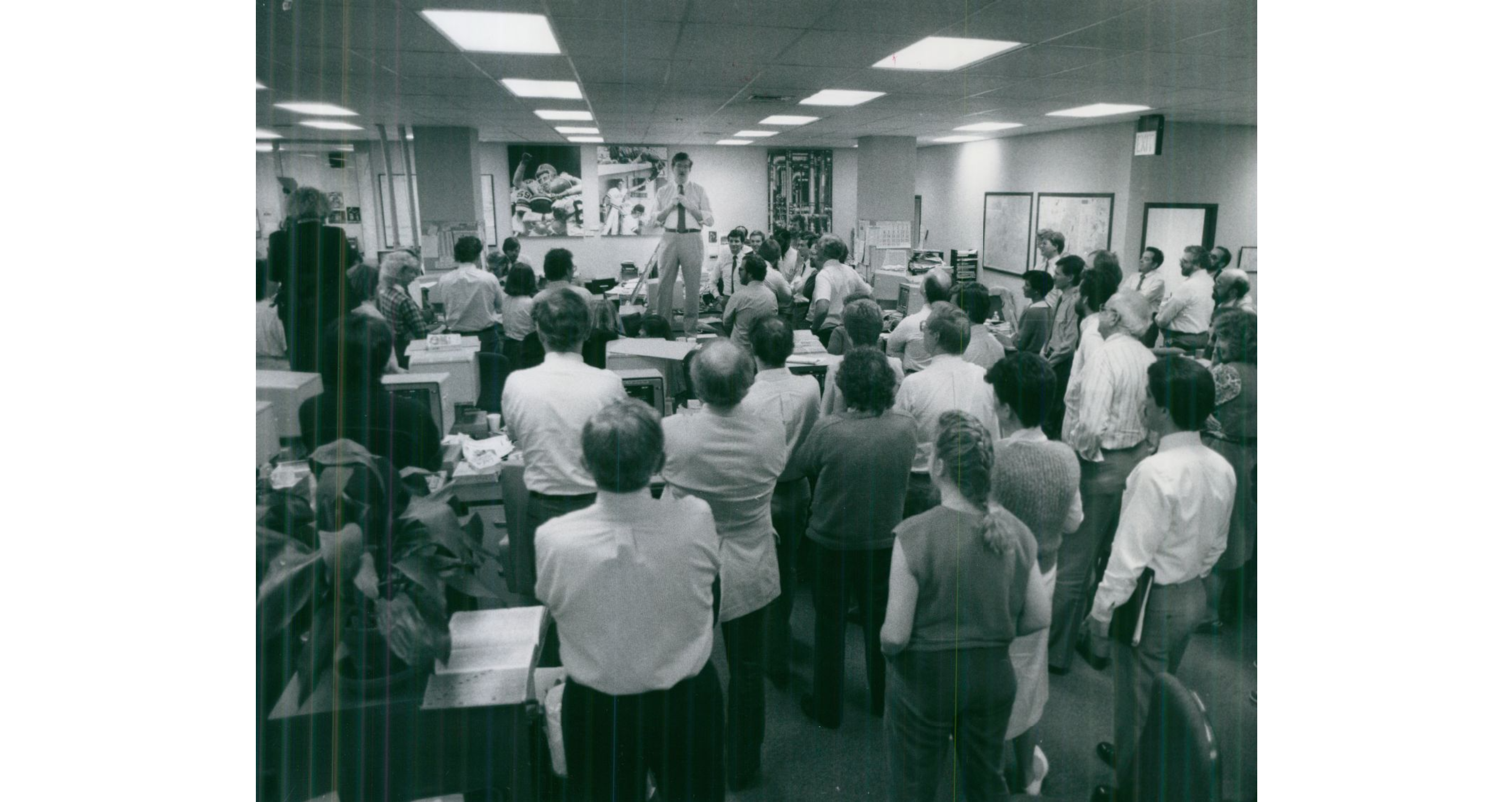
Finally, with the union issues resolved, the big day arrived. An aura of excitement could be sensed throughout the building on Sunday evening, as we prepared to produce our first Monday morning newspaper. John McMillion was there to push the button, firing up the first presses at midnight.
While there were a few hiccups involving carriers missing their assignments, the consensus was all of our planning had paid off. In a follow-up meeting that first afternoon, we assessed our efforts and decided we had done a good job. That lasted about one month. Then, disaster struck.
As the fall term began in area school districts, carriers began to drop off the rolls like flakes in a winter snow storm; not just one flake here and there. They came down in clusters.
We began noting the trend in mid-August. By the first of September it was an avalanche.
At one point, as September rolled around, we had almost one-hundred routes “uncovered,” as the circulation folks labeled routes where no carrier was assigned. Those pesky little merchants, the ones who had signed a pledge saying they would remain on their routes, did not say how long they would continue carrying their routes. And, as the school year began, they decided getting up at four or five in the morning to deliver their routes was more commitment than they wished to make to the Beacon Journal.
The folks in circulation – in fact folks in every department in the building – were pulling their hair out, trying to figure out how to get all of the newspapers delivered. It soon became clear that doing it was an impossibility. The district managers, who were supposed to cover when a route went uncovered, simply could not keep up with the unprecedented demands put upon them.
Meanwhile, in accounting and in Miami, folks charged with counting the beans and the newspapers we sold were seeing a concomitant drop in our circulation numbers. Instead of the rise we had predicted in circulation numbers, we were watching as the numbers plummeted; not just a few subscribers lost but thousands of them over the course of the next two months.
In none of those hours of planning sessions leading up to the conversion had we contemplated the reality we were now facing. It was a time for action.
Within days, the circulation department was running big advertisements in the classified section of the paper, seeking adults who wanted to make some extra bucks delivering morning newspapers. We needed to deliver ourselves of the little merchants and replace them with reliable adults, who would see that subscribers got their papers on time.
In all of our advance notices to subscribers, we promised them we would get their paper to their home by no later than 6:30 in the morning on weekdays or no later than 7 in the morning on weekends. Clearly, it was a promise broken. And we paid the price for that oversight for the next full year, which is the time it took us to get our act together and to begin recouping our losses.
So, who was responsible for the faux pas?
I’m positive no one at the Beacon Journal foresaw the bittersweet development. Certainly not moi. In looking back at our planning, none of us realized the little merchants would break the promise they made to continue carrying their routes within a one-month period. Moreover, we had not heard of that problem from folks at the other newspapers we consulted before making the conversion. But, boy, there it was in black and white in all those incipient reports the bean counters were sending off to Miami.
We had, to use the coarse idiom of the day, “screwed the pooch.” There was not much consolation in realizing that we were, in fact, producing a better and more timely newspaper than we had been providing as an afternoon newspaper. It didn’t much matter to the folks whose papers never arrived.
In retrospect, there was one other factor at play, as we watched our circulation figures tumble into the abyss. Many of the Teamsters – the drivers and district managers – did not like the fact that we had made the conversion. Some of them felt, if the switch to morning publication failed, the newspaper would ultimately be forced to return to afternoon delivery. So, they set up little roadblocks here and there to see if they could influence that decision.
I learned that years later, when a retired driver and I were discussing our days at the Beacon Journal. It should not have come as a surprise. Generally, the Teamsters looked askance at most anything we did at the Beacon Journal, if it involved change.
What they did not understand at the time was that the conversion to morning publication was one of the smartest moves the Beacon Journal ever made. We could only look down the path toward the future and hope brighter days were ahead for us after the convulsions we felt when we switched to morning publication.
We had to wait for a few more years to pass, before the genius of that move became apparent. It surfaced in many ways, but became absolute when The Plain Dealer of Cleveland, launched an aggressive campaign to attract new readers in the suburbs around the city, including areas within our prime circulation market. If we had remained an afternoon newspaper at that time, there’s no telling how much circulation the Cleveland paper could have siphoned off from us.
(Dale Allen, former editor of the Beacon Journal, died in 2019. This chapter was reprinted from his unpublished memoir with permission of his family.)
By Dale Allen
 Mr. Write Coach: What's Your Story?
Leave a comment