
The ballroom of the Brown Hotel in Louisville was illuminated with star power on June 25, 1999. Heavyweight champ Muhammad Ali, back in his hometown where he grew up as Cassius Clay, was presented a lifetime achievement award by the Kentucky Athletic Hall of Fame. Jockey Steve Cauthen, who had won the first leg of the Triple Crown aboard Affirmed only a few miles away in the Kentucky Derby at Churchill Downs, and NASCAR legend Darrell Waltrip were inducted into the hall that night with several others.
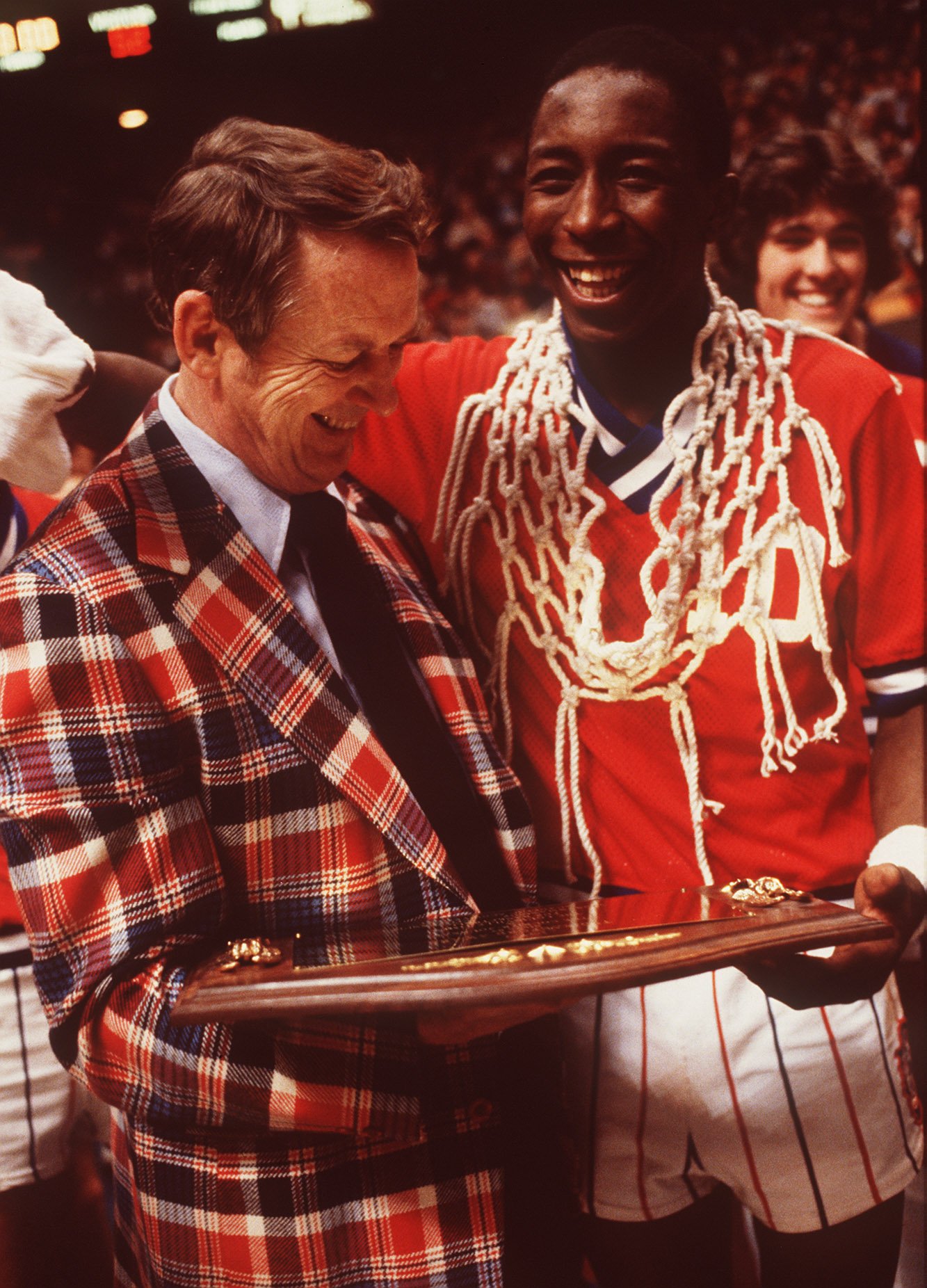
One of them was a man not known nearly as well nationally as his fellow inductees. But he was a man who had traveled just as far in his own personal journey to reach that dais, a man who kept reinventing himself at every difficult turn in the road. He was a sickly boy – he contracted a form of tuberculosis at age 8 — who became a star high school athlete; he was the class clown who became a doting father; he was a coach who thought he might never win a game who became a state champion; he was a son who never knew his father who became a father-figure to hundreds of players, black and white; he was a widower who turned his anger over his wife’s death into a humorous shtick that made him the state’s most polarizing and talked-about sportscaster; and he was a kid who was embarrassed by his stutter who became a raconteur who rarely stopped talking.
And Charles “Jock” Sutherland was supposed to limit his acceptance speech to five minutes that night at the Brown Hotel in Louisville. Anybody who knew him knew that wasn’t going to happen.
He walked up to the podium, his eyes twinkling, and took over the crowd.
“True story,” he began. “I started my career at a little school called Gallatin County in Warsaw, Kentucky. I hadn’t even heard of the place when I got hired. Well, my first season, I wasn’t much of a coach. But I was excitable. We were playing a game at Henry Central High School and were getting our brains beat out by 30 points. The gym was real narrow, kinda like a bowling alley. There was hardly any room between the benches and the playing floor. One step and you were on the court.
“I was already frustrated by the score and the official made a terrible call against one of our kids. I jumped out of my seat and before I knew it, I was in the middle of the court. The official didn’t see me and he backed into me as he was running back down the floor.
“He was furious and started cursing me. He jammed his finger right up in my nose. Right up in my nose.
“I guess I said a few things back to him.
“That was all he was going to take.
“‘Jock, I’m going to give you a technical foul for each step it takes you to get back to the bench!’” he yelled.
“Well, as I said, the gym was small and narrow and everybody could hear what he said.
“I didn’t know what to do, so I threw up my hands.
“I guess my players thought I was signaling them to come get me, so a couple of them rushed out, picked me up on their shoulders and carried me back to the bench.
“I didn’t have to take a step.
“Well, the crowd got into it and the Henry Central band started playing a John Phillips Sousa march. So the players didn’t stop, either. The whole team joined in they carried me a couple of laps around the gym. Here we were getting beat by 30 points and we were celebrating like we just won the national championship.
“The ref had had it. He threw down his whistle and stormed out of the gym. “I’m not taking this crap for $10!” was the last thing I heard him say.
“Now, that should have been the end of the story, except that a sportswriter, Earl Cox, from the Louisville Courier-Journal got wind of what happened. The next day, the paper carried a story headlined “The Quickest Thinking Coach in America.” There was even a cartoon with it. The wire service picked up the story and must have sent it all over the world. People have sent me clippings from as far away as Japan. It got reprinted in Sports Illustrated and Readers Digest.
“I swear, that’s a true story.”
The crowd was roaring. And Jock was on a roll.
He kept the crowd in stitches for 15 to 20 minutes, well beyond the allotted time for his acceptance speech. He left to a huge ovation.
Waltrip was next up to the podium. “I can’t follow that,” he said.
Who could?
I wasn’t there that night, but I had heard all of Jock’s stories before. Some I had heard more than 30 years earlier.
I knew him first not as Jock, but as Coach Sutherland. I met him on my first day of high school, in the fall of 1967. It was his first day back at the school where he had graduated 20 years earlier. Most of my classmates, especially those of us who had hopes of making the basketball team, knew well his growing reputation as a coach. So we were a little intimidated when he walked into our sophomore Health and Physical Education class that day. I guess we expected a no-nonsense disciplinarian who would make us young bucks cower in the classroom. Instead, we were greeted by an impish man, who kept us laughing with stories about his coaching career. I remember very little of what I learned about health and physical education that year. Our lessons about sexual relations lasted about 15 minutes – “Keep it in your pants, boys, until you get married. If you can’t, at least wear a rubber.” But I have never forgotten the stories about the Quickest Thinking Coach in America, the untied shoes, and my favorite, the way he disciplined a player he caught smoking.
It was early in my second season … he was a husky, farm boy named Vincent Davis, probably had been working in the tobacco fields and smoking all his life.
Like a damn fool, I decided I was going to teach this kid a lesson. In front of the entire team, I told him he had two choices: I would either put him off the team or I would lock him in a closet and make him smoke a five-cent cigar.
I should have realized something was wrong when he grinned at me and said, “I’ll do anything you ask coach. Just let me stay on the team.”
Something made me feel guilty, and I reckoned I shouldn’t make any of my kids do anything I wouldn’t do. Never mind that I had never even smoked a cigarette in my life. If I was going to make him do it, I would, too.
I bought two cigars and both of us went into the janitor’s closet after school, closed the door and lit up. To this day, my stomach does flip-flops whenever I’m around someone who’s smoking a cigar. The more we puffed, the sicker I got. I finally keeled over and fell onto the janitor’s mop bucket, knocking it over and spilling the dirty water all over me. By the time I had sense enough to open the door, I was sicker than a mule and soaking wet. Meanwhile, this kid was just puffing away and smiling. He smoked his cigar, then asked: “Want me to finish yours, too, coach.” He smoked the rest of my cigar and then drove me home because I was too sick to drive.
Behind the laughter, though, was a man with an intense desire to win basketball games, pushing his players and himself beyond their comfort zones. He transformed the basketball program and the lives of his players everywhere he went.
My basketball career consisted of one season on the jayvee team his first year at Lafayette High School in Lexington. (He still thinks he cut me from the squad.) He left Lafayette after that season, lured away to become an assistant at the University of Alabama, where he played a role in changing college basketball in the south forever.
But none of that is what led me finally to write this book.
IHe touched so many lives of young men during that journey, bringing them together from their disparate backgrounds to work together as a single unit.
As I researched this book, I traveled with him to meet some of his former players, many of them now in their sixties. It’s touching to see how the respect they hold for him has never diminished.
On one of those trips, he pulled out a letter one former player, Jimmy Edwards, had written to him from a foxhole in Vietnam. Edwards was a big, strong, shy farm boy who was at Harrison County High School, where he played for Jock. Edwards had a difficult relationship with his father and his mother died during his senior year. He lacked confidence in himself. Jock always had to encourage him to shoot more. “He’d look at me and almost apologize if he missed a shot,” Jock said. Edwards played one of his best games in the 1963 regional tournament, but he missed a tip-in shot at the buzzer of that game, a 45-44 loss that ended the season of one of Jock’s best teams ever.
The old coach, who is 79 now, started reading from the letter as we drove along Highway 27 toward Cynthiana, Ky.
“Coach Sutherland:
“I was really glad to hear from you. … You told me about where you were at … I will give you an idea where I am. We are on Operation Manhattan, in the Bali Woods. We are supposed to have Charlie surrounded. It may be just the opposite. We have made light contact, but I expect heavier contact in the hours ahead. I read your letter very carefully. It brought back many memories. … I am a squad leader now. This is a very dangerous game we are playing. A big responsibility has been laid upon my shoulders. I don’t only have to look out for myself, but the members of my squad …. If something goes wrong with them, I will feel responsible. I’ve done some foolish and childish things before, but I have grown up a little bit now. I’ve always have had a problem with lack of confidence. I’ve found out that I had a little more inside than I thought I had.…
“I really didn’t mature very well in school. I hope that I will better than before. I have approximately 120 days left here. I hope that I will make it. I have been very lucky so far. There is so much I want to say but there isn’t much time. You have been more than a coach and a friend. I admire you more than any person in the world. You have done so much for me. I don’t want to disappoint you. I’m going to come through for you for a change. Well I guess I had better sign out. Don’t worry, I’m not going to shoot like a scared stick.”
Jock folded the letter and placed it in the original envelope.
“You see why I’ve kept it for 40 years,” he said.
I did. It’s why I wrote this book.

 Mr. Write Coach: What's Your Story?
Leave a reply to Steve Love Cancel reply