By Stuart Warner
I was sitting at the end of the bar at our local hangout, not sure if I wanted another drink or a better explanation of the world.
My pal Wired Al InCognito dropped a folded packet between us.
“Don’t,” I said.
“You haven’t even looked at it.”
“I’ve looked at enough documents.”
He smiled. “That’s what you said about the last one.”
I opened it anyway.
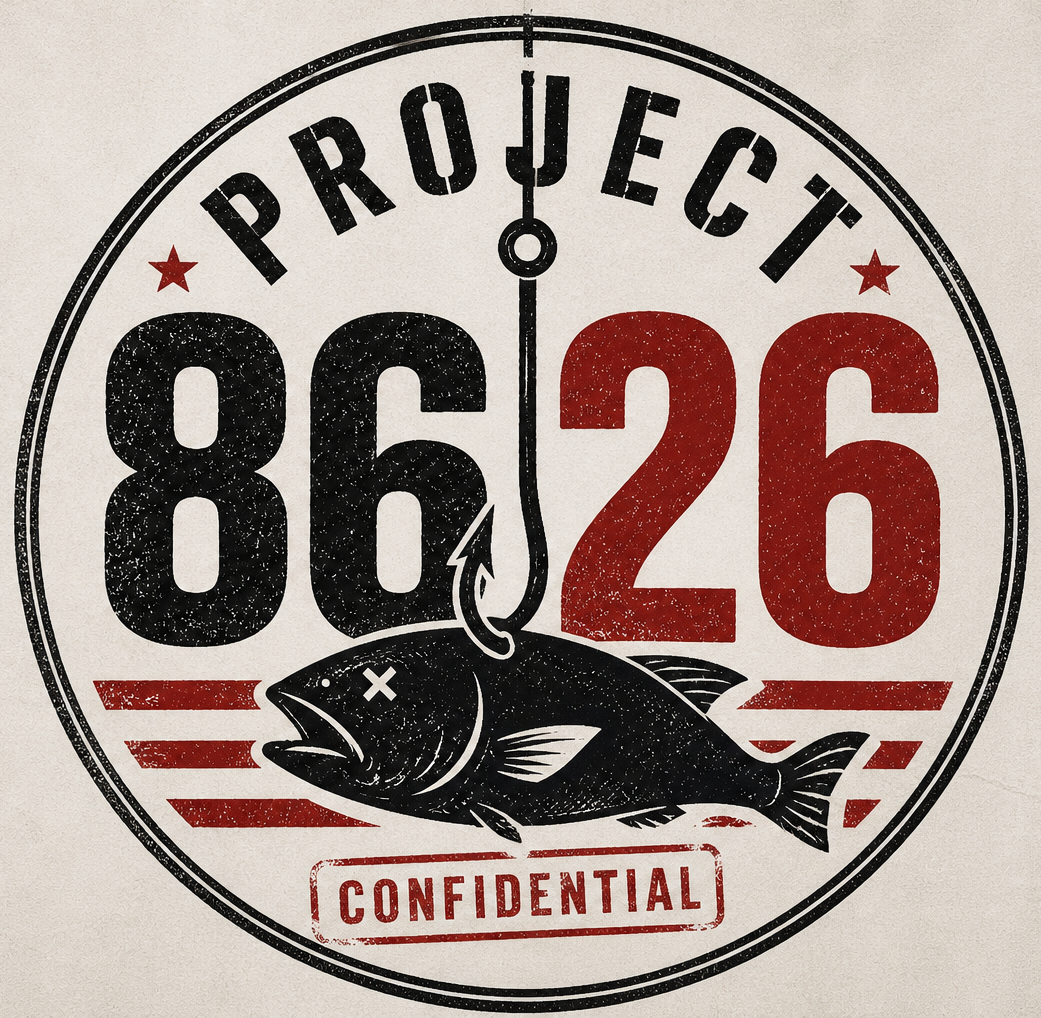
Project 8626.
“Where’d you get this?” I asked.
“Friend of a friend of an enemy of a friend,” he smiled.
“Nope,” I said, starting to fold it back up. “We’re not getting worked up again like we did over Project 2025.”
“We didn’t do anything last time,” Al said. “We read it. Nobody else did.”
“So what’s this supposed to mean, anyway? The Republicans have a grand plan for the year 8626? I don’t think even Trump can live that long.”
Al shook his head. “Don’t you know what ‘86’ means, paisan? In mob movies, ‘86’ is slang for getting rid of someone – eliminating them.”
“I’ve seen The Godfather at least 10 times and Goodfellas five,” I said. “Don’t remember hearing that number.”
“It’s not a number,” Al said. “It’s a command. Get rid of this mug. Eighty-six him.”
The bartender interrupted us. “Couldn’t help but overhear you guys. In restaurants, we use ‘86’ to mean we’re out of something – like fish, for example.”
“See,” Al said, grinning. “It means go sleep with the fishes.”
I couldn’t suppress a chuckle. “So the Republicans are going to get rid of the number 26.”
He glared at me. “The ’26 elections, dummy.”
That stopped me for a moment.
“Voting rights?” I said.
Al nodded. “You saw what the Supreme Court did this week.”
I started flipping through the document, stopping at a section titled “Getting Out the Vote.” It went on about how minorities and women shouldn’t have special voting rights. How race shouldn’t determine congressional district boundaries. How you should have to register under your name and sex assigned at birth. And maybe how we should even suspend primaries until their new rules are set.
“We used to talk about access for all,” I said.
“Back when the Voting Rights Act of 1965 was the point,” Al said.
“This feels different,” I said.
“How?”
“Less about getting people to vote,” I said. “More about making sure everything lines up once they do.”
Al raised his glass. “Now you’re getting it.”
I kept reading.
There was a section about authority. Another about providing security at the polls. Voter IDs to prevent rampant fraud.
“Funny thing,” I said.
“What?”
“There’s at least one justice up there who probably doesn’t get that robe if the Voting Rights Act doesn’t exist.”
“And he’s the loudest voice behind this,” Al said.
The tall, lanky guy two stools down gave a knowing laugh.
“Yeah,” he said. “That’s not irony. That’s efficiency.”
I closed the packet halfway.
“This is the same playbook.”
Al shook his head. “No.”
“What?”
“It’s cleaner,” he said. “Less explaining. Besides, they’ve already done most of the stuff they said they’d do to us in the first one.”
“You’re saying this is the next version.”
“I’m saying they don’t need to write it all down anymore. The court is doing that for them.”
The guy two stools down raised his glass.
“You guys still think this is about stopping elections,” he said.
There was something about the way he said it – calm, precise – like he was used to being listened to.
“It’s not,” he said. “It’s about controlling everything around them.”
I turned to look at Al, as if to say, “Who is this guy.” Then I turned back. The stranger was gone. He glass was empty.
I stared at the packet, pushed it back across the bar toward Al.
“So what do we do?”
“Same as last time,” Al said.
“Which was?”
“Read it. Write it. Explain it.”
“And when nobody believes it because the president says he knows nothing about it?”
Al smiled.
“Then we’ll be right again later.”
We sat there watching the game, arguing about whether the digital umpire got that strike right.
“The people in Hungary showed us that voting still matters,” I said.
“Yeah? They realized what was at stake. Do we?”
“Maybe,” I said.
Al sat quietly for a moment. Then he looked back and me. It was no joke this time when he said:
“If we don’t, democracy may be sleeping with the fishes.”
(Note: Project 8626 isn’t real. Yet. ChatGPT-5 assisted in writing this column.)

 What's Your Story?