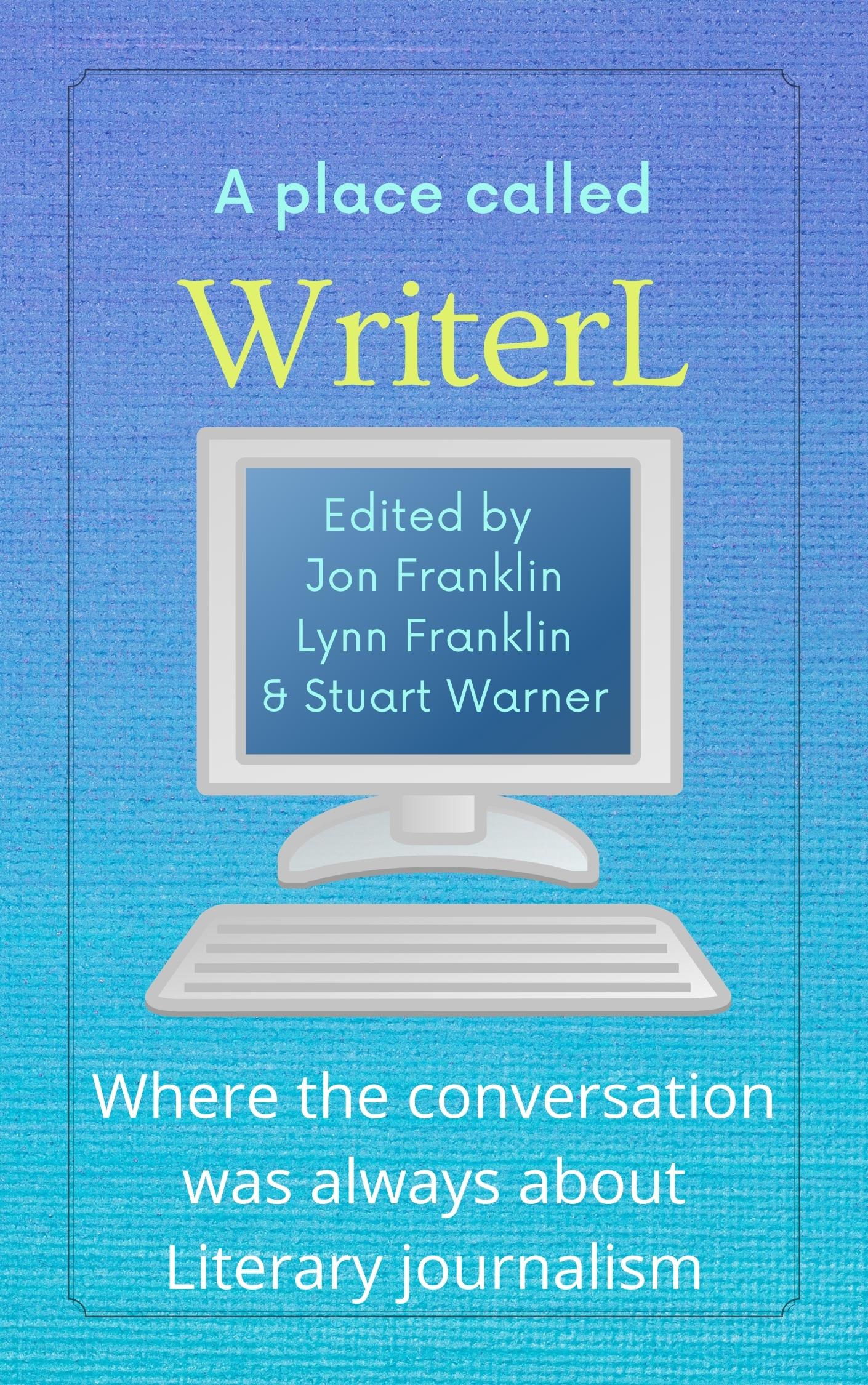
What the ‘L’ was WriterL?

By Stuart Warner

(@copyright 2022 Jon Franklin, Lynn Franklin and Stuart Warner)

Back before the turn of the century, before Facebook, Twitter and Zoom, nonfiction writers from around the country could gather around their computers on email message boards to discuss their craft, often referred to as Literary Journalism.

One of these message boards was called WriterL, run by two-time Pulitzer-winning journalist and author Jon Franklin and his wife, the mystery novelist Lynn Franklin.  An article in The New York Times likened the site to the “Paris of the 1920s.” Discourse was passionate and stimulating – if mostly sober and distant.  Alas,  the process was slow  – it often took a few days  to get your thoughts posted and see the response from fellow members.

In addition to the Franklins, the group included a number of outstanding nonfiction writers, editors and educators. Among them: Pulitzer-winning editor and writing coach Jack Hart; Pulitzer-winners Connie Schultz and Sheri Fink;  award-winning authors  Michael Capuzzo, Caitlin Kelly, Don Obe, Mark Kramer and Mark Pendergrast; author, educator and former Washington Post magazine senior writer Walt Harrington and Poynter Institute writing guru and author Roy Peter Clark. 

Their discussions could go on for days, weeks, even months. Some debates, like the value of first-person writing, lasted years.

Jon and Lynn began the site when he was a professor at the University of Oregon in 1994.  They lived on about 50 acres in a rural county with little contact with writer friends.

And therein lies a tale of how WriterL got its name and how it has now become a book, “A Place Called Writer L: Where the Conversation Was Always About Literary Journalism.”

The Franklins wanted to find a way to share their thoughts about nonfiction writing and hear from others.  The internet was still fairly new, so Jon went to one of the university’s information technology folks and asked if it were possible to set up some kind of electronic message board where writers could converse through emails.

Within hours, the IT guy came back with a listserv program that could be shared with a group. Back then it was common to name such programs with an L for the type of listserv it was.  Like DogL for canine enthusiasts or KitchenL for cooks.

So naturally the technician called the Franklins’ listserv WriterL.

“I hated the name,” Jon recalls.

But Jon’s reputation – two Pulitzer Prizes and his seminal book on narrative nonfiction, “Writing for Story” – quickly drew writers to the new site.

“After we had gotten it up and running, we asked people to suggest ideas for a new name,” Lynn says.  “And that created an uproar.  People loved the name.”

So WriterL it was forevermore.  Or at least the next 15 years.

The Franklins originally intended the site for newspaper journalists, but it found a much wider audience among all descriptions of writers – nonfiction and fiction authors, freelance magazine writers, children’s books authors, educators, etc.  To weed out participants who weren’t serious, the Franklins charged a $20 annual fee, and most gladly paid. 

The electronic conversations, which included several hundred writers over the years, continued through the Franklins’ move to the East Coast but finally came to an end in 2009 as the news industry began to implode.

“It hurt to end it, but journalism was such a mess, and people didn’t have time,” Lynn says.  “I was writing almost all the posts. … But it was a painful decision.  People became like family.”

That might have been the last of WriterL but during a moment of boredom during the pandemic, I scrolled down to the end of my AOL.com email basket just to see what was there.

I joined the group in 2002.  For some reason I had saved a couple dozen WriterL posts from 2005.  Curious, I read through them.  The emails contained a fascinating discussion on the vision of nonfiction writers: Could you teach vision? Did nonfiction writers actually have the same kind of vision as artists in other mediums? If so, did art make good journalism?

The discussion lasted from early June through the end of August of that year.  I wondered what the contributors’ comments would sound like if I arranged them as if the writers were sitting around a table with Jon or Lynn debating the issue in real time; making sure not to take any of the posts out of context.

That thread led to a 10,000-word piece on what is now the first chapter of this book: “Oh, Say, Can You See the Writer’s Vision?”

I showed it to the Franklins and they both loved it.  Jon suggested publishing it as a short story. 

In the meantime, though, I discovered that I had saved more than 100 additional WriterL posts in another email account, which I no longer used.  It was easy to see at least two or three more topic threads that would make interesting chapters.

I asked Jon and Lynn if they had saved any more WriterL posts.  Lynn did a deep dive into her computer drives and found posts from seven more years.  We didn’t have everything but we had at least a million words from some of the country’s best writers.  The posts may have been 15 to 20 years old but the wisdom had only been enhanced by time.  Why not a book about the WriterL discussions?

It seemed like a daunting task … a MILLION words?  But as I began to sift through the digital files I realized that Lynn had edited them so well and organized them so efficiently with appropriate topic labels that I easily could pull together the threads with simple document searches.

In fact, it took me longer to locate the 60-plus contributors whose posts we used than it did to pull together 16 chapter threads – unlike me, most of them didn’t keep their AOL email accounts that were so popular back then. 

We wanted to make sure the writers saw their posts and that we were using them in context. context.

Everyone we contacted seemed enthusiastic about the project.

At that point, all we needed was a big finish.  I remembered a section of Jon’s book “A Wolf in the Parlor.” I had used it several times in writing presentations as an example of why emotion-centered nonfiction writing could have a powerful impact on readers.

Jon agreed to share it and we had our book. 

The result, we think, is a series of robust conversations about the art of nonfiction writing, conversations that may have taken place 15 to 20 years ago, but are still relevant and enlightening to writers today.

Interviewing tips

Ten Tips for a Better Interview
By Anonymous
Created Oct 2 2007 – 10:19am
International Center for Journalists, http://www.icfj.org, October 2, 2007
1. Be prepared! Always read up on the subject you are reporting about and the person you are interviewing. Your source will appreciate your effort, and you will be able to skip questions that can be answered by an assistant, book or document. When scheduling the appointment, ask your source to suggest documents or other sources of information about the topic you will discuss. The interviewee will appreciate your interest and often share valuable documents before the interview. Make sure your tape recorder has batteries that work. Bring an extra tape as well as pens and notebook.

2. Set the rules of the interview right up front! Be sure your subject understands the story you are working on (this will help keep the interview on track). Additionally, the interviewee must understand that everything they say is “on the record.” It is best to establish these ground rules when making the interview appointment. Although most government officials have enough experience with the media to indicate when something is “off-the record” or “on background,” other experts may not understand the differences. Remember that an upfront clarification may be required (especially when your source’s job or life could be endangered by being quoted).

3. Be on time! The worst impression you can make on a source is being late for the interview.

4. Be observant! Observe details of the place and of your interviewing partner; this can add color to your story. If you are interviewing people in their home or office, be sure to get a good look around and note what you see. For example, they may have some old photos that show them in a more personal light. You may start an interview with assumptions about a person and leave with a completely different impression. However, this may be exactly what your source intended. Perception is a tricky business! Try to talk to others, colleagues or friends of your source, to get a bigger picture.

5. Be polite. Don’t rush your source! It is important to establish a polite rapport and a level of comfort for the interviewee. Some interviewees, on the other hand, need a couple minutes to become comfortable talking to reporters. Even though you may only have 30 minutes for an interview, you should not rush your subject. If you sense the interviewee is in a hurry, adjust your timing accordingly. Keep in mind, everyone is different. Taking the time to get to know your sources will prove valuable, especially when you need to call with follow-up questions or use them as a source for future stories. If the interview goes well, it may even go beyond the scheduled time. Give yourself plenty of time between appointments to avoid scheduling conflicts.

6. Listen but don’t be afraid to interrupt when you don’t understand! Keep your audience in mind! One reason you are conducting this interview is to explain it to your readers. If your subject uses scientific jargon or explanations only his/her peers would understand, politely interrupt and ask for further explanation. Never be embarrassed about not knowing something.

7. Silence is golden. Sooner or later you will have to ask the tough questions that your subject may be loath to discuss. When you start asking those provocative questions, the answers most likely will be short, useless or carefully worded. You may not get an answer at all. If this occurs, look your source in the eye and don’t say a word. In most cases, your opponent will begin to feel uncomfortable and begin to share information again. If this doesn’t work, ask for sources who might be able to answer your question.

8. Maintain eye contact! A reporter who spends most of the interview bent over taking notes or looking into a notebook can be as disconcerting as a tape recorder in an interviewee’s face. While taking notes and recording the interview, maintain as much eye contact as possible. Learn to take abbreviated notes looking down only once in a while so you can focus on your interviewee. This will make the interview more like a conversation, and enable everyone to be more relaxed.

9. Before your leave… ask your source if there is anything that you might have forgotten to ask. Perhaps the interviewee is burning to tell you useful information, but you did not even think to ask that question. Don’t leave without getting a contact number or e-mail address and a good time to call with follow-up questions. Always ask for other sources. Colleagues or friends of the interviewee may be more knowledgeable or willing and able to speak to you. Thank your source for spending time talking with you before you leave.

10. Review your notes right after the interview! Don’t wait until the end of the day or later in the week to review your notes. Go over them right away, while everything is fresh in your mind, filling in your shorthand and elaborating on your observations. Skip that date for drinks with your office pals until after you have reviewed and organized your notes.

Lexicon of Leads – from Jack Hart

Writing guru Jack Hart defines a variety of types of leads in his book A Writer’s Coach.
Here is a list aimed at improving our lexicon of leads:
Straight Leads
1. Summary Leads:
The University of Oregon must move more women into higher-level faculty jobs or face federal sanctions. (12/24/92, B1)
This is the spring from which all journalistic waters flow. Summary leads summarize (what else?) the most important idea in the story. They often top inverted-pyramid news stories, the most traditional form. Because a good summary lead makes meaning instantly clear, it’s often the preferred form for breaking-news and issue stories.
2. Blind Leads:
The state’s land-use planning agency on Friday chose a former city planner from Eugene to be its new director. (5/6/89, D4)
A blind lead is a summary lead that leaves out potentially confusing detail. The lead cited here omits the name of the planning agency (the Department of Land Conservation and Development) and the city planner, who was relatively unknown statewide.
A “catch-all graf” immediately follows a blind lead. The catch-all includes the specific detail omitted from the lead.
3. Wraps:
Thursday’s storm caused the deaths of a Salem woman who broke her neck in a fall, a Bend man who had a heart attack while shoveling snow and a Eugene teen-ager struck by a skidding car.
An editor’s order to “wrap it” means to combine several items. The reporter usually packages the items under a lead that refers to all of them.
4. Shirttail Leads:
“A man taking photographs of Portland’s skyline about 2:15 a.m. Sunday apparently was struck by a car and knocked into the Willamette River off the Interstate 5 ramp to Interstate 84….”
“Another accident Friday, this one involving a hit-and-run driver in Southwest Washington, left a Lynnwood, Wash., man in serious condition….” (10/8/90, B3)
The shirttail is the alternative to the wrap lead. The reporter writes a summary lead focusing on the most newsworthy element in the wrap. Then he hangs the remaining items, each with its own lead, from the first element’s “shirttails.”
Shirttail leads are traditional on meeting stories. The first lead targets the most important item on the agenda. The remaining items are introduced with an “in-other-business” transition.
Feature Leads
1. Anecdotal Leads:
Richard Leakey likes to tell about the day in 1950 when he was a 6-year-old whining for his parents’ attention. Louis and Mary Leakey were digging for ancient bones on the shores of Lake Victoria, but their little boy wanted to play. He wanted lunch. He wanted his mother to cuddle him. He wanted something to do. “Go find your own bone,” said his exasperated father, waving Richard off toward scraps of fossils lying around the site. What the little boy found was the jawbone — the best ever unearthed — of an extinct giant pig. As he worked away at it with the dental picks and brushes that served for toys in the paleontologists’ camp, he experienced for the first time the passion of discovery. (Kathleen Merryman in the Tacoma News Tribune)
Here’s a true anecdotal lead, as opposed to all the other kinds of feature leads. As an anecdote, the lead takes the form of a short narrative with a beginning, middle and end. The end is particularly important. It’s analogous to the punch line in a joke — it wraps up the story with a flourish that brings things to a apt conclusion.
An anecdotal lead should illustrate the story’s central theme. Kathleen Merryman’s anecdote, for example, explains something central about her subject, Richard Leakey.
2. Narrative Leads:
They pulled the car to the side of the road, turned off the motor and waited silently as the memories washed over them in a series of gentle waves…. (Tom Hallman, 3/8/90, B1)
A narrative lead simply launches an action line. It’s not part of an anecdote, necessarily. But it puts central characters into a scene and begins telling the story that pits those characters against some kind of complication. Narrative leads are — surprise! — most appropriate to narrative stories. But they work on other kinds of stories, too. The bookend narrative, for example, begins with some relevant action, turns to standard news-feature style for the middle of the story and completes the narrative for the story kicker.
3. Scene-Setter Leads:
A woman with tormented eyes talks to herself as she plays a battered piano in Ward D’s dayroom. Other psychiatric patients shuffle on the beige linoleum or stare from red-and-green vinyl chairs. A bank of windows opens to a fenced courtyard. Outside…. (Brian Meehan, 10/27/93, D1)
Scene-setters open with description. They may contain some action, as is the case here. But the main point is to create a stage on which action can unfold or to give a sense of place important to the focus of the story. Brian Meehan’s story concerned conditions at Dammasch State Hospital. So a description of those conditions was an appropriate way to begin.
4. Scene-Wraps or Gallery Leads:
A man claiming to be a Catholic priest sits in a Santa Claus suit in a wheelchair outside a Southeast Portland supermarket, collecting money for the “Holy Order of Mary Inc.”Across town, a supposed South African visitor asks a holiday-spirited shopper for directions to a local church. The South African then launches into a complicated tale that soon has the Portlander withdrawing $2,000 from the bank…. Elsewhere, a boiler-room telephone sales company…. (Jim Long, 12/13/91, B1))
Scene-wraps illustrate trend stories. They show that the same thing is happening in a variety of places. Because they consist of a series of pictures, they’re also called “galleries.”
5. Significant Detail Leads:
Hidden beneath a heap of inner-tubes in a tiny storeroom on an island in the middle of the Vistula River is the statue of Lenin that stood for decades inside the Gdansk Shipyard. (6/18/91, A3)
As you might expect, this story explored the continuing influence of Communism and central planning on the operation of the shipyard and the economy of Poland. The statue of Lenin — hidden, but still in the neighborhood — perfectly symbolized the story’s central theme. And it perfectly illustrates the use of a significant detail to craft a lead.
6. The Single-Instance Lead:
For five days, Alice’s husband, high on drugs, threatened to kill her. He hit her and abused her. Terrified, Alice fled the house when she finally got the chance and ran to a local business to call the police. “He would kill me. He’s very scary,” Alice said. “He would walk through walls if he had to.” The police advised her to contact the Domestic Violence Resource Center in Hillsboro, and Alice found her way there. (12/7/89, WM1)
The single-instance lead uses one example to illustrate a larger topic. For that reason, single-instance leads are also called “microcosm leads.” In this case, Alice’s story was a gateway to a larger story on the Domestic Violence Resource Center.
Single-instance leads are a mainstay of magazine writing. In fact, they’re almost required for stories in the most popular women’s magazines. They’ve spread rapidly into newspaper writing, to the point that some critics now complain about their overuse.
7. Word Play Leads:
In Michael Crichton’s previous novel, “Jurassic Park,” a tropical island has been transformed into a zoo whose denizens are dinosaurs brought to life by a group of greedy, irresponsible scientists who have been cloning around. (2/1/92, D2)
Word-play is essentially lighthearted. Word-play leads therefore work best on less-than-serious stories. They’re popular in sports and entertainment, but they can succeed at grabbing and delighting readers in other forms as well.
Dangerous Leads
1. Question Leads:
What’s black and orange and the worst nightmare for teams headed to the state football playoffs? (10/28/95, C1)
Some editors simply ban question leads, reasoning that readers want answers, not questions. But George Orwell assures us that the only rule in writing is that there are no rules. So let’s concede that question leads occasionally work, for all the right reasons.
They often fail because they seldom perform the basic function of a lead — stating the central theme that organizes and explains the entire story. Furthermore, they can be irritating. Readers probably do resent frivolous questions when what they really want is news.
Still, some stories deal with fundamental questions. So a question lead can be appropriate. Nonetheless, question leads seldom represent the best solution. It pays to be especially cautious when using them.
2. Quote Leads:
Quotation leads were banned in some newsrooms, too. The rationale was similar to the justification used for banning question leads: The chances that a quote was the best way to express the story’s theme were awfully slim.
But quote leads can work wonderfully well, too. Consider the famous Saul Pett lead for a 1963 AP Newsfeatures story on Dorothy Parker: “Are you married my dear?” “Yes, I am.” “Then you won’t mind zipping me up.” “Zipped up, Dorothy Parker turned to face her interviewer, and the world.” Or this intriguing opener from a Jeanie Senior story: Michael H. Walsh calls it it “teaching the elephant to dance.” “That’s his term for making the enormous, historic Union Pacific Railroad Co. competitive and profitable in the 20th century. (5/28/89, D1)
3. Topic Leads:
More than 40 environmentalists and developers debated before the Portland City Council on Wednesday on the future of wetlands areas in the Columbia South Shore area. (3/9/89, B4)
BOARDMAN — The prospect of tripling this town’s population with a 3,000-inmate prison was the subject of a hot debate Tuesday. (9/27/89, B1)
Orwell notwithstanding, topic leads probably should be banned. The point of a news story is to tell us what happened, what the outcome was. In the case of a meeting story, the important thing is not that the meeting took place, but the consequence of the meeting. What was the key decision? Why is that important? Where do we go from here?
Topic headings, in other words, should be restricted to information. It’s hard to imagine that they can ever be an appropriate way to introduce news

So what is literary journalism? A Q-A with Jon Franklin

A generation ago, writers such as Gay Talese, Tom Wolfe and Hunter S. Thompson wowed a lot of us with the so-called “New Journalism,” applying the techniques of fiction writing to the demanding discipline of reporting.

Probably no one did more to bring this type of writing to newspapers than two-time Pulitzer winner Jon Franklin, who won the first Pulitzer Prize for feature writing with “Mrs.Kelly’s Monster” and his book “Writing For Story” has influenced an entire generation of narrative journalists.

Through several discussions with Jon and from observations made in “Writing for Story,” I pieced together this fictional conversation between an aspiring narrative journalist and one of the masters of the form. You should note that many of Franklin’s responses are paraphrased.

What is literary  journalism? 
Some people also call it creative nonfiction, but I don’t like that term, because it implies that writers can make things up that ought to have happened. I prefer narrative nonfiction or literary journalism. But whatever you call it, you combine the writing techniques of fiction with the fact-gathering techniques of journalism to tell a story. 

We tell stories every day. What’s different about literary journalism?
In truth, all stories are part of a narrative. Hard-news stories on an unfolding trial or election are paragraphs in the greater narrative. But when writing the true narrative or literary journalism, you don’t tell the reader what happens until the end. The story begins with a complication that needs to be resolved, then takes the reader on a journey to the resolution of that complication. Narratives usually are told without attribution, although sometimes that attribution is included in a separate box. 

So how do I find a story that will make a good narrative? 
The temptation is to jump on a story because someone promises you unlimited access. The reporter and editors say, “Wow. We’ve never had access like that before. Let’s tell the story” — usually over several days with lots of pictures. But just go to any hospital, and you can find dozens of these stories and, if you ask, you can probably get access. I look for a clean story — with a limited number of elements. I want to make sure I know who the main characters are. I don’t like the main character to be someone who has a nonstandard life. I want a unified experience for the reader. Above all, there are two things to avoid: Confusion and boredom. Readers get enough of both in their lives. 

How do you define a clean story? 
It’s kind of a batting average. Given all the variables, where is this probably going to go? Do I see the components of a story? The main characters? The complication? Is there a fallback structure? 

But what if the story doesn’t go in the direction you predicted? 
That’s just your default position. If you’re lucky, you’re wrong and you will find something better. That happened to me last year and after all these years, it still scared the living hell out of me. When I started I had a medical story about a woman in a coma. I woke up at 2 in the morning and realized it was a love story about her and her husband. Still, I didn’t want to admit it. I didn’t want to change directions. Most of my reporting was already done. Then my wife told me, “How long have you been telling others that the story can change?” She convinced me. 

So what did you do? 
I did some more reporting. I went back to the relatives and asked, “This is a love story, isn’t it?” And they said, “Of course it is.” From that point on, it was easy. 

OK. I’ve picked a clean story. How do I persuade my editors to give me time to work on it when I’ve got a beat to cover, too? 
None of us started out doing narratives full time. We all had to work them in around other assignments. And you don’t have to start with something that takes months and months. “Mrs. Kelly’s Monster” happened over three or four days. Any good feature writer can get that kind of time. 

Many narrative writers advocate becoming a fly on the wall in reporting these stories. Does that mean we write only what we see?
The fly on the wall is only a technique to make your subjects feel comfortable. That’s all it is. You still have to get into the heads of your characters. And you do that by interviewing them, by reporting. 

So you don’t have to follow your story 24/7 to write a narrative? 
No, in fact, I prefer a retrospective approach over the perspective approach. 

What’s the difference? 
In a perspective, you write what you see as it happens. The danger is that the story changes on you and you won’t know it. A Tom Hallman or a Tom French can write with perspective because they’re experienced enough to recognize the change. But in a retrospective approach, you wait until the story is over and you’re sure what the story is. 

By retrospective, do you mean you re-create scenes, dialogue, etc.? 
Yes. This seems to bother some journalists, but I think they just don’t know the rules or the amazing accuracy with which this can be done. Readers don’t mind. They like it. And in truth, journalists do this every day. Rarely do we witness the murder, the bank robbery, etc. Writing in the retrospective is much the same thing. We re-create scenes; we don’t attribute every detail, but we’ve done the same reporting.

But it is important to remember that writing in the retrospective is not a license to steal. There are rules, and they are strict. 

So after I spent weeks or months filling my notebook with observations and microcassette tapes with interviews, what do I do with all this stuff? 
Start getting rid of it. 

But I’ve got so much great material!!! 
You’re going to find you collect dozens and dozens of great stories — stories you’d probably put in the newspaper under normal circumstances. You have to throw out everything that doesn’t contribute to the main theme of the story — everything that doesn’t take you directly from the complication to the resolution. 

What about all these great quotes I’ve collected?
Quotes have become a security blanket for writers. When you’re hiding behind them, you’re letting quotes substitute for reporting. You try to let quotes tell the story instead of doing it yourself. Quotes don’t move a story along. They don’t have action. They’re all words. I like for a narrative to be at least 60 percent action. And so often the quotes are chosen because that’s when the reporter was there. We worked hard for that quote, so we’re going to get it in there. That’s what I call a notebook dump. The only quotes that belong in a narrative are those that are part of a dialogue that move the story along. 

So what’s my lead? 
I often don’t even write my lead until I find the point of insight. 

The point of what? 
The point of insight is that moment in the story when all the parts are in place for the finish. It “feels” like we understand now. It usually comes at the last or the next-to-the-last piece in a series, though in a single story it’s almost always near the end, setting up the resolution. It’s the most dramatically germane part of the piece and, as a practical matter, the part the writer usually arrives at first. Essentially, in the narrative, the point of insight is the equivalent of the nut graf in a more traditional newspaper story. It’s the graf that tells you what the story is really about. In “Mrs. Kelly’s Monster,” the point of insight is the moment the doctor realizes the operation is going to fail.

So how does the point of insight relate to the lead? 
When I have the point of insight, I know whose story it is and where it’s going to go. Then I construct my lead to make it fit to that.

 Some writers begin narratives in media res — at a critical turning point in the story. Others begin at the beginning. Do you have a preference?
I usually try to begin a story in the middle of telling action. David is picking out the stone to hurl at Goliath, or whatever. Then I flash back to the beginning and how the hero got into this pickle.

What are some other characteristics of a good narrative lead?
You make promises in a lead. Then you have to live up to them. “Erin’s Race” makes the promise that this is going to be a race. But it isn’t. A narrative needs an overarching metaphor, but you can’t force a metaphor on the story. It’s got to happen naturally. 

What verb tense do you prefer for the story? 
Writers need to realize that story present can exist in past tense. I don’t like present tense for longer stories, especially those told over more than one day. Present tense is too limiting. In present tense, the story has to move at a breathless pace, but in a more reflective story it’s like playing a symphony in three-quarter time. 

I met so many people during the reporting. How do I choose my main characters? 
In literature, the character with the most courage is your main character. In journalism, it’s the character at the center of the action. Your job is to figure out whose story this is. As a general rule, all the main characters need to enter the story before the end of the first chapter or first day of a series. And you have to develop those characters through your reporting. We need to see them do things that denote intimacy, happiness, etc. When a main character makes a decision, the reader needs to understand why. 

Much of what I’ve witnessed during my reporting has been pretty boring. How do I keep my readers interested? 
We often think life is boring because we’re afraid to engage in it, and those pieces aren’t boring at all if you look at the dramas being played out. For instance, if you’re writing a medical story, yes, the patient is often bored to death. But I can guarantee you it’s not boring for the doctor who’s trying to save a life. So get inside the doctor’s head. 

What other advice do you have for the writing? 
Build scenes by showing, not telling. In one story there is a line, “Erin’s mood visibly lifts.” That’s telling. Show me her mood lifting — a smile, a bounce in her step, etc. 

So I’ve written 6,000 words. What’s next? 
You’ve got a rough draft. You begin rewriting. And re-reporting. 

More reporting? Are you kidding? I’ve been reporting this thing for six months.
Right, at this point, you can’t imagine why you started this project and you can’t imagine how you’re going to get through it. It’s painful. But you’re just getting to the fun part. Now you should know what the story is. You’ll probably throw out half of what you’ve written and then go back and improve on the best parts. That means more reporting to flesh out the story. The longer I’m in this business, the more I realize that it’s the reporting that makes these stories work. The writing is almost secondary. 

Tell me again why I started this in the first place.
When you get it right, when you ring the bell, the readers walk away touched and changed in some way. You’ve incorporated your story into their life’s experiences. 