By Stuart Warner
Gaylon White was working late on Friday, Nov. 14, 1986, when the boss’s son, Robert G. Mercer, appeared in his doorway.
“Dad says the company’s his if he wants it.”
The company was Goodyear. Dad was Robert E. Mercer, its chairman and chief executive. And the man who could have it if he wanted it was Sir James Goldsmith, a corporate raider who had already made millions buying American companies and selling off their pieces and parts.
White, a Goodyear public relations man, had spent weeks trying to make life difficult for Goldsmith. He started looking for a new job the next day.
In public, Mercer was still projecting confidence. But years later, he told me he believed Goodyear had run out of ways to stop Goldsmith. The Ronald Reagan administration, he said, had no idea what was happening and wouldn’t help.
Yet, six days after that conversation in White’s office, Goldsmith walked away without the company but with a profit of more than $90 million. Goodyear stayed in Akron. Forty years later, I still think the subhead on our special section, The Goodyear War, had it right: It was hard to tell who really won.
I do know this much. Many people in Akron had a hand in the fight. As the local humor columnist, I supplied Goldsmith’s mailing address. This is how the battle played out.
********
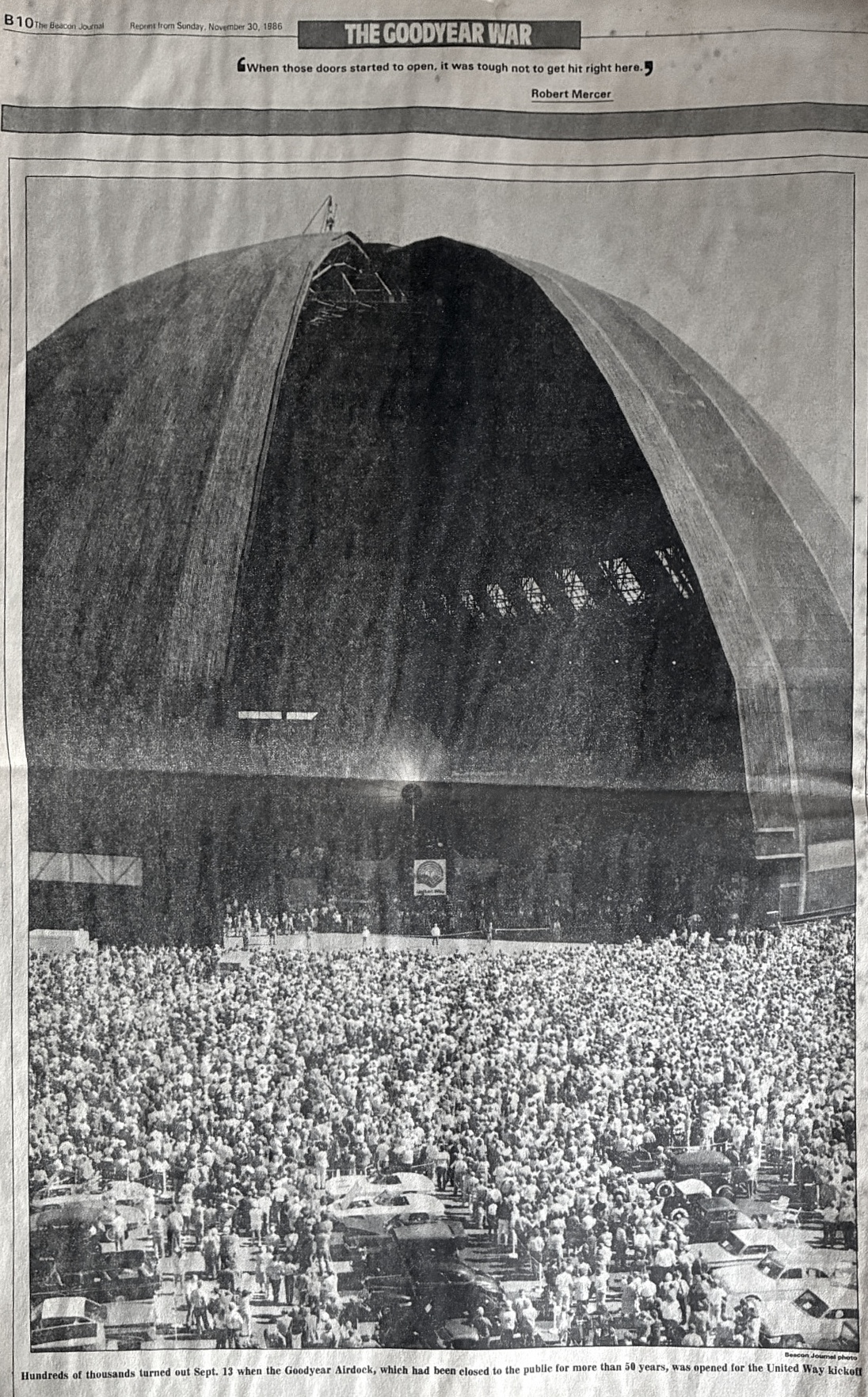
On Sept. 13, 1986, two months before White got the bad news, the 600-ton doors of the Goodyear Airdock began sliding open a few minutes past 11 in the morning. The Akron Symphony Orchestra played the theme from 2001: A Space Odyssey. The timpani built to the first crescendo. Men and women cried.
Goodyear had opened the Airdock to the public for the United Way campaign. Mercer watched from inside as a shaft of sunlight cut into the building. When he told us about the moment later, he tapped his chest with his fist.
Steve Seigfried, then 59, a Goodyear Aerospace employee, had worked until 11:30 the previous night getting the building ready. He stayed home. He’d already heard the orchestra rehearse the piece at least a dozen times. Maybe more than anyone, Siegfried embodied what had already happened to Akron’s rubber industry. He’d been laid off twice, and now his current job was being threatened.
Rufus Johnson, who shined shoes at the Goodyear barbershop, wanted to go, but Saturday was a working day, even when most of his customers were someplace else. Donald Walsh, who ran the local Merrill Lynch brokerage office, drove to Columbus with his wife and two sons to visit his parents. In Washington, Akron Congressman John Seiberling, grandson of Goodyear’s founder, went to his office to clear his in-basket. Mark Blitstein, Goodyear’s director of investor relations, stayed away from the crowds. His parents had come from New York for his 35th birthday. They really came to see his 11-month-old son, he told us.
United Way officials estimated that as many as 300,000 people made it to the Airdock or tried to. Sen. John Glenn got stuck in traffic and missed the ceremony. For Akron, the building held the memory of a time when tens of thousands of people made their living in the rubber mills. It still held the prospect of work. The event doubled as a chance to impress the Navy, which had a $193 million contract at stake that could put as many as 600 people back to work building blimps.
Six days after the doors opened, Goldsmith bought his first shares of Goodyear stock. The battle had begun.
*********
Doug Oplinger, then The Akron Beacon Journal’s business editor, noticed Goodyear’s stock climbing in early October and put reporters Rick Reiff and Larry Pantages on the story. At first, the rumor pointed to a New Jersey chemical company. By the end of the month, the paper had identified Goldsmith as the likely raider, and Goldsmith disclosed that he owned 11.5 percent of Goodyear.
In Akron, the idea of somebody buying the company and selling off pieces of it was easy enough to grasp. People already knew what losing rubber jobs felt like. The region hadn’t made passenger tires since 1982. Now they had reason to learn about junk bonds and arbitrageurs. Junk bonds helped raiders raise enough money to take on companies worth billions. Arbitrageurs looked for a profit in the difference between what a stock cost and what a buyer was offering, assuming the deal went through.
Managing Editor Larry Williams, who Editor Dale Allen had just hired from The Philadelphia Inquirer, understood the language. At the Inquirer, he had supervised the coverage of the Three Mile Island nuclear accident, where reporters turned weeks of daily work into a long reconstruction. As the Goodyear story grew, Larry and Doug put the business staff to work on the finances and drew on the rest of the newsroom to cover the fight in Congress, at the Statehouse and in Akron. Deb Van Tassel, my wife, supervised local coverage. By the time the story was over, more than 50 people at the paper had had a hand in it.
The local reporting brought out what a stock chart could never show. An Akron church that needed $150,000 for a new roof refused to sell its 100 shares of Goodyear. Students got up a stock-buying campaign and wrote to Congress and Merrill Lynch. Joan Lukich, whose family had put in more than 200 years at the company, took to the streets in a sandwich board urging people to buy shares. Wheels of Fortune co-author David Giffels, then a college student, remembered a motor home parked in West Akron with a hand-lettered sign that said “SAVE GOODYEAR!” To Giffels, that motor home looked like somebody’s dream, a bit of luxury a rubber job had made possible.
Walsh, who had taken his family to Columbus that September Saturday, found himself answering for what his colleagues in New York were doing. An Akron-area machine shop pulled $130,000 out of the local Merrill Lynch office and told the firm why. In Tyler, Texas, the union at Goodyear’s Kelly-Springfield plant pulled its money from Merrill Lynch, too.
Meanwhile, White called a columnist using the name Kenny Hubbs, the late Chicago Cubs second baseman. He asked the columnist to meet him at Dontino’s. White said his boss had told him to be disruptive. The lifelong Cubs fan showed up with photocopies of stories about Goldsmith’s love life.
I was that columnist. In those days I wrote Warner’s Corner, poked fun at the affluent suburb of Hudson, where Larry Williams had bought a house, and occasionally I turned in a column Larry decided we shouldn’t publish.
White also led me to Rufus Johnson, the man who’d worked through the Airdock opening. When Mercer came in for a haircut, Johnson told him, “Mr. Mercer, it’s Rambo time.” The line became a rallying cry at Goodyear.
Then White passed along a copy of a biography about Goldsmith titled Goldenballs. It contained a tidbit that Goldsmith couldn’t stand rubber bands. I found the premise irresistible: The man was trying to take over the world’s biggest tire maker, and he had a rubber phobia. I printed the address of his New York townhouse and asked readers to send him rubber bands, millions of them, according to The Wall Street Journal.
***********
By the time Mercer privately conceded that Goldsmith could have the company, Akron Mayor Tom Sawyer was using his friendship with Gov. Dick Celeste and his connections in Columbus to push through legislation that would make hostile takeovers harder. And Seiberling, the congressman who’d gone in to do a little work on the day the Airdock opened, had arranged a hearing for Nov. 18.
Workers and retirees came to Washington to face Goldsmith. Sally Edwards, a union steward from Lincoln, Neb., remembered the room full of retirees who had ridden in from Akron. They were respectful, she said. They wanted him to see what the company meant to them. Edwards also thought some of what Goldsmith said about Goodyear’s management was true. She could see that the company needed to take a hard look at where it was going.
Seiberling’s grandfather had founded Goodyear and lost control of it to New York bankers. The congressman had a pointed question for Goldsmith.
“Who the hell are you?”
That night, according to the Akron rubber-industry history Wheels of Fortune, Goldsmith watched a tape of the hearing and told a friend he looked like a monster. Mercer, who had seemed so defeated only a few days earlier, met with the financier for lunch and asked whether he would consider selling his stock back to Goodyear. Goldsmith said he would. On Thursday, Nov. 20, Goodyear agreed to buy back his shares for $49.50 each.
When I spoke years later with Denis Kelly, who had worked on the takeover at Merrill Lynch, he still couldn’t understand why Goldsmith had backed down. He said the lawyers thought they could get around the Ohio legislation. Then, without my asking, he remembered something that really had bothered Goldsmith. The bags and bags of rubber bands. Why, Goldsmith had wanted to know, were people sending him all those rubber bands?
I would love to tell you that my readers saved Goodyear. Kelly at least gave me enough to enjoy the possibility.
*********
On Nov. 20, the story was far from over in our newsroom.
The day after Goldsmith dropped his bid, Larry Williams told me I would be the lead writer on the team reconstructing the takeover. I had done some long-form work as a religion writer, but I’d also spent weeks writing jokes about the people the business staff had been covering around the clock. I know some of those reporters wondered why I was on the team. I wondered, too. I had been the sports editor, then the religion reporter before I started writing Warner’s Corner. I wasn’t sure how to pronounce arbitrageur, much less spell it. I thought a raider played for Oakland.
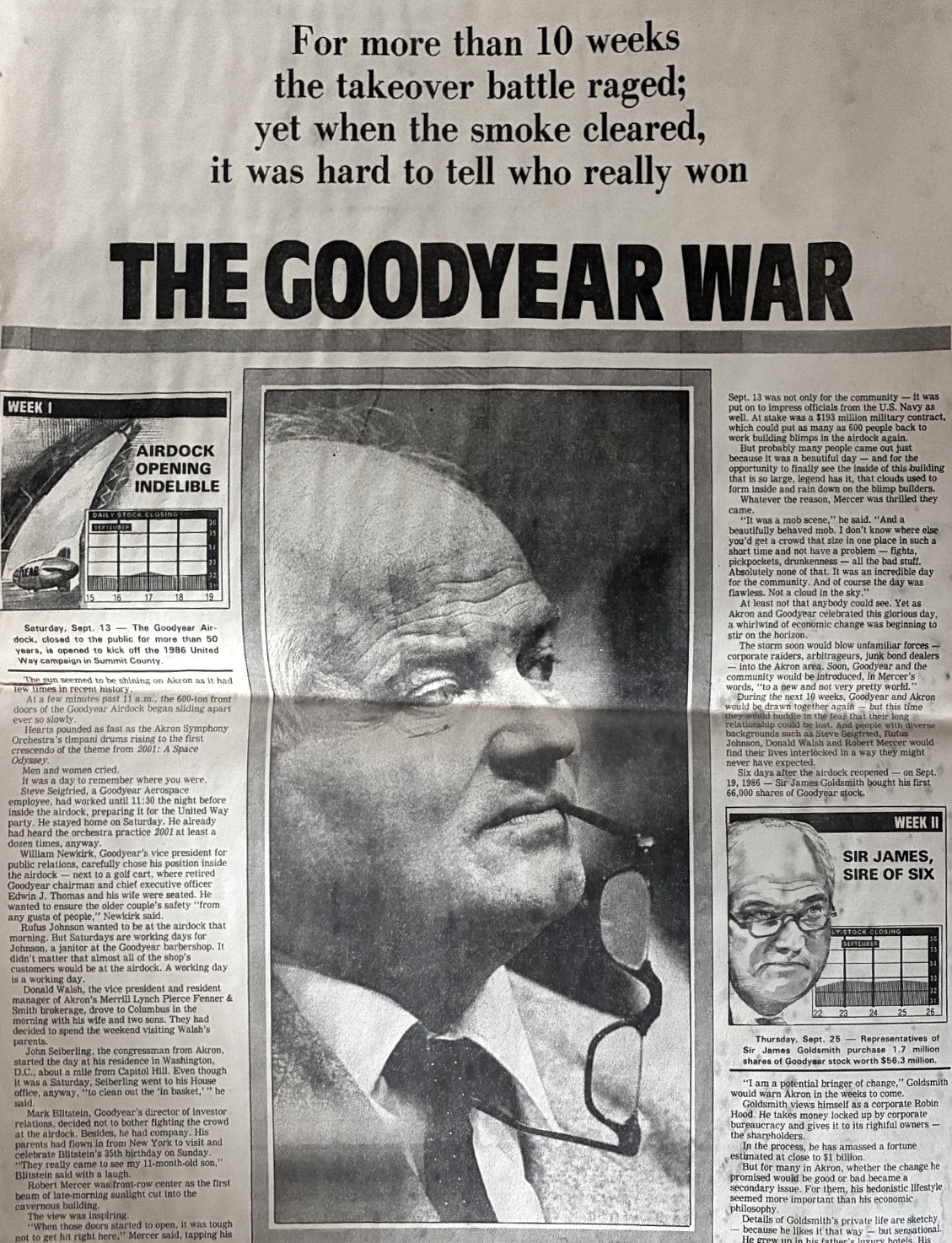
I clipped and read everything we’d published about Goodyear since the Airdock opening. Larry and I worked out a detailed plan over the weekend. We had an eight-page section to fill for Sunday, Nov. 30, and a Saturday night deadline. Much of the reporting still had to be done.
On Monday afternoon, I sat down at our Highland Square home and began writing on my Commodore 64 PC. By midnight I had nothing. At 2 a.m. I was still deleting copy. Deb told me to go to bed and try again in the morning. I couldn’t imagine facing the team with empty pages. Sometime after 5, I fell asleep on the couch beside my desk, my screen still blank.
I was back at the keyboard by 7. I’d been trying all night to figure out how to start a story about a takeover. Now I knew what I wanted to find out. Where were all the key players in our story on the day those doors opened?
By 9, I had a full draft. When I got to the office, nobody knew I’d been up all night. The chapter went over well. There were 10 more to write and edit by Saturday.
I wrote the first drafts of seven of the 11 chapters. Reiff, Pantages and Melissa Johnston worked on the others while they kept reporting. Reiff and Pantages took readers into the world of Wall Street and got Mercer to reconstruct his first lunch with Goldsmith in Manhattan. Mercer could remember the buckets of wine by the table and how he’d turned down a drink at noon. Goldsmith offered him water.
“Fizzy or otherwise?” Goldsmith asked.
“Otherwise,” Mercer said.
By late Wednesday we knew we would be working on Thanksgiving. Dale came in on Thanksgiving morning and found Larry asleep with his feet propped on a desk and a folder of notes across his lap. Larry gave us two hours for dinner. I remember swallowing turkey and mashed potatoes with Deb and our 2-year-old, known to readers of the column as Baby Corner. By 5 p.m., I was back at the paper.
We finished the 11 chapters, some 15,000 words, around 4 o’clock Friday morning. When we came back at noon, I figured the edit would take three or four hours. I even suggested we could save time by starting at Chapter four. I’d written the first three and thought they were in good shape, I said. That did not go over well with Larry Williams or the other reporters.
Larry started at page one, line one.
For 20 hours, seven of us, including Doug Oplinger and Metro Editor John Greenman, went through the piece together. Larry questioned assertions and asked what we knew and how we knew it. I sat at the terminal and typed as the others talked. Around 1 a.m., we found a false premise in Chapter 8 and had to rewrite it. I gave up the keyboard and slept on a couch while the other six worked through a couple of thousand words. By Chapter 9, I was back.
Then we realized we didn’t have an ending. Somebody in the room pointed out that Goldsmith had never come to Akron during the fight.
There it was. We’d opened by putting our characters in Akron and Columbus and Washington on a September Saturday. Now we knew where to leave the man who had upended all those lives. He had terrified Akron without ever once setting foot in the city.
We finished at 8 Saturday morning. Then the copy editors, artists, page designers and composing room took over. Mickey Porter line-edited every word. Larry sat beside the copy editor, fighting to stay awake. When Deb and I stopped back at the paper that evening, the place was as busy as election night. Dennis Balogh’s front-page illustration captured the turmoil of those 10 weeks. The headline asked readers to think about who’d come out ahead.
We reprinted thousands of copies and mailed the section to journalists around the country. In those days, if you wanted somebody in another city to see your work, you wrapped it up and sent it.
*
The next April, the Beacon Journal won the Pulitzer Prize for its Goodyear coverage. At the party I poured champagne over Larry’s head. Mercer sent Dale a telegram crediting the paper with saving Goodyear. Dale later told me he was proud of the work we did covering Goldsmith and Goodyear, “except for that rubber band stunt.”
The company had survived the bid, but it had to pay for the victory. Shareholders were offered roughly what Goldsmith got, although the company’s offer covered only a portion of their holdings. It raised more by selling its aerospace division and the Airdock. Workers were laid off. Mercer’s son, Robert G. Mercer, who’d walked into Gaylon White’s office that Friday night, lost his job in the public relations cuts. He became a senior public relations executive at a new company called DirecTV. The Goodyear operation in Lincoln where Sally Edwards worked was sold. John Nash, who’d helped negotiate a contract that allowed Goodyear to make radial tires at a plant in Tyler, Texas, lived to see the plant close anyway. By the time I interviewed him for the 25th anniversary, he wondered whether his people would have been better off if Goldsmith had won.
By that anniversary, Goodyear was building a new headquarters in Akron. The city’s three other big tire companies had all come under foreign ownership and lost their headquarters. Goodyear was still there, with about 3,000 employees in Northeast Ohio, down from about 12,000 in 1986. Kelly thought the company that emerged was much like the one Goldsmith had imagined. Frank Kelley, who had helped build the University of Akron’s polymer science program, wondered what discoveries had gone unmade as companies cut research to improve their bottom lines.
Larry and I kept disagreeing about my column, and I never really thanked him for what he taught me that week. Years later, when I was back editing other people’s work, I found myself asking some of the same questions he wanted answers for back at that terminal. I’d spent the night at my Commodore trying to prove I could write the story. I spent the next few days learning what it took for a newsroom to tell it.
**********
Postscript: Goldsmith never raided another company. He became a noted philanthropist before his death of a heart attack related to pancreatic cancer in 1997 at age 64. Merrill Lynch was taken over by Bank of America during the 2008 financial crisis. Dale Allen retired in 1997 and died in 2018. Larry Williams was promoted to Knight Ridder’s Washington Bureau. He died in 2019. Robert E. Mercer died in 2020. Tom Sawyer, who later became a congressman, died in 2023.
Doug Oplinger retired as the Beacon managing editor in 2017 and continues to work as a journalism consultant. Deb Van Tassel edited the book about Akron’s rubber history, Wheels of Fortune, in 1997-98. We both left the Beacon for The Plain Dealer and later the Arizona Republic, retiring in 2019. I helped Gaylon White edit his most recent sports book, Coach of a Lifetime. I wonder if he’ll write one about Kenny Hubbs.
Goodyear is still headquartered in Akron but had fewer than 2,600 employees in the city as of June. Goodyear reported a $238 million third-quarter net loss on $4.5 billion in sales. The company fired CEO Mark Stewart on Nov. 8, 2026.
I used research from articles I wrote for The Akron Beacon Journal in 1986, The Plain Dealer in 2011, Inside Business in 2011 and Akron’s Daily Miracle in 2021 to compile this essay. Deb and AI programs edited it and helped with research.