Was Pierre Legal? Young Haitian More Than a Grammatical Debate

By Stuart Warner

I apparently upset a few Facebookers yesterday when I posted about the tragic death of 20-year-old Haitian Pierre Damas Bel in Springfield, Ohio.

“He FOLLOWED the rules,” I wrote. “He was legal.”

Several were quick to point out that Pierre remained in this country this summer after the Trump administration ended the Temporary Protected Status that had allowed Haitians like him to stay.

Was I wrong?

To paraphrase another president, Bill Clinton, it depends on what your definition of “was” is.

I used the word in the past tense. Pierre did nothing wrong when he came here. He followed the rules.

Pierre was born in Haiti, the oldest of three children. His parents left Haiti about three years before Pierre came to the United States. They bought a home in Springfield. Pierre remained behind in Haiti until 2024.

He came here at 18 to rejoin his family and continue his education.

But Pierre represents more than a grammatical argument to me.

I had no direct connection to him, but I came to know hundreds of children like him through the writing of Emily Troutman, an AOL News reporter I supervised for a year while she covered Haiti in the aftermath of the devastating Jan. 12, 2010, earthquake.

She wrote dozens of heartbreaking stories about displaced children surviving in unsanitary, makeshift communities, including this excerpt from six months after the earthquake:

“There are now more than 1,300 camps. They are filled with 700,000 tarps and 100,000 tents. They are tied up alongside 8,000 cubic yards of rubble and 190,000 destroyed houses. There are 1.5 million people, including half a million children, in the streets.”

Then she asked Haitians what they had been doing lately.

“Nou leve chak jou, epi nou chita.”

In Creole: We get up every day, and we sit back down.

Pierre would have been 4 or 5 years old then.

He had been getting up every day and doing his best since arriving in America.

On March 5, 2024, Pierre made an appointment through the government’s CBP One program. He presented himself at a port of entry in Brownsville, Texas. He was released into the U.S. while his immigration case proceeded.

He enrolled at Springfield High School, where he became a National Honor Society student, a varsity soccer player and a member of the Marine Corps JROTC. He earned a scholarship. He worked at a local Texas Roadhouse, where coworkers thought enough of him to write character letters for his immigration case.

After graduating from Springfield High in May, Pierre enrolled at Wright State University. He was studying neuroscience and intended to go to medical school. He hoped to continue playing soccer.

He followed the rules.

Then Washington changed them.

The Trump administration moved to terminate Haiti’s Temporary Protected Status. On June 25, the Supreme Court cleared the way. The protection ended July 27.

Two days later, ICE placed Pierre in its Alternatives to Detention program and fitted him with a GPS ankle monitor while his immigration case continued.

The next day, Pierre wrote publicly about his “shame and humiliation.” He said he had come to America for an education, not to commit crimes or hurt anyone.

His father later said Pierre felt he was being treated “like an animal.”

Pierre didn’t just complain about the monitor.

His father said Pierre made two trips to immigration offices asking officials to remove it. He worried about attending college wearing it. He worried about playing soccer.

His father said students ridiculed him because of the monitor. Wright State says it has no confirmed information about complaints or investigations involving bullying.

On Aug. 24, Pierre began classes at Wright State.

He had made it.

Neuroscience. College. Maybe medical school.

Eight days later, at 8:03 on the morning of Aug. 31, Pierre video-called his father and told him he wasn’t doing well mentally. His father told him to come home so they could talk.

Pierre parked his Toyota on the shoulder of Interstate 70.

He never made it home.

So I stand by what I wrote on Facebook.

Pierre was legal.  He followed the rules.

Then the rules changed.

Now Pierre is past tense, too.

(Chat GPT-5.6 contributed to the research and editing of this column.  It also created the illustration.)

I apparently upset a few Facebookers yesterday when I posted about the tragic death of 20-year-old Haitian Pierre Damas Bel in Springfield, Ohio.

“He FOLLOWED the rules,” I wrote. “He was legal.”

Several were quick to point out that Pierre remained in this country this summer after the Trump administration ended the Temporary Protected Status that had allowed Haitians like him to stay.

Was I wrong?

To paraphrase another president, Bill Clinton, it depends on what your definition of “was” is.

I used the word in the past tense. Pierre did nothing wrong when he came here. He followed the rules.

Pierre was born in Haiti, the oldest of three children. His parents left Haiti about three years before Pierre came to the United States. They bought a home in Springfield. Pierre remained behind in Haiti until 2024.

He came here at 18 to rejoin his family and continue his education.

But Pierre represents more than a grammatical argument to me.

I had no direct connection to him, but I came to know hundreds of children like him through the writing of Emily Troutman, an AOL News reporter I supervised for a year while she covered Haiti in the aftermath of the devastating Jan. 12, 2010, earthquake.

She wrote dozens of heartbreaking stories about displaced children surviving in unsanitary, makeshift communities, including this excerpt from six months after the earthquake:

“There are now more than 1,300 camps. They are filled with 700,000 tarps and 100,000 tents. They are tied up alongside 8,000 cubic yards of rubble and 190,000 destroyed houses. There are 1.5 million people, including half a million children, in the streets.”

Then she asked Haitians what they had been doing lately.

“Nou leve chak jou, epi nou chita.”

Creole translation: We get up every day, and we sit back down.

Pierre would have been 4 or 5 years old then.

He had been getting up every day and doing his best since arriving in America.

On March 5, 2024, Pierre made an appointment through the government’s CBP One program. He presented himself at a port of entry in Brownsville, Texas. He was released into the U.S. while his immigration case proceeded.

He enrolled at Springfield High School, where he became a National Honor Society student, a varsity soccer player and a member of the Marine Corps JROTC. He earned a scholarship. He worked at a local Texas Roadhouse, where coworkers thought enough of him to write character letters for his immigration case.

After graduating from Springfield High in May, Pierre enrolled at Wright State University. He was studying neuroscience and intended to go to medical school. He hoped to continue playing soccer.

He followed the rules.

Then Washington changed them.

The Trump administration moved to terminate Haiti’s Temporary Protected Status. On June 25, the Supreme Court cleared the way. The protection ended July 27.

Two days later, ICE placed Pierre in its Alternatives to Detention program and fitted him with a GPS ankle monitor while his immigration case continued.

The next day, Pierre wrote publicly about his “shame and humiliation.” He said he had come to America for an education, not to commit crimes or hurt anyone.

His father later said Pierre felt he was being treated “like an animal.”

Pierre didn’t just complain about the monitor.

His father said Pierre made two trips to immigration offices asking officials to remove it. He worried about attending college wearing it. He worried about playing soccer.

His father said students ridiculed him because of the monitor. Wright State says it has no confirmed information about complaints or investigations involving bullying.

On Aug. 24, Pierre began classes at Wright State.

He had made it. Neuroscience. College. Maybe medical school.

Eight days later, at 8:03 on the morning of Aug. 31, Pierre video-called his father and told him he wasn’t doing well mentally. His father told him to come home so they could talk.

Pierre parked his Toyota on the shoulder of Interstate 70.

He never made it home.

So I stand by what I wrote on Facebook.

Pierre was legal.  He followed the rules.

Then the rules changed.

Now Pierre is past tense, too.

(Chat GPT-5.6 contributed to the research and editing of this column.  It also created the illustration.)

Jon Husted, Data Centers and Community Input

Findings from the public record, 2019-2026

The earlier public record is notably consistent: Jon Husted discussed data centers as an economic-development opportunity to be recruited, incentivized and expanded. Explicit language about local residents making the choice appears much later, amid the political backlash.

The strongest evidence

2019 – Google/New Albany. Husted celebrated Google’s $600 million project, defended a 15-year state sales-tax exemption worth an estimated $43.5 million and argued that imposing the tax could have driven Google elsewhere. His emphasis was jobs, economic activity and making Columbus the Midwest technology hub. The contemporaneous Statehouse News Bureau account contains no mention of consulting residents beforehand or obtaining community consent.

Read the 2019 Statehouse News Bureau report
https://www.wosu.org/statehouse-news-stories/2019-11-01/with-new-google-data-center-husted-calls-columbus-tech-hub-of-midwest

2022 – Meta/New Albany expansion. Husted welcomed Meta’s expansion, saying Ohio valued the company’s continued investment and portraying tech infrastructure as Ohio’s future. New Albany Mayor Sloan Spalding discussed Meta’s community grants and called it a fantastic partner. Husted did not discuss resident input or approval.

Read the 2022 Meta expansion coverage
https://www.datacenterdynamics.com/en/news/meta-to-expand-new-albany-ohio-data-center-campus/

June 2023 – AWS’s $7.8 billion expansion. DeWine and Husted announced the expansion while the communities where the new data centers would be built had not yet been selected. JobsOhio said numerous localities were under consideration and final sites would be determined later. Neither Husted’s statement nor the accompanying state economic-development message said those communities would first be consulted or allowed to decide whether they wanted the facilities.

Read the original JobsOhio AWS announcement
https://www.jobsohio.com/newsroom/news-press/amazon-web-services-plans-to-invest-an-estimated-7-8-billion-in-ohio

August 2023 – Google expands to New Albany, Columbus and Lancaster. Husted appeared at Google’s announcement and again emphasized Ohio becoming the tech capital of the Midwest. Reporting noted the enormous electricity and transmission requirements of data centers, but Husted’s comments focused on investment and the lack of additional incentives, not community participation in the siting decision.

Read the Ohio Capital Journal account
https://ohiocapitaljournal.com/2023/08/29/google-announces-plans-to-invest-1-7-billion-in-a-trio-of-central-ohio-data-centers/

June 2024 – Husted recognizes the infrastructure problem. Husted acknowledged that Microsoft, AWS, Meta and other data centers demand large amounts of electricity and water for cooling and said Ohio needed a balance. When describing how the problem was being managed, however, he said the administration was in constant communication with AEP, the utility. He did not mention communications with affected residents, community votes or enhanced public participation. He then stressed that data centers generate local tax revenue without creating much housing demand.

Read WOSU’s June 2024 report
https://www.wosu.org/2024-06-21/as-data-centers-swell-in-ohio-facilities-strain-electric-and-water-services

June 2024 – Google’s $2.3 billion expansion. Husted’s formal quote was emphatic: “Data centers are essential to our digital lives.” He welcomed additional partnerships in education, AI and energy. His statement included no condition concerning resident approval or public consultation.

Read Google’s Ohio investment announcement (PDF)
https://www.gstatic.com/marketing-cms/48/64/6c79851d452ca8df0c21443fb0c5/final-06-18-24-oh-iia-press-release-2024.pdf

December 2024 – AWS announces another $10 billion. Husted said data centers and AI were “crucial to America’s economic superiority.” The state announcement describes the investment and economic benefits but contains no Husted call for local votes, resident consent or pre-siting public consultation.

Read the December 2024 JobsOhio announcement
https://www.jobsohio.com/newsroom/news-press/governor-dewine-announces-10-billion-investment-plan-from-amazon-web-services-in-greater-ohio

The contrast: the ‘always believed’ claim appears in 2026

The Washington Post asked Husted about his change in tone in summer 2026. His spokesperson responded:

“He has always believed that it should be up to the local communities whether or not they want new data centers.”

Read The Washington Post report
https://www.washingtonpost.com/technology/2026/08/23/most-gop-politicians-now-talk-negatively-about-data-centers-data-shows/

That is a retrospective assertion. A search of Husted’s earlier public statements did not locate a contemporaneous quotation demonstrating it.

Husted himself used much more explicit language on July 28, 2026:

“These are local decisions that should be made by local residents and local communities, not the federal government.”

In the same interview, he said:

“Look, we’re responsive to the public. If the public says that they don’t like something, then you listen…”

Read the Spectrum News interview
https://spectrumnews1.com/oh/columbus/news/2026/07/28/data-center-husted-ohio

Neither statement proves that Husted changed his position. Chronologically, however, this rhetoric differs markedly from the investment announcements of 2019-24.

Community-input concerns already existed

A 2022 critique of the closely related Intel/New Albany megaproject complained about secret negotiations and the absence of public input. Intel’s project is a semiconductor fabrication plant, not a data center, so it should not be treated as proof of Husted’s data-center policy. It does show that transparency and community participation were live issues surrounding the DeWine-Husted administration’s high-tech economic-development strategy.

Read the 2022 Free Press critique
https://freepress.org/article/busting-myths-intel-and-ohio-way-secrecy-deals-public-neglect-myth-making-and-re-election

TIME reported in 2022 that some longtime New Albany residents were worried about rapid development and objected to tax abatements for big-tech data centers because those projects generated relatively few permanent jobs. Husted, interviewed in the same story about the region’s technology boom, promoted the new high-tech economy; the account does not show him responding with a call for greater resident participation.

Read TIME’s 2022 report
https://time.com/6140476/intel-building-factory-ohio/

Husted used community listening in other policy areas

Community consultation was not foreign to Husted’s governing philosophy or administrative toolbox. BroadbandOhio used extensive public and stakeholder listening processes, including in-person and virtual sessions involving government, nonprofits, businesses and members of the public. Husted’s Common Sense Initiative likewise celebrated public and stakeholder input into regulations. What the reviewed record does not show is Husted publicly applying that approach to data-center siting during the years he was aggressively promoting the industry.

Read Ohio’s Digital Opportunity Plan
https://www.scribd.com/document/762899871/04292024-Ohio-Digital-Opportunity-Plan

Read the 2019 Common Sense Initiative description
https://www.wyandotcountyeconomicdevelopment.com/wp-content/uploads/2020/02/All-2019-WCOED-Newsletters.pdf

Carefully supportable conclusion

Husted now says he has “always believed” local communities should decide whether they want data centers. But a review of his public statements and Ohio economic-development announcements from 2019 through 2024 turns up no comparable call for resident approval or community consultation before data centers were sited. During those years, Husted repeatedly promoted data centers for their investment, tax revenue, jobs and importance to Ohio’s technology economy – even after acknowledging their enormous electricity and water demands.

The record reviewed does not support saying that Husted opposed community input. Nor does it establish that communities had no legal role; municipalities and townships often had zoning, annexation, infrastructure or tax decisions of their own.

The narrower question is more defensible: When Husted’s office now says he has always believed communities should decide, where is the contemporaneous evidence?

Among the major Google, Meta and AWS projects reviewed from 2019 through December 2024, no such public statement was located. The June 2023 AWS announcement is the strongest single exhibit: Ohio welcomed $7.8 billion in projects while the actual communities had yet to be selected, without Husted publicly conditioning the expansion on those communities wanting the facilities.

Research summary | Prepared September 2026

Seeing Yellow at the Fauci Farce

By Stuart Warner

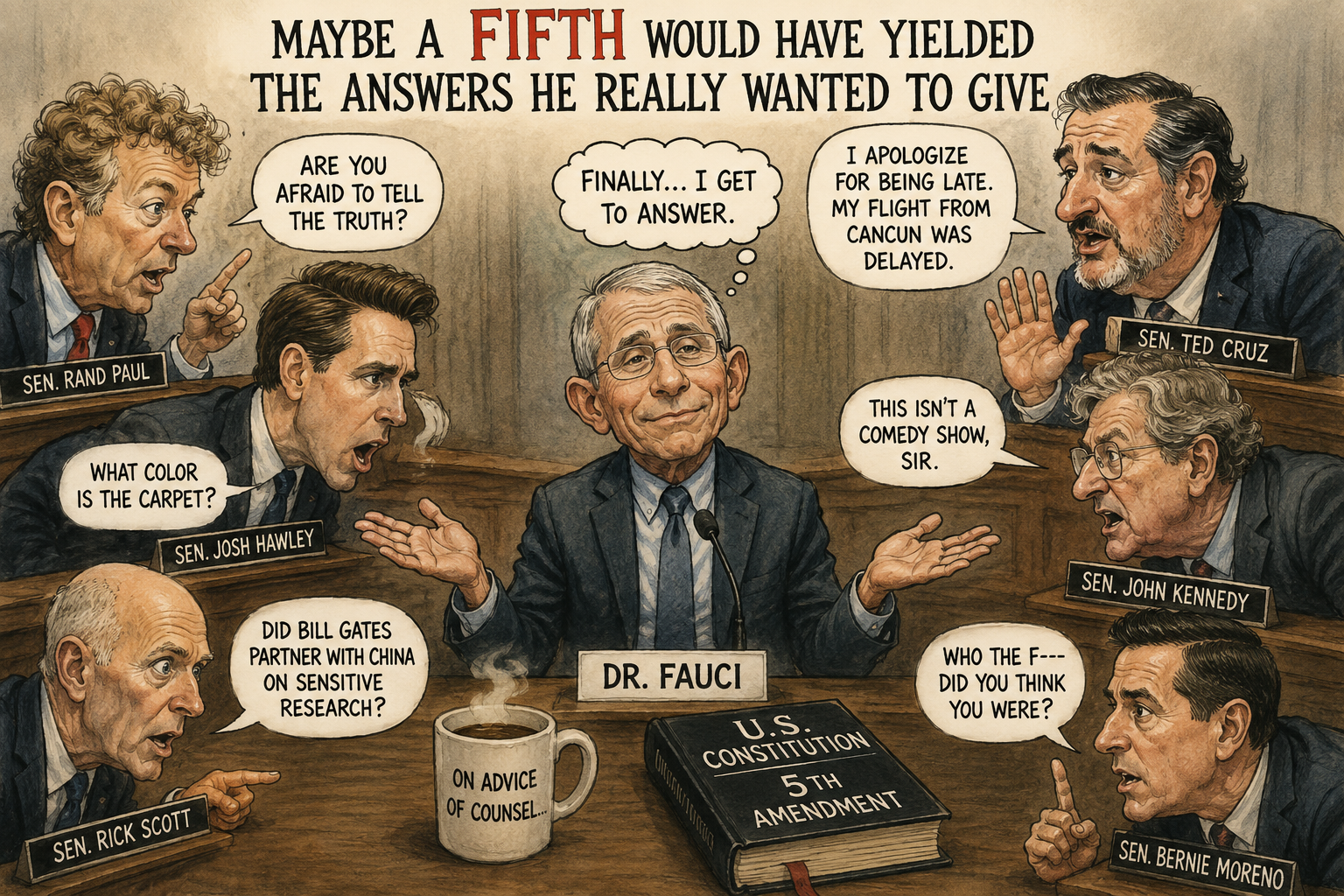
What if Dr. Anthony Fauci hadn’t taken the Fifth Amendment to every question in that televised circus they called a Senate hearing this week? What if instead of repeating the same legal sentence over and over, Fauci had answered the questions the way millions of Americans secretly wished someone would?

It might have gone something like this:

We pick it up after the curly-haired senator from Kentucky has blathered on for about 15 minutes in his opening remarks.

SEN. RAND PAUL: In 2004, you said the benefits of immunology research outweigh the risks. Do you still believe that?

DR. ANTHONY FAUCI: Do you still think the benefits outweigh the risks of having neighbors?

PAUL: Are you afraid to tell the truth?

FAUCI: I’ll tell it to Mitch McConnell.

PAUL: (exasperated) I yield to Senator Hawley.

SEN. JOSH HAWLEY: What day of the week is it?

FAUCI: The Fifth.

HAWLEY: What color is your tie.

FAUCI: On advice of counsel, I’d rather not discuss haberdashery..
HAWLEY: What color is the carpet?

FAUCI: You would know better than I would. You spent a lot of time running on it a few years ago.

HAWLEY: I must yield to Sen. Scott from Florida.

SEN. RICK SCOTT: “To your knowledge, sir, did Bill Gates partner with China on sensitive research?” 

FAUCI: Senator, I think we’d both be better off if we skipped the healthcare résumés.

SCOTT: Uh, yeah, I yield to the Honorable John Kennedy of Louisiana. This should at least be entertaining.

SEN: TED CRUZ (raising his hand): I ask to be recognized.

PAUL: Everyone recognizes you, Ted.

CRUZ: I just wanted to apologize for being late. My flight from Cancun was delayed.

PAUL: You’re excused, Ted. Now go find your own committee. We were about to hear from Senator “There’s No F in This” Kennedy.

SEN. JOHN KENNEDY: Dr. Fauci, do you owe the American people an apology?

FAUCI: Do you apologize to nuns for suggesting people seek their advice about sex?

KENNEDY: This isn’t a comedy show, sir. Were you ever wrong?

FAUCI: Constantly. That’s why they call it research instead of religion.

KENNEDY: I yield to Senator Morono, er, Moreno from Ohio.

MORENO: Dr. Fauci, do you need a new car? Oh, wait, that’s for later. Where was I … oh, yes, I thought your six-foot rule was total crap.

FAUCI: Senator, are you saying there are never circumstances when you’d rather somebody stayed six feet away?

MORENO: This isn’t about my family, doctor. This is about re-litigating 2020. Who the F— did you think you were?

FAUCI: I thought I worked for Donald Trump. 

(Looks around the room.)

You gentlemen seem to think Donald Trump worked for me.

PAUL: That’s enough. This hearing is adjourned.

FAUCI: Thank you, Mr. Chairman. Oh, and Senator Hawley, I just remembered. The carpet is yellow. It’s not alone. 

(ChatGPT-5 contributed to this column and produced the illustration.) 

See less

Leaving Ohio on a Jet Plane?

By Stuart Warner

I confess. I celebrated America’s 250th birthday in Mexico. Not very patriotic of me, I suppose, but it was a lot cooler. Both the weather and the political temperature.

At least we tried to bribe a mariachi band into playing Bruce Springsteen’s “Born in the U.S.A”. They didn’t know it. We had to settle for “Sweet Caroline,” which all of the Americans in the Mexican restaurant knew by heart.

I doubt, though, that you really care that a former Ohio journalist spent his holiday out of the country. (At least I flew coach.)

You may care a little more about where someone asking Ohioans to elect him governor reportedly spent his.

According to The Rooster, a Columbus newsletter that has taken to tracking Vivek Ramaswamy’s private jet the way bird-watchers chase rare warblers, the candidate’s Bombardier Global 5500 left John Glenn Columbus International Airport at 10:20 on the night of July Fourth and landed at Paris-Le Bourget the following morning.

Or at least the airplane did.

We don’t actually know who was aboard.

Maybe FBI Director Kash Patel borrowed it for a quick champagne run, anticipating a U.S. victory after President Trump reinstated our soccer star. Who knows

Whatever happened, I can’t complain too loudly since I was out of the country myself.

Some people, however, think the optics matter. Cincinnati Enquirer guest columnist Nick Anderson argued the reported trip reflected the kind of detachment that enormous wealth like Ramswamy’s can produce.

Personally, I can’t understand why anyone would leave the Olentangy River for the Seine, though I’m not entirely sure even the natives know how to pronounce either one.

What does Paris have that Ohio doesn’t?

The French like Grey Poupon. Ohioans prefer Bertman’s Ballpark Mustard.

Advantage: Ohio.

Paris has Notre Dame. We have Big Butter Jesus. At least we had Him, until the 62-foot statue in Monroe, Ohio, was struck by lightning and destroyed in 2010. Notre Dame was almost destroyed, too, but has subsequently reopened. I guess God thought Big Butter was just too sacred to replace and rebuilt a steel structure, Hug Me Jesus, in its place.

You can cheer the dancers at the Folies Bergere in Paris, but is that really any comparison to following the follies at the Factory of Sadness in Cleveland, where the Browns turned the Can-Can into the Can’t-Can’t.

Paris has the Louvre, but Ohio has a legislature that treats ethics as an abstract art.

While the French have their haute couture, Ohio has the finest collection of Jim Jordan’s sweat-stained, short-sleeve shirts. You’ll have to wrestle those away from him, though.

And neither the French’s Chateaubriand nor that Cincinnati Skyline stuff vaguely resemble chili.

Truth be told, though, I’m glad I spent the Fourth in Cabo instead of Cleveland. I’d probably rather spend next year’s Fourth in Paris than Parma, too. Retirement comes with certain privileges.

Running for governor doesn’t.

When you’re asking 12 million Ohioans to hire you, every parade, every county fair, every VFW picnic, every church festival is more than another campaign stop. It’s your way of saying, These are my people. This is where I belong.

That’s why the issue isn’t whether Vivek Ramaswamy had the right to go to Paris – if he even did. (Photos show he attended at least one parade before his jet took off.) The issue is whether it was the right weekend to do it.

There are 364 perfectly good days each year to fall in love with Paris.

There is only one Fourth of July.

If you want to govern the Heart of It All, that’s when you ought to spend all weekend in the heart of it.

(Stuart Warner is a former editor at the Akron Beacon Journal, The Plain Dealer in Cleveland and the Arizona Republic. ChatGPT-5 contributed to the editing of this column.)

See less

The Ballad of Jed’s Cousin Don

(You can almost imagine Jethro D. Vance swimmin’ in the cement pond)

Illustration by ChatGPT-5

With apologies to Flatt and Scruggs I present:

“The Ballad of Jed’s Cousin Don”

Come and listen to my story ’bout a man named Trump,
Said the pool by his house looked like a D.C. dump.
Then one day he decided to paint it blue,
And suddenly he’d turned our water into goo.
(Algae, that is. Pond scum. Green slime).

Well, the billionaires arrived to see what they could do.
One suggested silver flakes, one suggested glue.
RFK Jr.: “Ivermectin oughtta do the trick,”
But the algae just got thicker and the smell got mighty sick.
(Algae, that is. Pond scum. Green slime).

Trump blamed the mess on Democratic vandals,
But after Epstein, he needed no more scandals.
There were more arrests and arguments of state,
But before too long the papers were callin’ it …

Water Gate.
(Cover-ups, that is. Dirty tricks. Pond politics)
Y’all come back now, ya hear? 

Project 8626: Fishing for (the Right) Voters

By Stuart Warner

I was sitting at the end of the bar at our local hangout, not sure if I wanted another drink or a better explanation of the world.

My pal Wired Al InCognito dropped a folded packet between us.

“Don’t,” I said.

“You haven’t even looked at it.”

“I’ve looked at enough documents.”

He smiled. “That’s what you said about the last one.”

I opened it anyway.

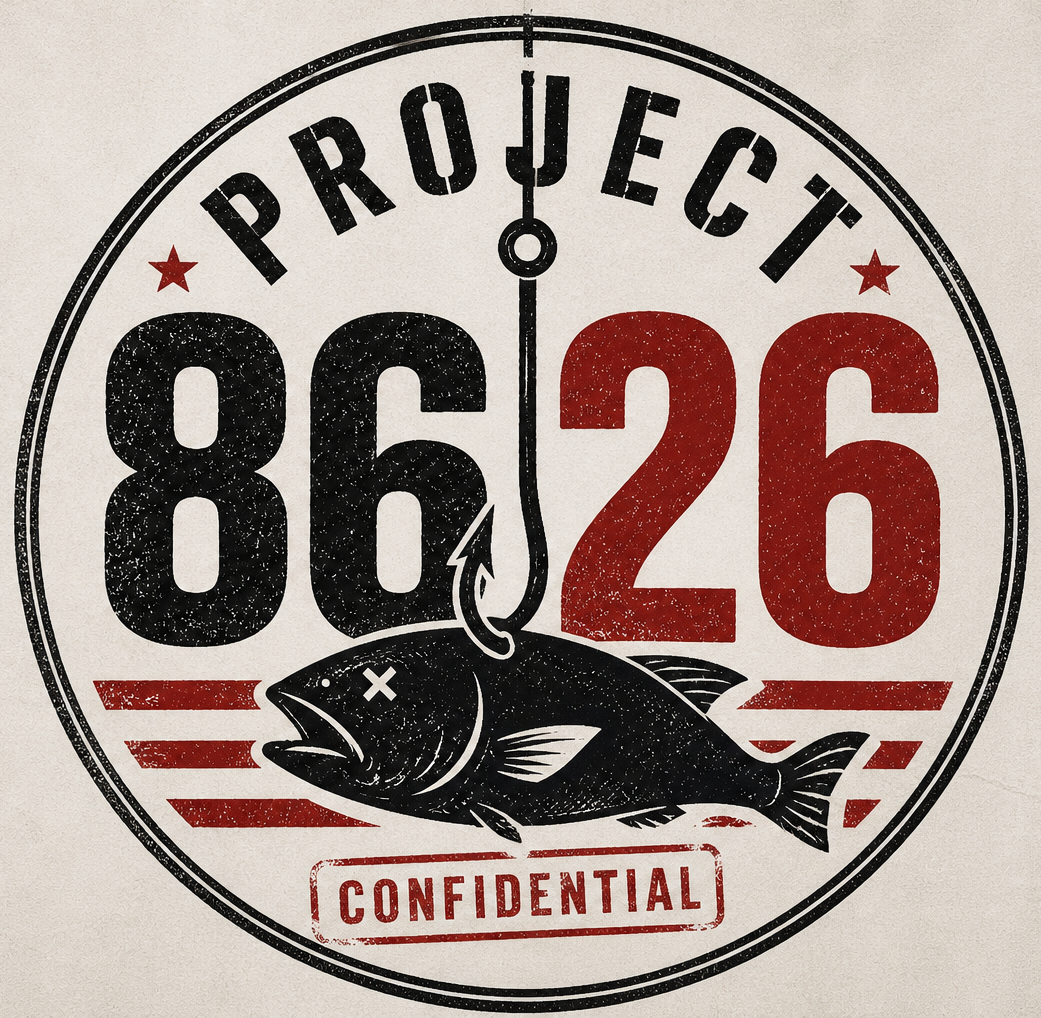
Project 8626.

“Where’d you get this?” I asked.

“Friend of a friend of an enemy of a friend,” he smiled.

“Nope,” I said, starting to fold it back up. “We’re not getting worked up again like we did over Project 2025.”

“We didn’t do anything last time,” Al said. “We read it. Nobody else did.”

“So what’s this supposed to mean, anyway? The Republicans have a grand plan for the year 8626? I don’t think even Trump can live that long.”

Al shook his head. “Don’t you know what ‘86’ means, paisan? In mob movies, ‘86’ is slang for getting rid of someone – eliminating them.”

“I’ve seen The Godfather at least 10 times and Goodfellas five,” I said. “Don’t remember hearing  that number.”

“It’s not a number,” Al said. “It’s a command. Get rid of this mug. Eighty-six him.”

The bartender interrupted us. “Couldn’t help but overhear you guys. In restaurants, we use ‘86’ to mean we’re out of something – like fish, for example.”

“See,” Al said, grinning. “It means go sleep with the fishes.”

I couldn’t suppress a chuckle. “So the Republicans are going to get rid of the number 26.”

He glared at me. “The ’26 elections, dummy.”

That stopped me for a moment.

“Voting rights?” I said.

Al nodded. “You saw what the Supreme Court did this week.”

I started flipping through the document, stopping at a section titled “Getting Out the Vote.” It went on about how minorities and women shouldn’t have special voting rights. How race shouldn’t determine congressional district boundaries. How you should have to register under your name and sex assigned at birth. And maybe how we should even suspend primaries until their new rules are set.

“We used to talk about access for all,” I said.

“Back when the Voting Rights Act of 1965 was the point,” Al said.

“This feels different,” I said.

“How?”

“Less about getting people to vote,” I said. “More about making sure everything lines up once they do.”

Al raised his glass. “Now you’re getting it.”

I kept reading.

There was a section about authority. Another about providing security at the polls. Voter IDs to prevent rampant fraud.

“Funny thing,” I said.

“What?”

“There’s at least one justice up there who probably doesn’t get that robe if the Voting Rights Act doesn’t exist.”

“And he’s the loudest voice behind this,” Al said.

The tall, lanky guy two stools down gave a knowing laugh.

“Yeah,” he said. “That’s not irony. That’s efficiency.”

I closed the packet halfway.

“This is the same playbook.”

Al shook his head. “No.”

“What?”

“It’s cleaner,” he said. “Less explaining. Besides, they’ve already done most of the stuff they said they’d do to us in the first one.”

“You’re saying this is the next version.”

“I’m saying they don’t need to write it all down anymore. The court is doing that for them.”

The guy two stools down raised his glass.

“You guys still think this is about stopping elections,” he said.

There was something about the way he said it – calm, precise – like he was used to being listened to.

“It’s not,” he said. “It’s about controlling everything around them.”

I turned to look at Al, as if to say, “Who is this guy.” Then I turned back.  The stranger was gone.  He glass was empty.

I stared at the packet, pushed it back across the bar toward Al.

“So what do we do?”

“Same as last time,” Al said.

“Which was?”

“Read it. Write it. Explain it.”

“And when nobody believes it because the president says he knows nothing about it?”

Al smiled.

“Then we’ll be right again later.”

We sat there watching the game, arguing about whether the digital umpire got that strike right.

“The people in Hungary showed us that voting still matters,” I said.

“Yeah? They realized what was at stake. Do we?”

“Maybe,” I said.

Al sat quietly for a moment. Then he looked back and me.  It was no joke this time when he said:

“If we don’t, democracy may be sleeping with the fishes.”

(Note: Project 8626 isn’t real.  Yet.  ChatGPT-5 assisted in writing this column.)

“Boss Donald … He Take the Oil and Ran Venezuela”


We need something to make us happy right now so I asked my digital pal Wired Al if we could collaborate on song that could get us tapping our toes. When oil starts moving and explanations start dancing, it’s usually time to listen to the music.

This week’s melody comes courtesy of calypso, a genre designed in places where power strutted in uninvited, taking what it wanted. That tradition runs straight through Harry Belafonte, whose cheerful songs were often about theft, betrayal and the kind of authority that laughs while picking your pocket.

Fast-forward to now, where foreign policy increasingly sounds like a real estate pitch delivered through a bullhorn. Venezuelan oil is rebranded as a strategic necessity. Greenland becomes a punch line that won’t die. Colombia and Mexico are name-checked the way middle managers talk about “synergy” – vaguely, loudly, and with complete confidence that someone else will clean it up. None of this is framed as conquest. It’s framed as leadership. Boss moves. Executive decisions made while the band plays on.

Which brings us to the song. Belafonte’s Matilda, which was a folk tale about a thief who ran off with the money. But theft, like everything else, has been promoted. Today it wears a suit, demands applause, and insists the chorus keep singing.

So sing along with Harry and Wired Al on the chorus of Boss Donald.

OPENING CHORUS

ALL (cheerful, loud):

Boss Donald … Boss Donald … Boss Donald
He take the oil and ran Venezuela.

Once again now!

Boss Donald …  Boss Donald … Boss Donald,
He take the oil and ran Venezuela

VERSE 1 — GOOD INTENTIONS

Five hundred slogans, friends, I lost:
“Energy freedom” – cheap words, high cost.

LEAD (grinning):
Boss Donald –

ALL:                                                         
He take the oil and ran Venezuela.

Everybody now ..

(Boss Donald!) Sing out the chorus!
(Boss Donald!) Sing a little louder!

ALL:
Boss Donald, he take the oil and ran Venezuela


VERSE 2 — EMPIRE SHOPPING

Well, the oil was to buy  “strength and pride,”
A house, a flag, a border wide.

Said, “Trust me, friends, I have a plan,”
Then waved a pen, said, “Watch out,  Iran.”

ALL:
Boss Donald, he take the oil and ran Venezuela


GREENLAND BREAK (classic calypso aside)

CROWD (shouting):
Can we have Greenland?

LEAD (matter-of-fact):
Not for sale.

ALL (right back to melody):
Boss Donald, he take the oil and ran Venezuela.


VERSE 3 — LEGAL MAGIC

Well, the oil was just inside our bed,
In “strategic reserves,” the lawyers said.

Buried deep in a footnote thread—
Stamped temporary, signed, unread.

LEAD:
Don’t you know—

ALL:
Boss Donald, he found the oil and…

EVERYBODY:
Ran Venezuela!


RHYTHM CHANT

(Boss Donald!) Oom-ba-locka-chimba!
(Boss Donald!) Bring me talking points!

Boss Donald, he take the oil and ran Venezuela

VERSE 4 — CONSEQUENCES, MINIMIZED

Well, me friends, never to ask again,
All me norms gone down the drain.

He may want Mexico, too.
Colombia: We’re watching you.

ALL:
Boss Donald, he take the oil and ran Venezuela

FINAL BUILD (soft → loud)

ALL (soft):
Boss Donald…
Boss Donald…
Boss Donald…

He take the oil and ran Venezuela.

Sing it softer now…

Boss Donald, Boss Donald, Boss Donald,
he take the oil and ran Venezuela


BIG FINISH

EVERYBODY (full voice):
Boss Donald ,… sing out the chorus!
Boss Donald, he take the oil and ran Venezuela!

CROWD (last shout):
Can we have Greenland?

LEAD
Still not for sale.

BAND CRASH. END.

Of course, you music historians know that calypso didn’t start as entertainment. It started as information, originating in Trinidad and Tobago in the 18th and 19th centuries among enslaved Africans. When colonial authorities banned drums and restricted speech, people did what humans always do under pressure: they found another channel. Rhythm replaced the drum. Melody replaced the shout. Lyrics carried news, warnings, insults and political commentary in plain sight, disguised as song.

And it’s appropriate today because Trinidad and Tobago are the southernmost Caribbean nations, just off the Venezuelan coast.

Perfectly placed to see empire coming before it arrived.

Boss Donald …  he take the oil and ran Venezuela.

(Chat GPT-5 produced the illustration and collaborated on the column.)

It Was Just One of Trump’s Things


By Stuart Warner and Al InCognito

Donald Trump packed a whole news cycle’s worth of contempt into 48 hours this week.

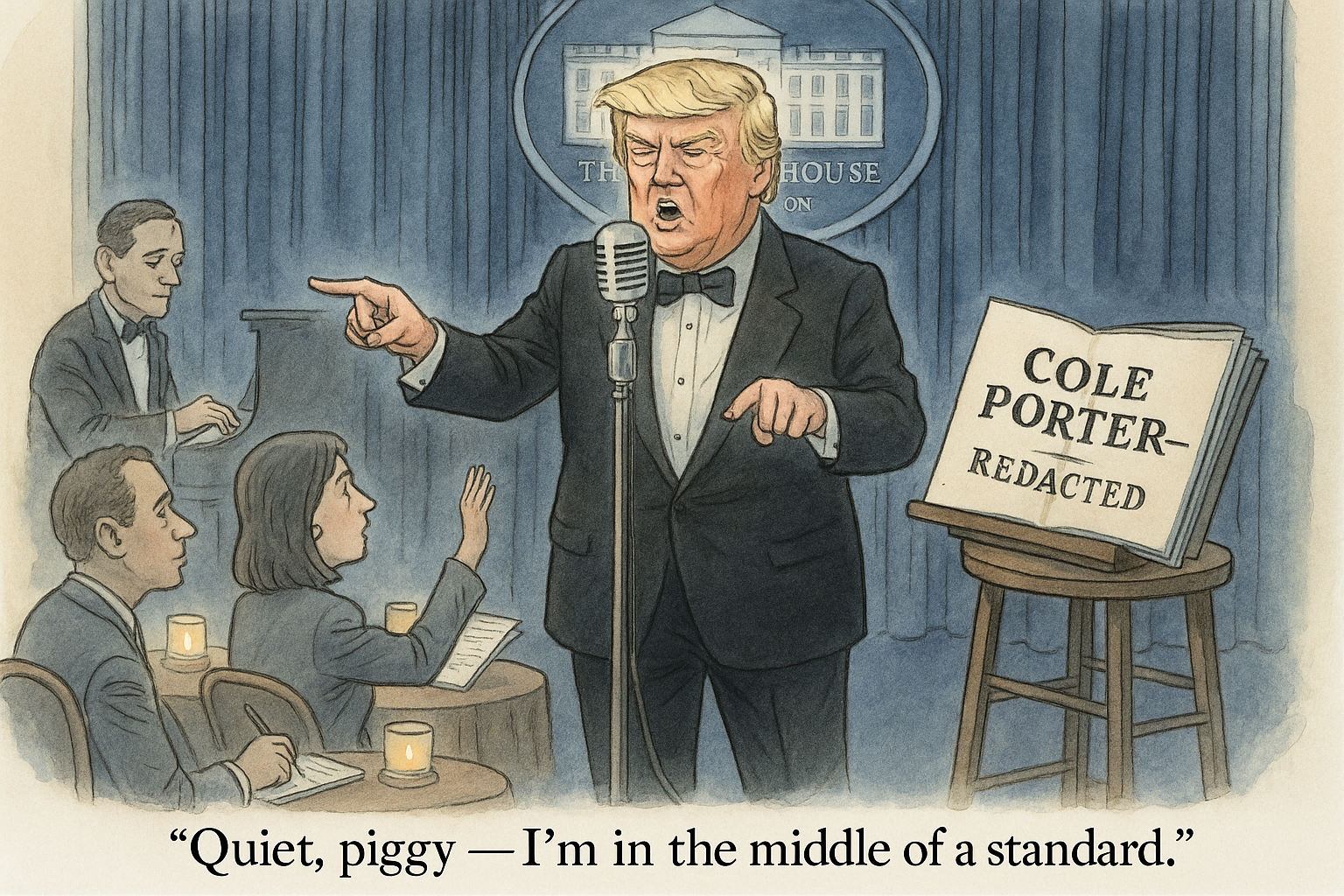
At a Bloomberg reporter questioning him about the Epstein files, he squealed: “Quiet. Quiet, piggy.”

At ABC’s Mary Bruce, who asked the Saudi crown prince about Jamal Khashoggi’s bonesaw murder, he fumed that she’d posed a “horrible, insubordinate, terrible question.”

And the murder itself? He brushed it aside with a shrug worthy of a man excusing a late FedEx delivery: “Things happen.”

Things happen?

He delivered that line with the jaunty air of a man humming show tunes — you could almost hear Cole Porter in the background, It Was Just One of Those Things, horrified but faintly in rhythm.

Which inspired me to score this week’s headlines in the only key this president seems to understand.


 “JUST ONE OF THOSE THINGS (2025 VERSION)”

A Cole Porter Parody for a President Who Thinks Murder Is a Mood

Opening Verse

It was just one of those things,
Just one of those crisp little stings,
A murder was mentioned? He shrugged off the zings—
Just, just, just … one of those things.

She just asked what the Epstein files bring,
A standard reporter-type thing,
But he replied with a flip, feathered fling—
“Quiet, piggy,” he sings.

A reporter called “insubordinate,” too,
Simply for doing her due—
Pressing the prince for an answer he knew—
Just one of those things.

Asked about Saudis and blame,
Trump waved off the whole bloody shame—
“Things happen,” he said, it’s all the same—
It was just a murder-ring.

Counter-Chorus: The Ladies Reply

We’re the ladies he calls “piggy,”
When the questions get too biggy,
When the facts are looking jiggy
And his temper starts to whine.

We’re the dames he calls “insub-’nate,”
For a query he deems too great—
But we’ve filed on worse than room-temp hate,
So darling, we’re doing fine.

If he sneers we’re “not obedient,”
Or our presence “inconvenient,”
We’ll just file it as expedient—
A quote for tomorrow’s lead.

For we learned long ago, sugar,
Nothing rattles like a boor, sugar—
And the truth, when we report, sugar,
Is the only song we need.

Finale

So let’s toast those Oval zings,
Those “terrible person” flings,
When he shrugs off a murder as next to nothing—
It was just one of those things,

Just one of those crazy Trump things.

Trump may think cruelty is performance, timing is policy, and assassination is a housekeeping issue. But there’s nothing musical about a leader who treats reporters as props, women as targets, and murder as a mood.

Cole Porter wrote about romance, regret, and the complicated grace of human folly. Trump offers none of those things — just the easy indifference of power and the shrug of someone who believes accountability is for other people.

And yet he’s right about one thing:

Things do happen. Especially when leaders forget that words have consequences — and voters decide they’ve had just about enough of this particular song

(ChatGPT-5 contributed to the editing of this column and created the illustration.)

Trump’s Ballroom Blitz: Wrecking Our House, One Wing at a Time

Melania’s gone missing, the plaster’s flying, and Rudy’s toupee never stood a chance.


By Al InCogito and Stuart Warner

WASHINGTON — The last time “Ballroom Blitz” blasted across America, Nixon was in the White House and polyester was a political statement. Now the song’s back  —  only this time, the ballroom’s real and the blitz is happening at 1600 Pennsylvania Avenue.

They’re calling it “renovation,” but from where I’m standing it looks more like an East Wing Blitz. Bulldozers at dawn. Curtains flapping like surrender flags. One aide says the goal is “a return to traditional values.” Another says the gold leaf’s already on order.

Trump, beaming in a hard hat that matches his tie, shouts into the camera: “We’re gonna open this place up! Make room for the People’s Ballroom! Everyone’s invited — except, you know, the people.”

Somewhere a band starts tuning up. It’s not democracy’s funeral march; it’s Sweet’s glam-rock classic from 1973, revived for “Wayne’s World.” Only now the lyrics have changed.


East Wing Blitz

(to the tune of “Ballroom Blitz” by Sweet)

[Intro]
Are you ready, D.C.?
A-one, a-two, a-you-know-who!


[Verse 1 – The Demolition Man]
He’s wearin’ a hard hat, swingin’ his fists,
Yellin’, “I built it all, now I’m wreckin’ this!”
Reporters scatter as the marble cracks —
“Get the cameras rollin’, I’m takin’ it back!”

[Pre-Chorus]
And the crowd starts yellin’,
And the bricks start smellin’ of gilt and spray-tan mist —

[Chorus 1]
And the White House shakes! (shakes!)
And the Trump tape plays! (plays!)
And the MAGA hats catch the rays —
It’s the East Wing Blitz!
Yeah, the East Wing Blitz!


[Verse 2 – Melania Missing]
Well the dust starts flyin’ and the walls cave in,
There’s gold leaf glitterin’ in the wind,
Where’s the lady with the frozen grin?
She’s long gone-ya — Melania!

Packed her bags for Mar-a-Lago,
Left a note that said, “I told you so.”
Now the bulldozers roll in rows —
Say goodbye to the East Wing show!

[Pre-Chorus 2]
And the interns scatter,
And the chandeliers shatter,
And the Secret Service checks their lists —

[Chorus 2]
’Cause the walls all quake! (quake!)
And the spin can’t fake! (fake!)
And the headlines start to break —
It’s the East Wing Blitz!
Oh yeah, the East Wing Blitz!


[Bridge – Trump Solo Breakdown]
He says, “We’re renovatin’ bigly, folks, it’s art!”
(“Sir, that’s a historical part …”)
“Fake news! I own this place, okay?”
Then the ceiling falls on Rudy’s toupee.


[Final Chorus & Tag]
And the press corps shakes! (shakes!)
And the truth outrakes! (aches!)
While the band keeps playin’ his greatest mistakes —
It’s the East Wing Blitz!
The East Wing Blitz!

Yeah, the plaster flies, the columns split —
Has anybody seen Melania yet?
(Has anybody seen Melania yet?)
It’s the East Wing Blitz!
The East Wing Blitz!

When the amps fade, the rubble still smolders and the nation hums the chorus under its breath. Another day, another building down, another slogan up.  And somewhere behind the caution tape, a lone staffer whispers the only truth that fits the rhythm:

“Democracy isn’t dead — it’s just under renovation.”

The Escalator’s Broken but the Show Still Goes On

· 

By Stuart Warner and Al InCognito

The news sounds more like a carnival these days, so with apologies to Neil Diamond,’s “Brother Love’s Travelin’ Salvation Show,” let’s all sing along to

Dr. Trump’s Travelin’ Epstein Sideshow

Hot September night, the lights hanging down,
Reporters all circling, like dogs for a treat.

The Big Top flaps by the edge of town,
Grooving to the bop of Kid Rock’s beat.

Step right in where the spotlights glow,
Welcome to Dr. Trump’s Epstein Sideshow.

It’s Trump, Dr. Trump, say —
Dr. Trump’s Travelin’ Epstein Sideshow (it’s now my party),
Pick up the babies and grab the young ladies,
And everyone goes — ‘cause everyone knows Dr. Trump’s show.


The room gets suddenly still and when you’d almost bet
You could hear yourself sweat, he walks in.
The escalator’s broke, but he still takes the mic,
“Don’t take a-seat-a-min-uh-foin,” he cries.
“Trust me instead, though I can’t spell why.
Skip the safe pill, try bleach or the worm paste.”
Epstein’s ghost nods — “fear has no taste.”

Every ear in the place is on him,
Starting soft and slow like a small earthquake.
And when he lets go, half the Congress shakes.

It’s Trump, Dr. Trump say —
Dr. Trump’s Travelin’ Epstein Sideshow (it’s still my party),
Pick up the babies and grab the young ladies,
And everyone goes …


He thundered at Kimmel, “You’re finished, you’re through!”
But the ratings shot higher — a punchline or two.
And back of the tent, where the dark truths reside,
Epstein still whispers — “enjoy the ride.”

The crowd chants louder, the spotlight’s bright,
But the shadows rule the darker night.
It’s Trump, Dr. Trump say,
Dr. Trump’s Travelin’ Epstein Sideshow.


Chorus (call-and-response)
Hallelujah, brothers (halle-hallelujah),
Reach out your hands (for the contribution jar).
Hallelujah, brothers (halle-hallelujah),
Epstein’s still there, though they sayi he’s afar.


Finale
Take my hand in yours, walk with me this day,
But don’t check the logs or the names, just pray.
In my heart I know, we will never stray,
‘Cause the tent stays packed till the lies decay.

It’s Trump, Dr. Trump, say —
Dr. Trump’s Travelin’ Epstein Sideshow!

(ChatGPT-5 contributed to writing and editing of these parody lyrics and produced the illustration.)