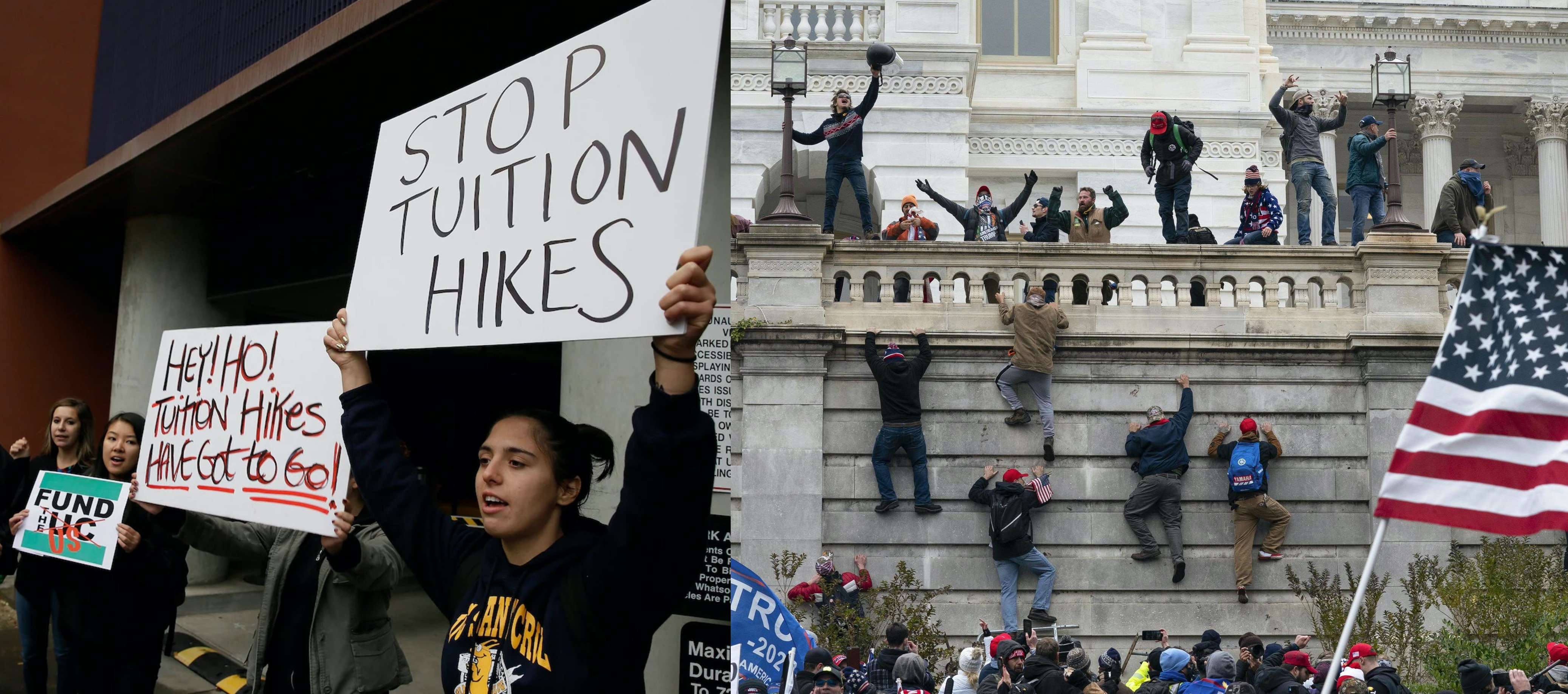
Trump’s First Amendment: Some Assembly Required (if He Approves)


Criminal protesters on the left, freedom fighters on the right (always on the right)

By Al Incognito (and ChatGPT)

In his previous life, President Donald Trump was a developer, constructing tall buildings that drove him into bankruptcy.  Now he’s bringing his talents to renovating the First Amendment.

Not a minor remake, mind you. No new coat of paint. We’re talking about a full-scale gut job. Walls are being knocked down. The plumbing is being ripped out. The free speech wing? Condemned. The protest clause? Bulldozed. The new blueprint? If you’re protesting something President Trump doesn’t like, you’re out. If you’re protesting something he does like, congratulations, you’re an American hero.

This morning, Trump issued an edict on Truth Social.  (We can’t say for certain whether this was before or after his constitutional on the  throne in the state secrets reading room at Mar-a-lago.)

The former president—now president again (because democracy is quirky like that)—has declared that federal funding for any college, school or university that “allows illegal protests” will be revoked. “Agitators,” as he calls them, will be thrown in jail or deported. American students? Expelled. Arrested. Packaged up like Amazon returns. (More profits for Jeff Bezos.)  

And he warned in capital letters, “NO MASKS.”

Why no masks? Because in Trump’s America, the only thing worse than an illegal protest is an illegal protester with good respiratory health.

Now, if you’re wondering what qualifies as an “illegal protest,” the answer is simple: It’s whatever Trump says it is.

Storming the U.S. Capitol and smashing windows while chanting about hanging the vice president? Not an illegal protest. That’s a patriotic gathering of misunderstood folks who just love their country with a little too much enthusiasm. But students holding up signs demanding social justice in Gaza? Anarchy. Treason. Grounds for exile.

The irony is rich, of course. Trump, who built much of his political persona around the idea of resisting the so-called “deep state,” now positions himself as the enforcer of federal obedience. The man who celebrated trucker protests in Canada and hailed Capitol rioters as heroes now wants to make sure no one rocks the boat—unless it’s in the direction he likes.

But Trump’s crackdown isn’t just limited to protesters. He’s taking the same approach to our neighbors. Today, Canadians and Mexicans are learning that when you don’t play by Trump’s rules, we’re going to make our citizens pay more for Molson’s and Modelo. Free trade? That was so pre-2016. Now it’s all about tribute and tariffs. If allies want access to the American market, they better bend the knee. Otherwise, they’ll be slapped with penalties  faster than a protester at a college rally.

And if you think Trump is only targeting students and trade partners, just ask Volodymyr Zelensky what happens when you don’t wear a suit to the White House. The Ukrainian president has spent years trying to defend his country from a Russian invasion, only to be mocked and dismissed by Trump, who has repeatedly called him “weak” and suggested he should just cut a deal with Putin.

Apparently, fighting for democracy isn’t enough to earn Trump’s respect. Maybe Zelensky should have stormed his own parliament, broken a few windows and taken a dump in an MP’s office.  Trump would have called him a freedom fighter and issued him a pardon.

The message is clear: standing up to Trump—or his allies—gets you nothing. Kowtowing, on the other hand? That’s the ticket.

Some of us disagree (we’re not protesting, mind you, we’re too old for jail) with Trump’s tactics. We liken them  to Vladimir Putin’s Russia. Certainly, it seems Trump is mimicking Putin’s playbook: control the narrative, criminalize opposition and redefine who counts as a patriot. Political opponents are labeled as foreign agents. Protesters are jailed under vague “extremism” laws. Free speech is a privilege, not a right, and it’s only granted to those who toe the party line.

But we’re wrong.  That’s not Russia. That’s the Soviet Union.

Is that where you want to live? (At least eggs were cheap.)

Project 2025, Chapter 4: More Money for the Military, Less ‘Wokeness’

(This is the fifth in a series of AI-generated analyses of the right-wing manifesto “Project 2025: Mandate for Leadership, the Conservative Promise.“)

Section 2 of the conservative manifesto “Project 2025: Mandate for Leadership,” Common Defense, offers a conservative perspective on the state of the U.S. military and proposes significant reforms. We begin with an examination of Chapter 4: Department of Defense.

Military ‘Wokeness’: A Contested Issue

The document defines “wokeness” as initiatives promoting diversity, equity, and inclusion (DEI) within the military. It argues that these efforts undermine military effectiveness by:

  • Prioritizing social agendas over warfighting capabilities.
  • Weakening unit cohesion and morale.
  • Diverting resources from readiness.

However, the document doesn’t provide concrete evidence for these claims. There’s ongoing debate about the impact of DEI programs on military effectiveness. Whether social policies are harming the military is a complex issue. There have been concerns that issues like gender integration could hurt unit cohesion, but studies have shown mixed results. It’s important to note that the military itself has embraced diversity efforts in recent years. In 2021, the Chairman of the Joint Chiefs of Staff stated that diversity is “absolutely essential” to military readiness.

Focus on China and Increased Spending

The document prioritizes China as the primary threat and proposes significant increases in defense spending. Here’s a breakdown of the key arguments:

  • China’s Military Buildup: The document highlights China’s rapid military modernization, including nuclear weapons expansion. It argues for a “denial defense” to prevent China from seizing Taiwan or other strategic territories.
  • Need for Modernization: The author believes the U.S. military lags in key areas like technology and needs more resources to compete with China.
  • Burden-Sharing: The document calls for increased defense spending by U.S. allies to lessen the burden on American taxpayers.

These arguments raise important questions:

  • Cost of Increased Spending: The financial feasibility of a significant spending increase is a major concern. Would it come at the expense of other essential programs?
  • Focus on China: While China is a major power, should other threats like terrorism and regional conflicts be neglected?
  • Effectiveness of “Denial Defense”: Can a purely defensive strategy deter China or would a more nuanced approach be necessary?

But again, the need for increased military spending is another complex issue. The US already spends more on its military than any other country in the world, and some argue that this spending is wasteful or inefficient. Others argue that the US needs to spend more to counter growing threats from China and Russia.

Critique of the Acquisition Process

The document criticizes the slow and inefficient process of acquiring new military equipment. It proposes reforms to:

  • Streamline decision-making to speed up the procurement process.
  • Encourage innovation and collaboration with the private sector.
  • Replenish depleted stockpiles of weapons and ammunition.

These are valid concerns. Delays and bureaucratic hurdles can hinder military readiness. However, the document doesn’t address potential drawbacks of faster acquisition, such as overlooking potential flaws in new technologies.

Conclusion

Project 2025’s chapter on the Department of Defense presents a conservative viewpoint on military reform. The document raises important questions about “wokeness” and defense spending, but its arguments lack nuance and require further evidence. It offers a valuable critique of the acquisition process but doesn’t fully explore the potential consequences of proposed solutions. A comprehensive assessment of the U.S. military requires considering diverse perspectives and conducting a thorough cost-benefit analysis before implementing major reforms.

Scary Quotes

“Reverse policies that allow transgender individuals to serve in the military. Gender dysphoria is incompatible with the demands of military service, and the use of public monies for transgender surgeries or to facilitate abortion for service members should be ended.”

“Reinstate service members to active duty who were discharged for not receiving the COVID vaccine, restore their appropriate rank, and provide back pay.” (In other words, hire back soldiers who refused direct orders.)

About the Author

Christopher Miller, who, after a brief stint as acting secretary of defense under Donald Trump, wrote a memoir in which he asserted that our military is “bloated and wasteful” and argued that we could “cut our defense budget in half and it would still be nearly twice as big as China’s,” according to The Nation.  You can read the entire article here.

Read the Entire Series

Reject Project 2025

Read the Entire Document Here (If You Dare)

2025_MandateForLeadership_FULL.pdf