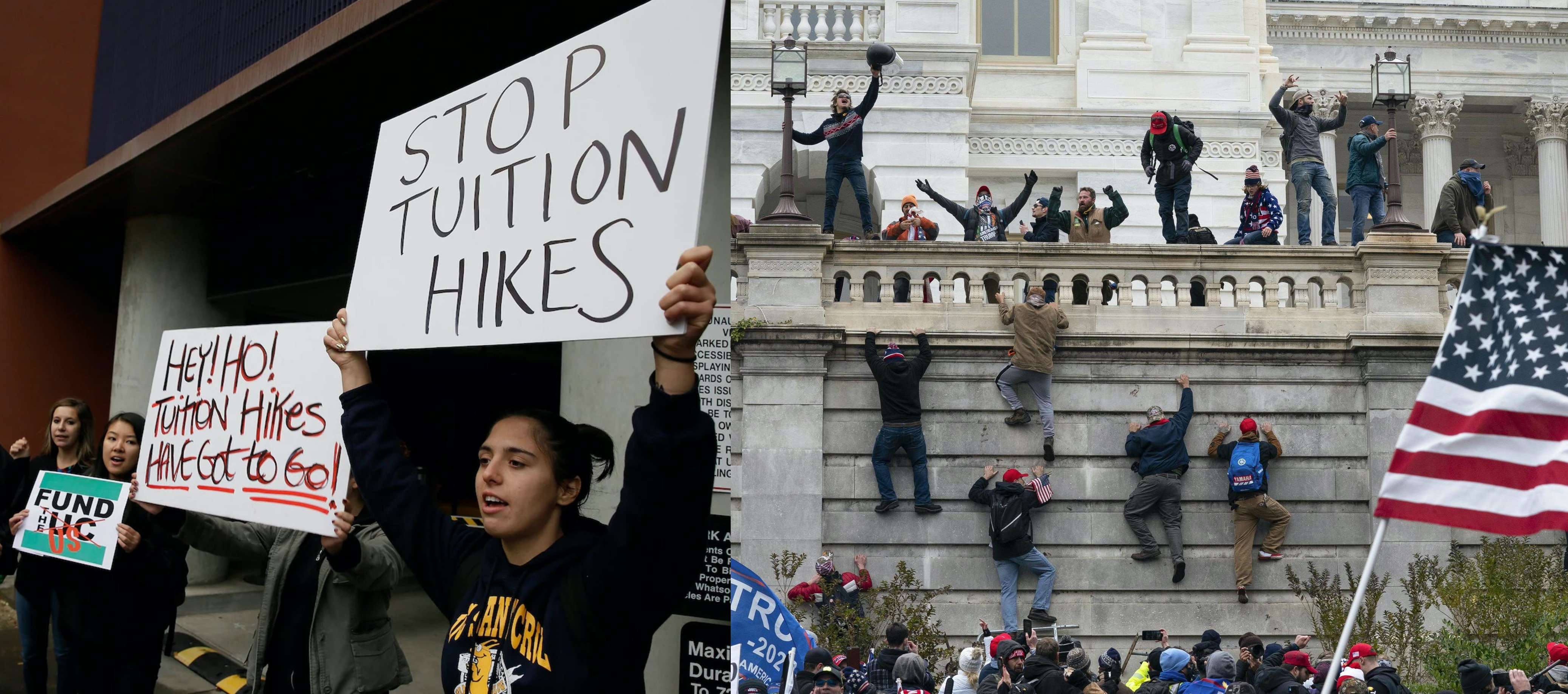
Criminal protesters on the left, freedom fighters on the right (always on the right)
By Al Incognito (and ChatGPT)
In his previous life, President Donald Trump was a developer, constructing tall buildings that drove him into bankruptcy. Now he’s bringing his talents to renovating the First Amendment.
Not a minor remake, mind you. No new coat of paint. We’re talking about a full-scale gut job. Walls are being knocked down. The plumbing is being ripped out. The free speech wing? Condemned. The protest clause? Bulldozed. The new blueprint? If you’re protesting something President Trump doesn’t like, you’re out. If you’re protesting something he does like, congratulations, you’re an American hero.
This morning, Trump issued an edict on Truth Social. (We can’t say for certain whether this was before or after his constitutional on the throne in the state secrets reading room at Mar-a-lago.)
The former president—now president again (because democracy is quirky like that)—has declared that federal funding for any college, school or university that “allows illegal protests” will be revoked. “Agitators,” as he calls them, will be thrown in jail or deported. American students? Expelled. Arrested. Packaged up like Amazon returns. (More profits for Jeff Bezos.)
And he warned in capital letters, “NO MASKS.”
Why no masks? Because in Trump’s America, the only thing worse than an illegal protest is an illegal protester with good respiratory health.
Now, if you’re wondering what qualifies as an “illegal protest,” the answer is simple: It’s whatever Trump says it is.
Storming the U.S. Capitol and smashing windows while chanting about hanging the vice president? Not an illegal protest. That’s a patriotic gathering of misunderstood folks who just love their country with a little too much enthusiasm. But students holding up signs demanding social justice in Gaza? Anarchy. Treason. Grounds for exile.
The irony is rich, of course. Trump, who built much of his political persona around the idea of resisting the so-called “deep state,” now positions himself as the enforcer of federal obedience. The man who celebrated trucker protests in Canada and hailed Capitol rioters as heroes now wants to make sure no one rocks the boat—unless it’s in the direction he likes.
But Trump’s crackdown isn’t just limited to protesters. He’s taking the same approach to our neighbors. Today, Canadians and Mexicans are learning that when you don’t play by Trump’s rules, we’re going to make our citizens pay more for Molson’s and Modelo. Free trade? That was so pre-2016. Now it’s all about tribute and tariffs. If allies want access to the American market, they better bend the knee. Otherwise, they’ll be slapped with penalties faster than a protester at a college rally.
And if you think Trump is only targeting students and trade partners, just ask Volodymyr Zelensky what happens when you don’t wear a suit to the White House. The Ukrainian president has spent years trying to defend his country from a Russian invasion, only to be mocked and dismissed by Trump, who has repeatedly called him “weak” and suggested he should just cut a deal with Putin.
Apparently, fighting for democracy isn’t enough to earn Trump’s respect. Maybe Zelensky should have stormed his own parliament, broken a few windows and taken a dump in an MP’s office. Trump would have called him a freedom fighter and issued him a pardon.
The message is clear: standing up to Trump—or his allies—gets you nothing. Kowtowing, on the other hand? That’s the ticket.
Some of us disagree (we’re not protesting, mind you, we’re too old for jail) with Trump’s tactics. We liken them to Vladimir Putin’s Russia. Certainly, it seems Trump is mimicking Putin’s playbook: control the narrative, criminalize opposition and redefine who counts as a patriot. Political opponents are labeled as foreign agents. Protesters are jailed under vague “extremism” laws. Free speech is a privilege, not a right, and it’s only granted to those who toe the party line.
But we’re wrong. That’s not Russia. That’s the Soviet Union.
Is that where you want to live? (At least eggs were cheap.)
Actions taken by the Trump administration in 2025 and the policy recommendations outlined in Project 2025: Mandate for Leadership, compiled by ChatGPT using “All of the Trump Administration’s Major Moves” and “Project 2025: Mandate for Leadership,” a 900-page document compiled by dozens of Trump loyalists through the Heritage Foundation.
1.Federal Workforce Reduction
Trump Administration Action:
Ordered mass firings at the Pentagon, laying off 5,400 civilian workers.
Directed plans for large-scale federal workforce cuts, expanding Elon Musk’s authority over hiring decisions.
Laid off thousands of employees across multiple agencies, including the IRS, Education Department, and USAID.
Project 2025 Recommendation:
Advocates for reducing the size of the federal government and curbing the administrative state.
Calls for appointing personnel aligned with conservative values to implement these reductions.
Source: Chapter 18, Dept. of Labor and Related Agencies
2.Restructuring USAID
Trump Administration Action:
Fired thousands of USAID employees and moved to dismantle the agency.
Put Secretary of State Marco Rubio in charge of USAID, signaling a shift in its mission.
Project 2025 Recommendation:
Criticizes USAID as an overly bureaucratic agency that should be restructured or eliminated
Source: Chapter 9, Agency for International Development.
3. Rolling Back Diversity, Equity, and Inclusion Initiatives
Trump Administration Action:
Ordered the removal of pronouns from federal employee email signatures.
Ended race-based programs in education.
Project 2025 Recommendation:
Calls for dismantling DEI programs across government institutions and schools.
Source: Chapter 18, Department of Labor and Related Agencies
4. Immigration and Border Policy
Trump Administration Action:
Revoked deportation protections for Venezuelans.
Transported migrants to Guantánamo Bay.
Project 2025 Recommendation:
Advocates for stricter border security and detention policies.
Source: Chapter 5, Department of Homeland Security
5. Trade and Tariffs
Trump Administration Action:
Imposed 25% tariffs on steel and aluminum.
Announced new “reciprocal” tariffs based on foreign trade practices.
Project 2025 Recommendation:
Calls for aggressive trade policies to counter foreign economic threats.
Source: Chapter 26, Trade
6. Health Policy Changes
Trump Administration Action:
Blocked funds for biomedical research.
Ordered the Health Department to scrutinize vaccine schedules and psychiatric medications.
Project 2025 Recommendation:
Calls for re-evaluating funding for health programs, particularly those linked to progressive policies.
Source: Chapter 14, Department of Health and Human Services
7. Reshaping the Intelligence Community and Law Enforcement
Trump Administration Action:
Planned a purge of FBI employees involved in January 6 investigations.
Appointed a right-wing commentator as FBI deputy director.
Project 2025 Recommendation:
Suggests replacing FBI and intelligence officials with personnel aligned with conservative priorities.
Source: Chapter 5, Department of Homeland Security
8. Judiciary and DOJ Restructuring
Trump Administration Action:
Purged FBI officials involved in January 6 investigations.
Appointed a right-wing commentator as FBI deputy director.
Project 2025 Recommendation:
Calls for eliminating “politicized” officials in the FBI and DOJ, particularly those associated with previous investigations into Trump.
Source: Chapter 17, Department of Justice
9. Government Overhaul and Presidential Power Expansion
Trump Administration Action:
Issued an executive order expanding presidential control over independent agencies.
Project 2025 Recommendation:
Proposes increasing presidential power over executive agencies, reducing the independence of institutions like the Federal Reserve and FTC.
Source: Chapter 2, Executive Office of the President
10.Climate and Energy Policy
Trump Administration Action:
Approved oil drilling in protected areas.
Withdrew from international climate agreements.
Project 2025 Recommendation:
Advocates for revoking Biden-era climate policies and reinstating Trump’s energy dominance agenda.
Source: Chapter 12, Department of Energy and EPA
11.Foreign Policy and National Security
Trump Administration Action:
Opposed a U.N. resolution demanding Russian withdrawal from Ukraine.
Resumed high-level talks with Russia without Ukraine’s participation.
Project 2025 Recommendation:
Calls for shifting focus away from Ukraine and prioritizing U.S. interests over foreign alliances.
Source: Chapter 6, Department of State
12.Education and Cultural Policies
Trump Administration Action:
Issued guidance recognizing only two sexes.
Threatened to cut federal funding for schools with race-based DEI programs.
Project 2025 Recommendation:
Proposes rolling back gender identity policies and ending race-conscious education initiatives.
Source: Chapter 11, Department of Education
13. Election and Voting Policies
Trump Administration Action:
Ordered a review of election security efforts and reassigned officials involved in investigating foreign interference.
Project 2025 Recommendation:
Calls for tightening election security measures and eliminating federal oversight that could be perceived as undermining state-controlled election processes.
Source: Chapter 29, Federal Election Commission
14. Defense and Military
Trump Administration Action:
Ordered the Pentagon to plan 8% budget cuts over the next five years.
Reinstated service members dismissed for refusing the COVID vaccine.
Project 2025 Recommendation:
Advocates for a leaner, more strategically focused military with reduced bureaucracy.
Calls for eliminating “woke” policies, including vaccine mandates for service members.
Source: Chapter 4, Department of Defense
15. Gender and Social Policies
Trump Administration Action:
Restricted gender-affirming treatments for minors.
Moved toward pushing transgender individuals out of the military.
Project 2025 Recommendation:
Supports policies that define gender as strictly male or female and eliminate federal support for gender-affirming medical care.
Source: Chapter 14, DHHS
16.Foreign Aid and Global Engagement
Trump Administration Action:
Froze foreign aid payments.
Halted global mine-clearing programs.
Project 2025 Recommendation:
Calls for cutting back on foreign aid, particularly to programs it deems wasteful or contrary to U.S. interests.
Source: Chapter 9, Agency for International Development
17. Government Workforce Overhaul
Trump Administration Action:
Encouraged millions of federal workers to resign in exchange for continued pay.
Laid off thousands of employees across multiple agencies.
Project 2025 Recommendation:
Calls for dramatically reducing the federal workforce and replacing civil servants with political appointees who align with the administration’s priorities.
Source: Chapter 18, Department of Labor and Related Agencies
18. Education Policy
Trump Administration Action:
Sought to expand access to private school vouchers.
•. Project 2025 Recommendation:
Supports increasing school choice programs and promoting voucher systems as an alternative to public education.
Source: Chapter 11, Department of Education
19.Federal Regulatory Power
Trump Administration Action:
Ordered an executive review of independent agencies, asserting presidential authority over their spending.
Project 2025 Recommendation:
Calls for curbing the power of independent federal agencies and consolidating control under the executive branch.
20. Overhauling the National Labor Relations Board (NLRB)
Trump Administration Action:
Issued an executive order limiting the enforcement power of the National Labor Relations Board (NLRB) and expanding right-to-work protections.
Project 2025 Recommendation:
Calls for restructuring the NLRB to limit its authority, reduce regulatory burdens on businesses, and shift power away from unions.
Source: Chapter 18, Department of Labor and Related Agencies
The Impact So Far
As of February 26, 2025, the Trump administration has implemented several policies aligned with the Project 2025: Mandate for Leadership blueprint. While it’s early to fully assess their long-term impacts, initial observations indicate notable effects in various sectors:
1. Economic and Consumer Confidence
Recent data shows a significant decline in consumer confidence, with the index dropping to its lowest point in eight months. This downturn is largely attributed to concerns over potential inflationary pressures stemming from the administration’s policies, including proposed tariffs and budget cuts. Such apprehensions suggest that these economic strategies may be contributing to public uncertainty and market volatility. reuters.com
2. Research and Development (R&D) Funding
The administration’s decision to reduce funding for federal research institutions, such as the National Institutes of Health and the National Science Foundation, has raised concerns about the future of American innovation. Experts warn that these cutbacks could hinder scientific progress and diminish the nation’s competitive edge in technology and healthcare sectors. ft.com
3. Healthcare and Social Services
A narrowly passed budget proposal includes significant cuts to Medicaid, totaling approximately $800 billion. This reduction could potentially impact millions of low-income individuals who rely on Medicaid for healthcare services. Additionally, the proposal outlines $2 trillion in spending reductions over the next decade, which may affect various social programs. theguardian.com
4. Deregulation and Executive Authority
The issuance of an executive order titled “Ensuring Lawful Governance and Implementing the President’s ‘Department of Government Efficiency’ Deregulatory Initiative” aims to rescind or modify existing regulations. This move is intended to reduce bureaucratic oversight but has sparked debate over potential risks to public health, safety, and environmental protections. skadden.com
5. Public Opinion and Political Climate
Public sentiment appears divided regarding these policy changes. While a significant portion of Republican supporters express optimism about the administration’s direction, a substantial number of Democrats anticipate negative outcomes. This polarization reflects broader debates about the potential benefits and drawbacks of the current policy trajectory. pewresearch.org
In summary, the initial implementation of policies aligned with Project 2025 has led to measurable shifts in economic indicators, funding priorities, and public opinion. Ongoing analysis will be essential to fully understand the long-term consequences of these actions across various sectors.
(This is the 16th in a series of AI-generated analyses of the right-wing manifesto “Project 2025: Mandate for Leadership, the Conservative Promise.“ Some chapters are reviewed out of order. Comments in italics are mine.)
In chapter 26 of Project 2025, author Peter Navarro makes the case for fair trade. He paints a bleak picture of the current global trade landscape, dominated by unfair practices, mercantilism, and the looming threat of China’s economic aggression. While his proposed solutions aim to revitalize American manufacturing and bolster national security, the potential impact on consumer prices remains a critical concern.
Navarro’s central argument revolves around the World Trade Organization’s (WTO) “most favored nation” (MFN) rule, which he claims has been systematically exploited to the detriment of American industries. The MFN rule mandates that the lowest tariffs applied to one country must be extended to all WTO members. That has led to the U.S. facing higher tariffs from many nations than it reciprocates. Navarro maintains that the policy has resulted in chronic trade deficits, hampered GDP growth, suppressed wages, and increased foreign debt.
Furthermore, Navarro highlights the existential threat posed by the Chinese Communist Party and its arsenal of mercantilist and protectionist policies. China’s aggressive economic tactics – ranging from dumping and intellectual property theft to currency manipulation and forced technology transfer – have significantly distorted global trade dynamics.
Navarro advocates for a radical overhaul of U.S. trade policy to counter these challenges. He calls for abandoning the MFN rule, the onshoring of manufacturing, and a more aggressive stance against China’s economic aggression. While these measures aim to revitalize American industry and reduce dependence on fragile global supply chains, their potential impact on consumer prices could be substantial.
The abandonment of the MFN rule and the imposition of higher tariffs on a broader range of goods could significantly increase the cost of imported products. This could translate into higher prices for a wide range of consumer goods, from electronics and clothing to food and automobiles. Moreover, onshoring manufacturing, while potentially boosting domestic employment, could also increase production costs due to higher wages and stricter regulations. These increased costs could further drive up consumer prices.
Here are several ways Navarro’s proposals could have a direct impact on consumer prices:
Tariff Impositions
Increased Costs of Imports: The immediate impact of imposing tariffs on Chinese imports would be an increase in the cost of goods that American consumers purchase. China is a significant supplier of various consumer products, from electronics to clothing. Tariffs would make these imports more expensive, and businesses are likely to pass these additional costs onto consumers, resulting in higher prices in the retail market.
Substitution Effect: As tariffs make Chinese products more expensive, consumers might shift their demand to alternative sources, potentially domestic producers or other countries not subject to tariffs. However, if these alternatives are more costly or less efficient, the overall effect could still be increased consumer prices.
Supply Chain Disruptions
Short-term Disruptions: Transitioning away from reliance on Chinese manufacturing could disrupt existing supply chains. Many American companies have intricate supply networks intertwined with Chinese suppliers. Disruptions could lead to temporary shortages or delays, further pushing up prices as supply fails to meet demand.
Long-term Adjustments: Businesses might adjust their supply chains over time to reduce dependency on China. However, this adjustment comes with costs associated with finding new suppliers, establishing new logistics networks, and potential inefficiencies during the transition period. These costs could be reflected in consumer prices for an extended period.
Domestic Production Incentives
Higher Production Costs: While incentivizing domestic production aims to reduce foreign dependency, production costs in the U.S. are typically higher due to labor costs, regulatory standards, and other factors. If businesses relocate production back to the U.S., these higher costs are likely to result in higher consumer prices compared to cheaper imported goods.
Innovation and Efficiency Gains: On a positive note, increased domestic production might spur innovation and improvements in efficiency over time. Investments in automation, advanced manufacturing technologies, and economies of scale could mitigate some of the cost increases. However, these benefits would take time to materialize and might not fully offset the initial rise in consumer prices.
The potential inflationary pressures resulting from Navarro’s proposals are a cause for concern. Higher consumer prices could erode purchasing power, reduce living standards, and disproportionately affect low-income households. Moreover, the increased cost of imported goods could trigger retaliatory tariffs from other countries, sparking a trade war that could further disrupt global supply chains and exacerbate inflationary pressures.
The intention behind these proposals may be to protect and boost the U.S. economy, the transition period is likely to be marked by higher consumer prices. Long-term benefits, such as increased domestic production capacity, innovation, and potential trade advantages, might mitigate some of these costs. However, the path to achieving these benefits is fraught with challenges and uncertainties. Policymakers must carefully consider these factors and balance protecting national economic interests with minimizing adverse effects on consumers.
Scary Quote
(Not from the document, but from the publication Media Matters)
“Economists have said that heavier tariffs on China, pushed by Navarro in his 31-page passage in the Project 2025 policy book Mandate for Leadership: A Conservative Promise and endorsed by Trump, would worsen inflation. Sixteen Nobel prize-winning economists additionally signed a letter last month warning that Trump’s dangerous economic policies would “reignite” inflation and undermine the strength of the American economy.”
Peter Navarro, Trump’s Director of Trade and Manufacturing, was convicted of contempt of Congress for refusing a congressional subpoena. He was released from prison in time to deliver a speech at the Republican National Convention.