Thirty-two years after the Akron Beacon Journal won a Pulitzer by embracing technology, its journalists are challenging their corporate owner with a byline strike over AI. Both sides should be asking a different question.
In the early 1990s, the future of journalism was scattered in piles around Bob Paynter’s desk.
Huge reels of magnetic tape, loaded with census and other data, surrounded the Akron Beacon Journal investigative editor’s workspace. Bob was among the pioneers of computer-assisted reporting, discovering how technology could help journalists uncover stories they might otherwise never find.
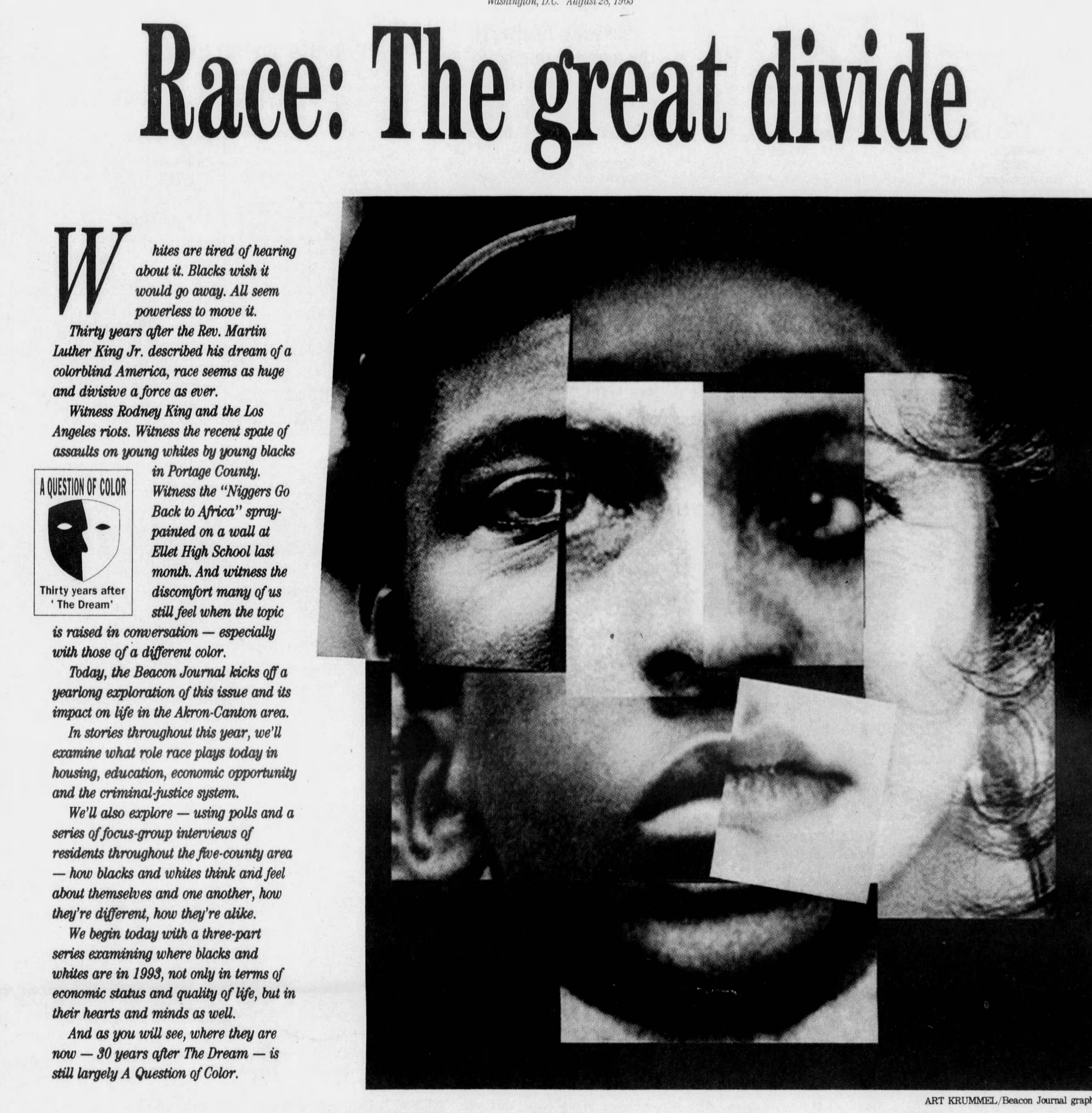
In the spring of 1992, after the riots following the Rodney King verdict, we decided to examine race relations in our own community. But we also learned that the much larger Plain Dealer was pursuing a similarly ambitious project. We knew we couldn’t match their resources or speed. So Bob, my wife, Deb Van Tassel, and four other journalists devised a different approach.
We enlisted the University of Akron’s political science department to survey residents about their attitudes toward race. Professional moderators conducted focus groups to explore what people really thought. Computer databases helped us examine demographic patterns. Reporters went into neighborhoods, interviewed residents and put human faces on the numbers.
The Plain Dealer published its fine series by the end of 1992. Our final installment didn’t appear until December 1993.
Four months later, the Beacon Journal won the Pulitzer Prize Gold Medal for Public Service for A Question of Color/Coming Together, an examination of racial divisions that helped launch a communitywide effort to confront them.
We didn’t win because computers replaced journalists. We won because technology helped good journalists do extraordinary work.
More than three decades later, journalists at that same newspaper are withholding their bylines to protest their corporate owner’s use of another emerging technology.
Artificial intelligence.
A legitimate complaint
Journalists at The Akron Beacon Journal and The Record-Courier in Kent are protesting DeeperDive, an AI-powered chatbot introduced by their corporate owner, USA TODAY Co., formerly Gannett. They began withholding their bylines from stories on Oct. 28. J
Journalists at other USA TODAY Co. newspapers, including the Columbus Dispatch, Milwaukee Journal Sentinel and Asbury Park Press, have also protested the company’s use of AI, calling for stronger editorial safeguards and greater journalist involvement in decisions about the technology.
The AI tool answers readers’ questions using newspaper content. According to the NewsGuild, the union that represents the local journalists, DeeperDive has produced inaccurate and misleading information, including an answer that mistakenly identified a journalist as a murder suspect.
If the Guild is correct that the company is violating its own standards requiring human verification of AI-generated content, the journalists have every reason to be angry.
I’ve spent much of my career on both sides of the newsroom divide. I was a Guild member in Akron before moving into management there, at the Plain Dealer and eventually at Gannett.
I understand the concerns of working journalists. I also understand the financial pressures facing newspaper companies, which have watched advertising revenue evaporate and newsroom staffs shrink.
But accuracy isn’t negotiable. Neither is accountability.
The problem isn’t that artificial intelligence makes mistakes. Human journalists make them, too. We misidentified a rape suspect in Akron back in the ’80s. The problem is publishing information without adequate safeguards to catch those mistakes.
The question shouldn’t be whether artificial intelligence belongs in journalism. It should be how journalists can use AI to produce better journalism.
USA TODAY executives have touted DeeperDive’s popularity, reporting millions of reader interactions and increased engagement. Those are encouraging business metrics. But they don’t tell us whether the technology is making the journalism itself more valuable to readers.
I understand why newspaper executives embrace technology that reduces costs. But cutting the cost of journalism and increasing its value are not the same thing.
In 1993, we didn’t ask how many reporters computers could replace. We asked what those computers could help our reporters accomplish.
It’s still the right question.
Artificial or augmented?
Artificial intelligence. Augmented intelligence.
One approach asks what machines can do instead of people. The other asks what people can accomplish with the help of machines.
An AI assistant can help a reporter examine thousands of public records, identify patterns, explore competing explanations and find weaknesses in a developing story.
They can challenge an editor’s assumptions, suggest alternative approaches and help turn a complicated subject into something readers can understand.
But they can’t be trusted to decide, on their own, what is true.
ChatGPT and I have collaborated on books, screenplays, business articles and columns. I use my assistant for research, brainstorming, editing and occasionally arguing.
Plenty of arguing.
Sometimes they offer an insight I hadn’t considered. Sometimes they challenge a weak premise or identify a hole in a narrative. And sometimes they produce something so spectacularly wrong that I wonder how anything supposedly intelligent could have come up with it.
That’s when I remind them who’s the boss.
The technology doesn’t replace my experience or judgment. It helps me put them to better use.
That’s augmented intelligence.
And I believe every reporter and editor should have an opportunity to develop that kind of working relationship with an AI assistant. It’s like having a writing coach at your side 24/7.
Give journalists the tools
Instead of fighting over whether we should use AI, work together to decide how to use it to make journalists more effective.
Give every reporter and editor access to a capable AI assistant, with appropriate protections for confidential sources and unpublished information. Provide training, encourage experimentation and give journalists time to discover what works.
Let the people who actually produce the journalism help establish the standards.
Make verification mandatory. Keep human editors responsible for what gets published. And distinguish between AI assisting a journalist and an automated chatbot communicating directly with the public.
A reporter can check an AI assistant’s work before using it. A chatbot answering thousands of reader questions may produce errors that no editor ever sees. If management can’t provide adequate safeguards for that second application, it shouldn’t be using it.
I don’t pretend that AI won’t change newsroom employment. It almost certainly will. But newspaper companies have spent decades trying to survive by producing journalism with fewer people.
Perhaps it’s time to ask whether technology could help the people who remain produce more ambitious, more valuable journalism instead.
That’s what we did in Akron.
The lesson from those tape reels
Our Pulitzer project wasn’t simply an exercise in technological innovation. Twenty-nine journalists and artists worked on A Question of Color. They challenged one another, argued over difficult decisions and ultimately produced journalism that reached far beyond the newspaper’s pages.
In the second phase of the project, Coming Together, thousands of residents joined efforts to improve race relations. The work helped change the conversation in Akron.
I find something reassuring about the current dispute. The journalists at my old newspaper are once again challenging a powerful institution, this time the corporation that employs them.
That independent spirit is worth preserving.
So is the willingness to embrace new ideas that helped make the Beacon Journal a great newspaper.
Those enormous reels of census data around Bob Paynter’s desk are long gone. The technology that once seemed revolutionary would be hopelessly primitive today.
But the principle hasn’t changed.
Give good journalists better tools. Encourage them to ask harder questions, pursue more ambitious stories and exercise their judgment.
We called it computer-assisted reporting in 1993.
Today, I’d call it augmented intelligence.
The future of journalism shouldn’t be measured by how many journalists AI can replace, but by how much better journalism those journalists can produce.
Veteran newspaper editor Stuart Warner worked with ChatGPT-6.0 to produce this article. Warner approved every word of the final version. We reached out to The Beacon Journal and a union representative for comments. We have not heard back.


