Stuart Warner can help you write books, write narrative journalism or just write better
Author: Mr. Write Coach
Stuart Warner can help you become a better writer. Warner has developed a national reputation as an editor and journalism teacher. He has written or edited three Pulitzer Prize-winning entries and edited three other Pulitzer finalists As the writing coach at The Plain Dealer in Cleveland, he edited stories than won more than 50 national awards.
Currently, Warner teaches journalism at Case Western Reserve University and is a regular contributor to AOL.com. He has been honored numerous times for his own writing. He has also been invited to speak on writing at the Nieman narrative conference at Harvard, the Let’s Do It Better conference at Columbia University, the National Writers Workshop sponsored by the Poynter Institute, the IRE’s national Computer Assisted Reporting workshop and at Capitolbeat, the national seminar for state government reporters.
He has also worked with the writers at a number of companies, including Politifact, Key Bank, Signal Cleveland, the Akron Beacon Journal, Cleveland Jewish News, Akron General Hospital and also taught at Cleveland State University.
(This is the fifth in a series of AI-generated analyses of the right-wing manifesto “Project 2025: Mandate for Leadership, the Conservative Promise.“)
Section 2 of the conservative manifesto “Project 2025: Mandate for Leadership,” Common Defense, offers a conservative perspective on the state of the U.S. military and proposes significant reforms. We begin with an examination of Chapter 4: Department of Defense.
Military ‘Wokeness’: A Contested Issue
The document defines “wokeness” as initiatives promoting diversity, equity, and inclusion (DEI) within the military. It argues that these efforts undermine military effectiveness by:
Prioritizing social agendas over warfighting capabilities.
Weakening unit cohesion and morale.
Diverting resources from readiness.
However, the document doesn’t provide concrete evidence for these claims. There’s ongoing debate about the impact of DEI programs on military effectiveness. Whether social policies are harming the military is a complex issue. There have been concerns that issues like gender integration could hurt unit cohesion, but studies have shown mixed results. It’s important to note that the military itself has embraced diversity efforts in recent years. In 2021, the Chairman of the Joint Chiefs of Staff stated that diversity is “absolutely essential” to military readiness.
Focus on China and Increased Spending
The document prioritizes China as the primary threat and proposes significant increases in defense spending. Here’s a breakdown of the key arguments:
China’s Military Buildup: The document highlights China’s rapid military modernization, including nuclear weapons expansion. It argues for a “denial defense” to prevent China from seizing Taiwan or other strategic territories.
Need for Modernization: The author believes the U.S. military lags in key areas like technology and needs more resources to compete with China.
Burden-Sharing: The document calls for increased defense spending by U.S. allies to lessen the burden on American taxpayers.
These arguments raise important questions:
Cost of Increased Spending: The financial feasibility of a significant spending increase is a major concern. Would it come at the expense of other essential programs?
Focus on China: While China is a major power, should other threats like terrorism and regional conflicts be neglected?
Effectiveness of “Denial Defense”: Can a purely defensive strategy deter China or would a more nuanced approach be necessary?
But again, the need for increased military spending is another complex issue. The US already spends more on its military than any other country in the world, and some argue that this spending is wasteful or inefficient. Others argue that the US needs to spend more to counter growing threats from China and Russia.
Critique of the Acquisition Process
The document criticizes the slow and inefficient process of acquiring new military equipment. It proposes reforms to:
Streamline decision-making to speed up the procurement process.
Encourage innovation and collaboration with the private sector.
Replenish depleted stockpiles of weapons and ammunition.
These are valid concerns. Delays and bureaucratic hurdles can hinder military readiness. However, the document doesn’t address potential drawbacks of faster acquisition, such as overlooking potential flaws in new technologies.
Conclusion
Project 2025’s chapter on the Department of Defense presents a conservative viewpoint on military reform. The document raises important questions about “wokeness” and defense spending, but its arguments lack nuance and require further evidence. It offers a valuable critique of the acquisition process but doesn’t fully explore the potential consequences of proposed solutions. A comprehensive assessment of the U.S. military requires considering diverse perspectives and conducting a thorough cost-benefit analysis before implementing major reforms.
Scary Quotes
“Reverse policies that allow transgender individuals to serve in the military. Gender dysphoria is incompatible with the demands of military service, and the use of public monies for transgender surgeries or to facilitate abortion for service members should be ended.”
“Reinstate service members to active duty who were discharged for not receiving the COVID vaccine, restore their appropriate rank, and provide back pay.” (In other words, hire back soldiers who refused direct orders.)
About the Author
Christopher Miller, who, after a brief stint as acting secretary of defense under Donald Trump, wrote a memoir in which he asserted that our military is “bloated and wasteful” and argued that we could “cut our defense budget in half and it would still be nearly twice as big as China’s,” according to The Nation. You can read the entire article here.
This is the fourth in a series of AI-generated analyses of the right-wing manifesto “Project 2025: Mandate for Leadership, the Conservative Promise.“
Project 2025’s chapter 3, Managing the Bureaucracy, proposes a sweeping overhaul of the federal civil service system. While couched in terms of improving efficiency, the plan would significantly strengthen the President’s control over the bureaucracy, raising concerns about politicization and the fate of federal employee unions.
The chapter highlights perceived shortcomings in the current system, particularly the lengthy appeals process and limitations on firing underperforming employees. These, it argues, impede effective management and prevent the President from enacting his agenda. Proposed reforms include streamlining appeals and granting political appointees greater control over performance appraisals. This would undoubtedly strengthen the President’s hand. He could swiftly remove problematic staff and ensure appointees loyal to his vision fill key positions. Supporters argue this translates to a more responsive and efficient bureaucracy, one that implements the President’s policies swiftly and effectively.
Critics, however, see a different picture. They fear politicization of the civil service, with appointments and performance reviews based on loyalty rather than merit. A President could strategically place political allies throughout the bureaucracy, potentially creating a system less interested in serving the public good and more focused on advancing the President’s agenda. Furthermore, a more punitive performance management system could lead to decreased employee morale and a flight of talent, ultimately hindering efficiency.
The Union Question: Bargaining Power on the Chopping Block?
The proposed reforms have a potentially devastating impact on federal employee unions. Their core function – protecting members from unfair treatment – is directly challenged by streamlined appeals processes and easier terminations. Unions would have less leverage to advocate for their members in disciplinary actions.
The chapter’s emphasis on performance-based pay adds another layer of concern. Shifting responsibility for performance appraisals to political appointees raises the specter of politicized evaluations. Union membership could become a factor, weakening protection against politically motivated performance critiques. Furthermore, prioritizing performance over seniority in layoffs weakens another key union bulwark – protection for long-term employees. Experienced workers with strong union ties could be more vulnerable to job cuts.
Beyond the Bureaucracy: A Broader Power Shift?
The impact extends beyond the civil service. The chapter suggests limitations on the Federal Labor Relations Authority’s (FLRA) authority to hear appeals. The FLRA plays a vital role in resolving disputes between federal agencies and unions. Weakening its authority would significantly limit unions’ ability to enforce collective bargaining agreements and protect their members’ rights.
Another proposal seeks to consolidate several agencies with overlapping functions, including the Equal Employment Opportunity Commission (EEOC) and the Merit Systems Protection Board (MSPB). These agencies handle complaints of discrimination and wrongful termination, respectively. Merging them could create a less efficient and responsive system for addressing employee grievances, further undermining unions’ ability to represent their members effectively.
A Balancing Act: Efficiency vs. Representation
While Project 2025’s focus is on efficiency, the potential consequences for unions are significant. Weakened union protections and a more punitive performance management system could disincentivize employees from joining unions, leading to decreased membership. Reduced bargaining power at the negotiating table, along with a potentially more hostile work environment, could further weaken unions’ role in representing employee interests. Unions might be forced to dedicate more resources to defending members from termination and less on advocating for better wages and benefits.
However, the impact might not be uniform across all unions. Larger, more established unions with strong political connections might be better positioned to adapt. Smaller unions representing specific agencies or professions could face a more significant threat.
Conclusion: A Double-Edged Sword
Project 2025’s proposals offer a double-edged sword. Strengthening the President’s control over the bureaucracy could improve efficiency and responsiveness. However, this comes at the potential cost of politicization and a significant weakening of federal employee unions. A balanced approach is crucial. Improving efficiency should not come at the expense of employee morale, fair treatment, and a healthy system of checks and balances within the federal government. Ultimately, the long-term impact on government effectiveness and employee well-being depends on how these reforms are implemented and the safeguards put in place to ensure a meritocratic and fair system.
Scary Quote
Frustrated with [the] activities by top career executives, the Trump Administration issued Executive Order 1395724 to make career professionals in positions that are not normally subject to change … an exception to the competitive hiring rules. It ordered the Director of OPM and agency heads to set procedures to prepare lists of such confidential, policy-determining, policymaking, or policy-advocating positions and prepare procedures to create exceptions from civil service rules when careerists hold such positions …. The order was subsequently reversed by President Biden at the demand of the civil service associations and unions. It should be reinstated … ” (My interpretation: Thousands of civil servants should be replaced by the President’s political appointees.)
About the Authors
Donald Devine was known as “Reagan’s Terrible Swift Sword of the Civil Service.” Paul Dans held several positions in the Trump administration and is now director of the 2025 Presidential Transition Project at the Heritage Foundation. Dennis Dean Kirk was nominated by Trump to be chairman of the Merit Systems Protection Board. But again, Trump knows nothing about the people behind Project 2025.
This is the third in a series of AI-generated analyses of the right-wing manifesto “Project 2025: Mandate for Leadership, the Conservative Promise.“
“Project 2025: Mandate for Leadership” lays out a roadmap for conservative policy under a future Republican administration. Chapter 2 delves into the proposed restructuring of the Executive Office of the President (EOP) and its role in enacting the president’s agenda. While advocating for a strengthened EOP, particularly the Office of Management and Budget (OMB), the chapter also proposes the elimination of the White House Gender Policy Council (GPC), established by the Biden Administration.
Russ Vought, the chapter’s author, argues for a more streamlined and presidential-controlled Executive Office. He views the current bureaucracy as resistant to presidential will. A key element is strengthening the Office of Management and Budget (OMB) to give the president greater control over federal agencies. However, this proposal comes at a cost – the potential dismantling of the Gender Policy Council.
The GPC, established in 2021, serves as a coordinating body for federal efforts on gender equality. Its elimination suggests a potential de-prioritization of these issues within the executive branch. Advocates for gender equality see the GPC as a crucial platform for advancing policies on women’s rights, pay equity, and LGBTQ+ inclusion. Its absence could lead to a significant shift in these areas.
Beyond specific policies, the symbolic message of abolishing the GPC is potent. It could signal to the public that the administration does not prioritize gender equality. This, in turn, could discourage initiatives aimed at addressing gender-based disparities. Additionally, the legal basis for the GPC’s creation might be challenged, potentially leading to lawsuits.
However, it’s important to consider the motivations behind the proposal. Vought argues for a more streamlined and efficient executive branch. Supporters might view the GPC as an example of “mission creep” within the bureaucracy. They might argue that existing agencies can handle gender-related issues without a dedicated council.
Furthermore, the elimination of the GPC wouldn’t necessarily spell the end of progress on gender equality. Legislation and judicial rulings can still drive change. Additionally, individual agencies could still prioritize these issues within their mandates.
However, the GPC’s role as a coordinating body cannot be understated. Its elimination could lead to fragmented and less effective policies addressing gender issues. Additionally, the loss of a centralized platform for these issues could make it harder for advocates to have their voices heard within the administration.
The broader context of Project 2025 is also crucial. The book advocates for a rollback of regulations, particularly those seen as burdensome to businesses. This could disproportionately affect sectors with a high concentration of female employees. Additionally, the book emphasizes national security concerns. While not explicitly linked to gender issues, some might argue that a focus on these issues could come at the expense of social concerns like gender equality.
It’s important to acknowledge limitations. Project 2025 represents a single perspective and may not reflect the views of all conservatives. Additionally, the feasibility of abolishing the GPC depends on a variety of factors – from congressional support to potential legal challenges.
In conclusion, the proposal to eliminate the Gender Policy Council in Project 2025 raises significant questions about the potential shift in federal priorities on gender equality. While the book advocates for a streamlined and efficient executive branch, the potential consequences for women’s rights and LGBTQ+ inclusion cannot be ignored. The 2024 election will likely determine whether the GPC remains a cornerstone of federal gender policy or becomes a footnote in American history.
Scary Quotes
“Abolishing the Gender Policy Council would eliminate central promotion of abortion (‘health services’); comprehensive sexuality education (‘education’); and the new woke gender ideology, which has as a principal tenet ‘gender affirming care’ and ‘sex-change’ surgeries on minors.”
“… the Biden Administration’s climate fanaticism will need a whole-of-government unwinding. As with other federal departments and agencies, the Biden Administration’s leveraging of the federal government’s resources to further the woke agenda should be reversed and scrubbed from all policy manuals, guidance documents, and agendas … “
About the Author
Russ Vought served in President Trump’s Cabinet as Director of the Office of Management and Budget, overseeing the implementation of the presidential budget, key policies on deregulation, and a landmark effort to eliminate critical race theory and other radical ideologies in executive agencies. Did we mention again that Trump says he knows nothing about Project 2025 or the people who wrote it?
This is the second in a series of AI-generated analyses of the document “Project 2025: Mandate for Leadership, the Conservative Promise”
The intro to Section I of “Project 2025: Mandate for Leadership,” titled Taking the Reins of Government, argues that America is currently divided between two opposing forces: “woke revolutionaries” and those who believe in the ideals of the American revolution. The author believes the “woke revolutionaries” believe America is fundamentally racist and needs to be transformed. The author argues that conservatives need to fight for the soul of America.
The author also references Abraham Lincoln’s warning that the greatest threat to America would come from within. The author references what they see as the “Left’s steady stream of insanity,” including mask and vaccine mandates, defunding the police, and denying the biological reality that there are only two sexes. The author argues that the next Administration must stand up for American ideals.
The author concludes by arguing that the federal bureaucracy has a mind of its own and does not reflect the will of the American people.
Here is a summary of the first chapter of Taking the Reins of Government:
Section I, Chapter I: The White House Office
This chapter from the book called “Project 2025: Mandate for Leadership, the Conservative Promise,” dives into the structure and function of the various offices that support the President of the United States.
The chapter highlights the significant role of the White House Office (WHO) in American government. It emphasizes the importance of choosing the right people to staff these critical positions, as their decisions directly impact the President’s legacy and the fate of the country.
It emphasizes the role of Chiefs of Staff in managing the WHO and prioritizing the President’s initiatives.
The following sections delve into specific offices within the WHO:
Deputy Chiefs of Staff: The chapter discusses the different roles Deputy Chiefs of Staff can play, including managing operations, policy, and overseeing communication strategies.
Senior Advisors: These advisors provide the President with guidance on a broad range of issues, including policy and communication.
Office of White House Counsel: This office offers legal advice to the President and ensures adherence to legal and ethical guidelines. The essay emphasizes the importance of the Counsel being well-versed in the Constitution and loyal to both the President and the law.
Staff Secretary: Acting as a gatekeeper, the Staff Secretary controls the flow of information in and out of the Oval Office.
Office of Communications: This office is responsible for conveying the President’s message to the public through various channels, including speeches, press briefings, and social media.
Office of Legislative Affairs (OLA): The OLA serves as a liaison between the White House and Congress, working to secure passage of the President’s legislative priorities.
Office of Presidential Personnel (PPO): The PPO is tasked with recruiting and vetting candidates for political appointments within the executive branch.
Office of Political Affairs (OPA): This office manages the President’s political interests by maintaining relationships with national committees, campaigns, and interest groups.
Office of Cabinet Affairs (OCA): The OCA coordinates policy and communication between the White House and the Cabinet departments.
The essay concludes by emphasizing the importance of a well-functioning White House Office in ensuring a President’s agenda is implemented effectively.
Scary Quote
“… the new Administration must fill its ranks with political appointees … who are answerable to the President and have decision-making authority in the executive branch are key to this essential task. The next Administration must not cede such authority to non-partisan ‘experts,’ who pursue their own ends while engaging in groupthink, insulated from American voters.”
Funny Quote
“Above all, the President and those who serve under him or her must be committed to the Constitution and the rule of law. This is particularly true of a conservative Administration, which knows that the President is there to uphold the Constitution, not the other way around. If a conservative Administration does not respect the Constitution, no Administration will.”
About the Author
Former President Donald Trump claims to know nothing about Project 2025 but many of its contributors have close ties to his administration including Rick Dearborn, author of Chapter 1. Dearborn served as White House Deputy Chief of Staff to Trump and then returned to The Heritage Foundation as a Distinguished Visiting Fellow.
This is the first in a series of AI-generated analyses of the conservative manifest “Project 2025: Mandate for Leadership, The Conservative Promise” The document presents itself as a guide for the next conservative president, outlining conservative solutions to problems facing America. Read the entire series here:
America in Crisis: The author argues America faces a crisis similar to the late 1970s, with economic decline, cultural decay, and threats from abroad. He blames “elites” and the “Left” for these problems.
Lessons from Reagan: The book draws inspiration from Reagan’s success in the 1980s, emphasizing clear goals, limited government, and a focus on family values.
The Conservative Agenda: The book outlines four core conservative promises:
Restore the Family: This involves promoting marriage, parental authority, and traditional gender roles. It also includes opposing abortion and pornography
Dismantle the Administrative State: This means reducing the size and power of federal agencies and reasserting congressional control.
Defend National Sovereignty: This involves securing borders, opposing globalism, and prioritizing American interests abroad.
Secure Individual Rights: This includes protecting free speech and religious liberty from “woke culture.”
Conservative Criticisms:
Elite Power: The book blames a shadowy elite for America’s problems, including corporations, universities, and media institutions.
Focus on Culture: The book prioritizes cultural issues like family structure and gender identity, potentially neglecting economic concerns.
Limited Government: The book advocates for a smaller federal government, but some may argue this could weaken necessary social programs.
Overall Tone:
The essay has a strong polemical tone, using terms like “cultural elites,” “woke culture warriors,” and “socialist extremism” to describe those who disagree with conservative positions.
In Conclusion:
Mandate for Leadership offers a comprehensive look at conservative ideology and its proposed solutions to America’s problems. It is a valuable resource for understanding conservative perspectives on a wide range of issues. However, readers should be aware of its potential biases and consider alternative viewpoints.
Scary Quotes From the Text
“The next conservative President should work with Congress to enact the most robust protections for the unborn that Congress will support while deploying existing federal powers to protect innocent life and vigorously complying with statutory bans on the federal funding of abortion.”
“The next conservative President must make the institutions of American civil society hard targets for woke culture warriors. This starts with deleting the terms sexual orientation and gender identity (“SOGI”), diversity, equity, and inclusion (“DEI”), gender, gender equality, gender equity, gender awareness, gender-sensitive, abortion, reproductive health, reproductive rights, and any other term used to deprive Americans of their First Amendment rights out of every federal rule, agency regulation, contract, grant, regulation, and piece of legislation that exists.”
About the Author
Kevin D. Roberts, Ph.D., is president of the Heritage Foundation, the conservative think tank behind Project 2025. In a recent radio interview, he said that the country was “in the process of the second American Revolution, which will remain bloodless if the left allows it to be.”
In other words (my interpretation) the right’s mantra is no longer: “They’re coming for your guns.” It is now: “We’re coming for you with our guns.”
Did this courtroom of horrors ultimately kill my Dad?
(This essay originally appeared in Cleveland Magazine in May of 2011.)
Five years after I wrote this column, my wife, Deb Van Tassel Warner, arranged for us to tour the courthouse at Nuremberg, where the trials took place. We saw the grainy photo of two clerks (at left) at work during the trials. Is one of them my father?
By Stuart Warner
I thought I saw a ghost as I watched the haunting documentary Nuremberg: Its Lessons for Today at the Cleveland International Film Festival in March 2011.
The camera swept past a young G.I. during a courtroom scene. He was thin with dark, wavy hair, and he was typing as he listened to the gruesome proceedings. Then he was gone.
Was it him? My heartbeat quickened. Could that soldier have been my father, Pfc. Maurice Hunter Warner?
My father was an Army clerk during the first Nuremberg Trials. He was in the courtroom almost every day as the most notorious Nazis, including Joseph Goebbels and Rudolf Hess, were tried for war crimes.
The image lingered for the briefest of moments. Then he was gone. Again. This month will mark my 50th Father’s Day without him. And perhaps, indirectly, he was a victim of the horrors of the Holocaust, too.
My dad had been on the front lines in Europe for a year when the war ended there. A 19-year-old from Mount Sterling, Ky., a town of fewer than 5,000 residents, he was assigned to operate a teletype machine at Nuremberg, not long after the trials began on Nov. 20, 1945, until his discharge in June 1946.
Even the documentary, at only 80 minutes long, is difficult to sit through. The Nazis filmed many of their own cruelties, films that were used in evidence against them. One, included in the documentary, showed how they developed a pipeline that carried automobile exhaust into a sealed room filled with prisoners. Then the camera took viewers inside to see the bodies piled on top of bodies, the terror frozen on their dead faces.
So I can’t imagine what Pfc. Warner experienced there.
He was engaged then to 18-year-old Thelma Sorrell. He never wrote to her about what he saw. But one day she got a letter from his roommate at Nuremberg, concerned about her fiance’s drinking. “He said Maurice was drinking buckets of beer every night,” my mother told me.
Maybe it was a coping mechanism. Henry T. King Jr., a former Case Western Reserve University professor, was one of 100 prosecutors at the Nuremberg Trials. In his 2009 Plain Dealer obituary, he said that when people asked him how he dealt with the brutality he saw daily, he always replied: “Scotch.”
Stuart Schulberg, another young G.I., directed the Nuremberg documentary for the military. It was shown in Germany in 1948 and 1949, but the U.S. government never released it here. Schulberg was never told why.
By then, the U.S. had a new enemy, the Soviet Union. The Marshall Plan to rebuild Germany and Europe was ongoing. The government “may have worried,” Schulberg’s daughter, Sandra Schulberg, speculated in an interview last year, that the film’s reminder that the Germans “were guilty of monstrous crimes” would have diminished our support for rebuilding their country.
More than 60 years later, Sandra Schulberg rescued the film in tatters and put it back together. Her father never told her about the documentary. She only discovered it after his death in 1979.
My father never said a word to me about his work at Nuremberg, either. I learned about it years after he passed away.
My parents were married on Christmas Day, 1946. Dad went to college, got a degree in fine arts and became a commercial artist. My mother says he got his drinking under control, except on Saturday nights. “I always had to drive him home,” she said.
On one of those nights in 1959, at a party, this otherwise gentle man became so belligerent that the host asked him to step outside and cool off. Dad took a swing at the man. The man swung back. Dad went down and his head hit the floor.
He suffered dizzy spells at first. Months later, doctors discovered a hematoma, a mass of broken blood vessels, too close to a nerve center in the back of his brain. One surgery followed another and another. Finally, the doctors sent him home to die.
In his last few weeks, he weighed no more than 80 pounds. His head was shaved. He appeared as emaciated as many prisoners at the Nazi death camps.
I was 9 years old. I was afraid to go into his room. He died early in the morning of Dec. 31, 1961, before I woke up. I never got to say goodbye.
I can’t say for certain that the Nuremberg experience led to my dad’s death. Nor will I ever know if that G.I. in the documentary was him. It doesn’t matter. What is important is that the film and the memory of him reminded me of lessons that are still as meaningful today.
We can never be afraid to look at what is too painful. We must accept what happened, learn from it and move forward.
On St. Patrick’s Day 1979, Jock Sutherland was within hours of achieving his lifelong dream, and he had a hard time mustering a smile.
This chapter is excerpted from The Quickest Thinking Coach in America: JOCK (copyright 2023 by Mr. Write Coach LLC)
March 17, 1979
Jock Sutherland was miserable on this Saturday morning. The coach who once pulled down his pants in the middle of a game to protest a referee’s call, the man some people referred to as the clown prince of Kentucky high school basketball, could barely manage a smile. He was 12 hours and two games from achieving the one thing that had kept him in coaching for almost 25 years — the state championship. He hadn’t slept more than an hour or two for three or four nights. His stomach churned. His head ached. He had assembled the team at Lafayette High School that he couldn’t even imagine when he had been a player at the school in the 1940s. Size. Speed. Athleticism. Dedication. Black players. White players. Nine seniors. They had won 34 games and lost only one. They had been ranked No. 1 in the state every week since the season started. They were ranked the No. 2 high school team in the nation.
None of that would matter at the end of this day if they couldn’t win these last two games. Sutherland didn’t want to start building over again. Not at age 51. His two sons were grown. Charlie, the oldest, was a lawyer. Glenn was finishing dental school. It was time to enjoy life with his wife, Snooks, who had been so patient with him for almost 30 years and quietly watched him suffer so much whenever his team lost a game.
Charles “Jock” Sutherland didn’t want to coach again after this day. He just wanted this day to be over.
He wished he could enjoy the moment. He wanted to walk out on the floor at the 24,000-seat Rupp Arena in Lexington, Ky., and just let the cheers of the massive crowd wash over for him. It’s a ritual that introduces spring in Kentucky — the boys’ state high school basketball tournament, a tradition so rich that the state owns the trademark — The Sweet Sixteen. In Kentucky, all 200-plus high schools compete for the same basketball championship. Big schools. Small schools. Urban schools. Mountain schools. Even Indiana’s storied high school basketball tournament has been divided into classes. But Kentucky has refused to change. There is always hope that some little school that nobody had ever heard of, schools with names like Carr Creek, Cuba and Brewers, will somehow rise up and swat the powerful teams from Louisville and Lexington, adding another chapter to the tournament’s Cinderella lore.
The tournament begins every March, with all the schools competing in 64 district tournaments. The winners and the runners-up in each of those districts — and that quirk in the system was huge for Sutherland’s team this year — advance to 16 regional tournaments, eight teams in each region. The 16 region champs, the Sweet Sixteen, come to Lexington or Louisville for four days of combat. First-round games on Wednesday and Thursday. Quarterfinals on Friday. The semifinal games on Saturday morning. Then, the final event in this teenage marathon, the championship game on Saturday night, always starting at 8 o’clock. And for a high school basketball coach in Kentucky, there’s nothing quite like having your team on the court that Saturday night.
The deafening noise starts long before the tip-off. The bands for the two championship teams are seated at opposite ends of the floor, behind each basket. The cheering sections stretch from the floor to the rafters, 100 feet above. There’s no need to cue fans to yell like they do in NBA games. Each side tries to make more noise than the other. Each band tries to play louder than its counterpart.
On the floor, the players try to ignore it all, going through their warm-ups as if they were back in their high school gyms, getting ready for another day of practice.
Then, when you think it can’t get any louder, all goes quiet. The horn sounds, and the clock shows that there are two minutes until game time. Those two minutes seem to last forever.
The players go back to their benches. The lights go dim.
The melody of “My Old Kentucky Home” permeates the arena. “Weep no more, my lady. Weep no more today …”
Alumni tear up. The players, so implacable only moments before, feel their hands begin to tremble, lumps forming in their throats. Coaches’ palms begin to sweat.
The lights return, and the parade onto the floor begins. Team managers, ball boys, superintendents, principals, and assistant coaches are introduced to loud cheers. Next, the reserve players, the decibel level increasing. Then the starting lineups, and you can’t hear your own thoughts. Finally, the announcer bellows above the crowd noise, “And now, the head coach of the …”
Jock Sutherland had attended every Kentucky Boys State Basketball Tournament since 1941, except for one year when he was in the Army. He had always been a spectator on that special Saturday night. In 1947, when he was a senior at Lafayette, the team was one of the top-ranked in the state, but the Generals were upset in the regional championship game, one game short of The Sweet Sixteen. As a coach, Sutherland was making his sixth trip to the tournament. He was the first coach in state history to take three different schools there. But in those five previous tournament appearances, his teams had won only one game, never making it even to Saturday morning’s semifinal rounds.
He had watched the tournament outgrow the 3,800-seat Alumni Gymnasium in Lexington, the 7,000-seat Convention Center in Louisville, the 11,500-seat Memorial Coliseum in Lexington and the 17,000-seat Freedom Hall in Louisville.
Now, the tournament was back in Lexington, being played for the first time in the Rupp Arena, the largest basketball-only facility in the nation.
He grew up only a few blocks from the arena named for the University of Kentucky’s legendary basketball coach, the coach whose practices he had watched as a boy, and now he was back with a team that everyone expected to win the state championship.
And he was flat-out miserable.
Sometimes, he feared he would never get this close to the championship game. Between 1959 and 1971, his teams reached The Sweet Sixteen five times. But by the fall of 1978, the beginning of this season, none of his teams had even won a single game in the district tournament since the ’71 season. He began to question his coaching ability. Maybe he had lost his touch. Maybe he couldn’t communicate with today’s players. Maybe he should have stayed in college coaching at Alabama when he had the chance. He knew he could have been an NCAA Division I head coach by now. But this team, the 1978-79 Lafayette Generals, had the potential to erase all the past doubts and disappointments. This team had a chance to be one of the best of all time in Kentucky.
They were led by 6-foot-3 guard Dirk Minniefield, who was being recruited by every major school in the country. They had two other first-team all-staters, 6-foot-7 center Tony Wilson and 6-foot ball-handling wizard Junior Johnson. Johnson had transferred to the school from nearby Scott County High just before the beginning of the season. Five other seniors would have been standouts at most schools in the state, but they were content to play supporting roles, even though their parents often weren’t happy about it.
They won their first two games in the tournament by more than 20 points each. That brought Sutherland to Saturday morning, March 17, 1979, and the endurance test that Kentucky requires of its best high school basketball teams.
In the NBA, the multi-millionaire players complain about playing games on back-to-back nights and have it written into the union rules that they can’t play more than two days in succession. To win the state championship in Kentucky, a team must win its first-round game on Wednesday or Thursday, a quarterfinal game on Friday, then two more games on Saturday, one in the morning, the second beginning, always at 8 o’clock on Saturday night.
Even 16- and 17-year-old legs get tired during such a demanding day. Then there is the nightlife. During state tournament weekend, every hotel room is a party. The lobbies and hallways are filled with students who come to support their teams and test their fake IDs and older basketball fans who forget they aren’t in high school anymore.
Sutherland knew he had to keep his team away from all that. Even though all his players lived in Lexington, tournament officials required them to stay at a local motel. He registered them at the Howard Johnson Motel, at the north end of the city, several miles from Rupp Arena downtown at Broadway and Vine. He hired two security guards to keep the players in and the fans out. There was no need to worry about the players. This team came to play. Not to party. They were all in bed early on Friday night. Jock was the only one awake. He fretted as he wandered the motel’s hallways, watching out for drunks and troublemakers. He knew he had the best team in the tournament, the best team he had ever had. Still … a turned ankle, a twisted knee, an antagonistic referee … anything could go wrong.
He told me that morning that he was still patrolling the motel around 2:30 a.m. when he encountered a staggering fan waving a whiskey bottle.
“Have a drink with me, Jock,” the man bellowed.
“No thanks, sir,” he replied.
The drunk became belligerent.
“Either drink with me or fight me,” the man said.
Jock never was much of a fighter. His competitive temper got him in trouble a few times, and he almost always got the worst of it. So he took the bottle and pretended to take a swig.
Then he watched the man crash onto the floor.
He was still there when Sutherland woke his players just after dawn.
The players, coaches and the journalist following the team, me, gathered for breakfast at around 6:30 a.m.
Jock kept his happy face on for the players as they ate. They barely paid attention anyway.
Away from his team, though, the anxiety showed. I was the sports editor of the Lexington Herald then and was spending the day following him and the team. “I feel like I’m getting ready to storm the beach at Normandy,” he confided. “I just want to wake up Sunday morning. I want this to be all over with.”
The players and assistant coach Donnie Harville rode together in a van. Jock drove Harville’s car with me tagging along. “The players can do all their jive talkin’ around Donnie,” Sutherland said. “But they’re pretty loose around me, too. They call me ‘Jock.’ A few years ago, I would never have let a player call me that during the season. You’ve got to change with the times, but you still have to draw the line. They don’t do all that other talking around me.”
As the team dressed at Rupp Arena, Sutherland attracted a small crowd of media types and basketball junkies outside the locker room. As usual, his nervousness manifested itself in a comedy monologue about his team’s quarterfinal victory over Caverna High School.
“I’ve got a bad feeling about today,” he said.
“Aw, be positive, Jock,” replied one of the men in the group.
“Well, I had a good feeling before the Caverna game, and we almost got beat,” Sutherland said.
“Almost got beat?” the man said incredulously. “You won by 21 points.”
“Yeah,” said Sutherland, recalling the late rally it took to beat Caverna, “that’s like a man who’s been in a car wreck, and the car rolls over 93 times. He comes out alive, all right, but he sure gets beat all to hell.”
Everybody laughed.
Jock seemed pleased. He always liked entertaining people. He had a knack for the quick joke for the media. And his stunts during games had become part of the state’s high school basketball lore. But most of his antics had a purpose. He often got so wound up in games that, in his words, he began over-coaching. He wanted to make every pass for his players, take every shot. He realized he was making them tense, making them play worse. So he would do something outrageous. Like, leave. Once, during a game in the Ashland Invitational Tournament, he jumped off the bench in anger, then bolted out of the gym doors, only to discover that they led directly to the outside and locked behind him. He went around the front of the school and tried to walk back in.
“You need a ticket,” the woman at the door said.
“I’m the coach,” Jock replied.
“How can you be the coach out here, and the game’s going on in there?” she asked.
Jock didn’t argue anymore. He paid the two dollars, he said, and returned to his seat on the bench.
But jokes and stunts didn’t get him to the semifinals of the state tournament with the No. 1 team in Kentucky in March of 1979. His intensity surfaced early in the Saturday morning game against Warren East. He didn’t expect his Generals to struggle much against this team. He told them to save something for the championship game. “And don’t commit any silly fouls,” he said. “Just play solid defense.”
Early in the second quarter, the referee called a reach-in foul on guard Junior Johnson. It was easily avoidable.
“Dammit, Junior, I said no silly fouls!” Sutherland yelled from the bench.
Johnson shrugged.
A minute later, the referee called another foul on Johnson.
Sutherland was furious. The score was still close, and now he would have to remove one of his top players because of foul problems.
“Get as far away from me as you can,” Sutherland told his unrepentant player. “You’re going to stay there until you’re ready to play.”
A few minutes later, the team manager approached Sutherland. “Coach, Junior says he’s ready.”
“You tell him he’ll be ready when I say he’s ready,” Sutherland said, sending the confused manager back to the end of the bench.
In the meantime, substitute Brandt Ely played well in place of Johnson. Ely probably would have started this season if Johnson hadn’t transferred. The senior reserve scored 11 points, and Lafayette, after trailing by one at halftime, outscored Warren East 20-6 in the third quarter.
Sutherland left Johnson on the bench until only a few minutes remained in the game. Lafayette led comfortably.
“Go in and work up a sweat, Junior,” Jock said. “I want you to be loose for tonight.”
Johnson refused.
Sutherland fumed.
It had been that way much of the season between them, so much alike in their desire to win the state championship, each so sure that they knew the best way to get it done. But one of them was the coach, one a player.
So Johnson sat alone in the locker room as his teammates whooped it up, anticipating the championship game, just a few hours away.
It was past noon when the team dressed and left the arena after its 66-58 victory.
I asked to ride in the van with the team to accompany the players to lunch.
“Why don’t you ride with me, Dirk,” Sutherland said to his All-American guard.
Minniefield looked at Johnson.
“Can I ride with you all, too?” Junior said quietly.
Jock invited him to get into the car.
I didn’t witness what happened next, but from the conversation I had then and 30 years later, it went something like this:
Minniefield played peacemaker. “Can you two settle this thing next week?” he said. “We got to win tonight.”
Jock looked at Junior.
“Go ahead, have your say,” the coach told the freckle-faced senior.
“You’re just an old-fashioned jackass,” Junior told him. “You don’t know anything about basketball. You never wanted me on this team. Why can’t you leave me alone.”
He continued the tirade for a couple of minutes.
“Do I get a turn?” Jock asked.
Junior stopped talking.
“You’re a spoiled rotten asshole,” the coach said. “The only thing you’re interested in is yourself. If you have a good game and Dirk doesn’t, but we win, he’s happy for you. But if he has a good game and you don’t, you’re not happy. It’s all about you. But we don’t need you. We can win this thing without you.”
Sutherland pulled the car into the parking lot at Frisch’s restaurant. It was quiet for a moment.
Then Junior spoke.
“I’m not going to get to play tonight, am I, Coach?”
Jock looked right at him.
“Yes, you are. I’m going to make you captain. And you’re going to embarrass yourself in front of 20,000 people. And I’m going to enjoy every minute of it.”
They walked into the restaurant and joined the rest of the team without speaking another word.
Springtime doesn’t always follow the calendar in Kentucky. It’s almost always sunny and warm by Sweet Sixteen time in mid-March unless the traditional April showers start early.
After lunch, Sutherland went back to the motel, and Snooks joined him. The swimming pool was empty, but they sat beside it outside in a couple of lounge chairs, sharing a moment as they almost always had on game day — him a nervous wreck, her calm and quiet.
After the dustup with Johnson, his miserable day seemed worse than ever. He told her, “If we don’t win this game, I think I’d rather die than face another day.”
As she had for almost 30 years, riding beside him in school buses across the commonwealth, raising their two boys, having dinner ready at 6:30 every night except game nights. She had always been the still to his storm.
“You’d rather die?” she said. “What about your boys? What about me? You’d just leave us here alone.”
The man once labeled “The Quickest Thinking Coach in America” didn’t have an answer.
“Well, I … I …”
She smiled.
“Don’t worry. You’re going to win this game. It’s what you’ve worked for your entire life.”
He wasn’t so sure. He was just hours away from the game of his lifetime and had been arguing with one of his star players. Everything seemed so complicated sometimes. College coaches began recruiting kids when they were still in junior high, telling them they were stars before they ever stepped foot in a high school gym. Even if the kids didn’t believe it, their parents did.
It’s supposed to be a simple game. You put the ball in the basket, just as he had done shot after shot, day after day, long before he was Jock, when he was just skinny Charlie Sutherland who met a neighbor boy named Tommy who changed the direction of his life.
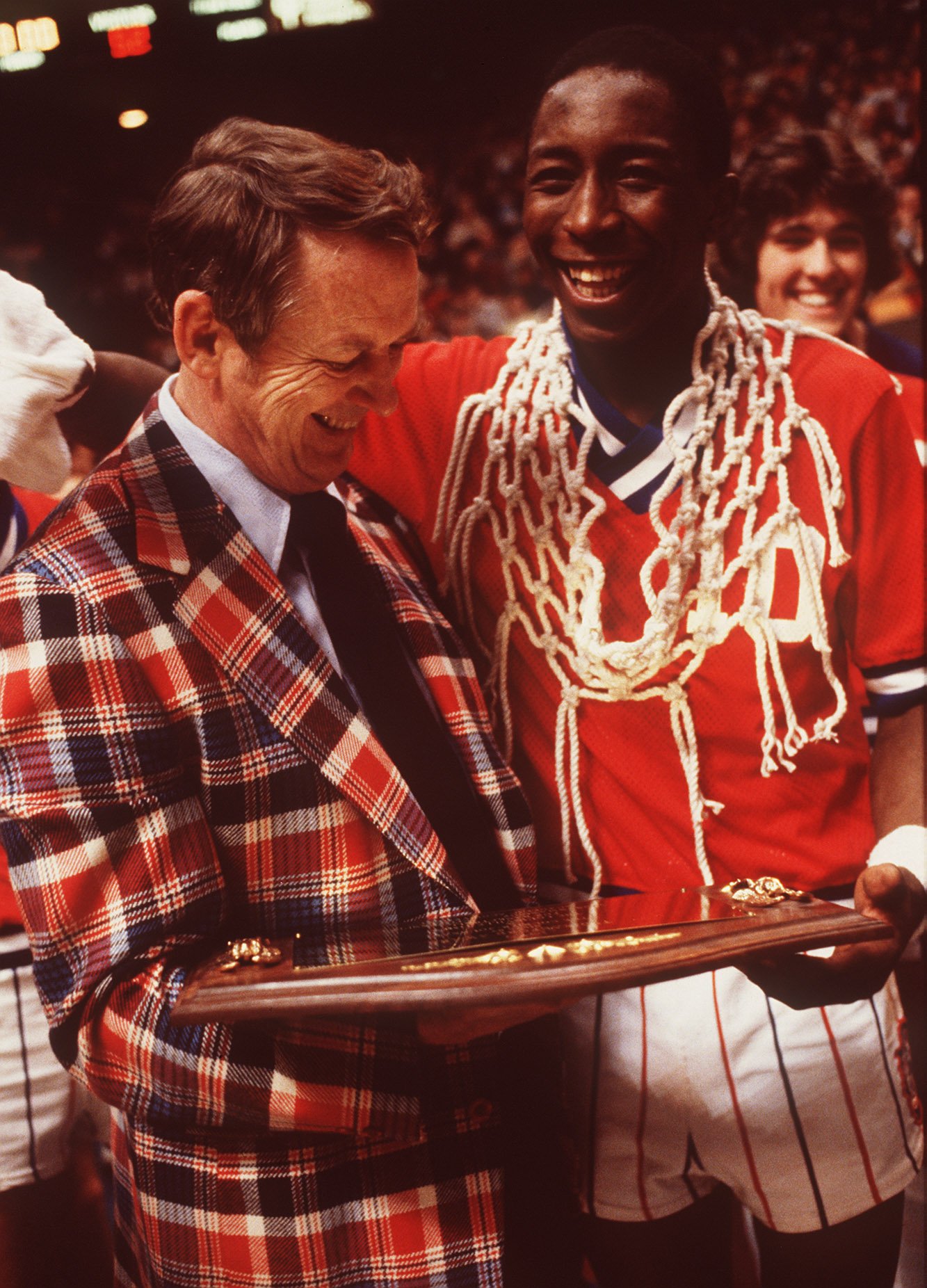
Lafayette High School head basketball coach Jock Sutherland and Dirk Minniefield during celebration after winning the Boys Sweet 16 March 17, 1979 in Rupp Arena, Lexington Kentucky. Photo by Ron Garrison | Lexington Herald-Leader
The ballroom of the Brown Hotel in Louisville was illuminated with star power on June 25, 1999. Heavyweight champ Muhammad Ali, back in his hometown where he grew up as Cassius Clay, was presented a lifetime achievement award by the Kentucky Athletic Hall of Fame. Jockey Steve Cauthen, who had won the first leg of the Triple Crown aboard Affirmed only a few miles away in the Kentucky Derby at Churchill Downs, and NASCAR legend Darrell Waltrip were inducted into the hall that night with several others.
One of them was a man not known nearly as well nationally as his fellow inductees. But he was a man who had traveled just as far in his own personal journey to reach that dais, a man who kept reinventing himself at every difficult turn in the road. He was a sickly boy – he contracted a form of tuberculosis at age 8 — who became a star high school athlete; he was the class clown who became a doting father; he was a coach who thought he might never win a game who became a state champion; he was a son who never knew his father who became a father-figure to hundreds of players, black and white; he was a widower who turned his anger over his wife’s death into a humorous shtick that made him the state’s most polarizing and talked-about sportscaster; and he was a kid who was embarrassed by his stutter who became a raconteur who rarely stopped talking.
And Charles “Jock” Sutherland was supposed to limit his acceptance speech to five minutes that night at the Brown Hotel in Louisville. Anybody who knew him knew that wasn’t going to happen.
He walked up to the podium, his eyes twinkling, and took over the crowd.
“True story,” he began. “I started my career at a little school called Gallatin County in Warsaw, Kentucky. I hadn’t even heard of the place when I got hired. Well, my first season, I wasn’t much of a coach. But I was excitable. We were playing a game at Henry Central High School and were getting our brains beat out by 30 points. The gym was real narrow, kinda like a bowling alley. There was hardly any room between the benches and the playing floor. One step and you were on the court.
“I was already frustrated by the score and the official made a terrible call against one of our kids. I jumped out of my seat and before I knew it, I was in the middle of the court. The official didn’t see me and he backed into me as he was running back down the floor.
“He was furious and started cursing me. He jammed his finger right up in my nose. Right up in my nose.
“I guess I said a few things back to him.
“That was all he was going to take.
“‘Jock, I’m going to give you a technical foul for each step it takes you to get back to the bench!’” he yelled.
“Well, as I said, the gym was small and narrow and everybody could hear what he said.
“I didn’t know what to do, so I threw up my hands.
“I guess my players thought I was signaling them to come get me, so a couple of them rushed out, picked me up on their shoulders and carried me back to the bench.
“I didn’t have to take a step.
“Well, the crowd got into it and the Henry Central band started playing a John Phillips Sousa march. So the players didn’t stop, either. The whole team joined in they carried me a couple of laps around the gym. Here we were getting beat by 30 points and we were celebrating like we just won the national championship.
“The ref had had it. He threw down his whistle and stormed out of the gym. “I’m not taking this crap for $10!” was the last thing I heard him say.
“Now, that should have been the end of the story, except that a sportswriter, Earl Cox, from the Louisville Courier-Journal got wind of what happened. The next day, the paper carried a story headlined “The Quickest Thinking Coach in America.” There was even a cartoon with it. The wire service picked up the story and must have sent it all over the world. People have sent me clippings from as far away as Japan. It got reprinted in Sports Illustrated and Readers Digest.
“I swear, that’s a true story.”
The crowd was roaring. And Jock was on a roll.
He kept the crowd in stitches for 15 to 20 minutes, well beyond the allotted time for his acceptance speech. He left to a huge ovation.
Waltrip was next up to the podium. “I can’t follow that,” he said.
Who could?
I wasn’t there that night, but I had heard all of Jock’s stories before. Some I had heard more than 30 years earlier.
I knew him first not as Jock, but as Coach Sutherland. I met him on my first day of high school, in the fall of 1967. It was his first day back at the school where he had graduated 20 years earlier. Most of my classmates, especially those of us who had hopes of making the basketball team, knew well his growing reputation as a coach. So we were a little intimidated when he walked into our sophomore Health and Physical Education class that day. I guess we expected a no-nonsense disciplinarian who would make us young bucks cower in the classroom. Instead, we were greeted by an impish man, who kept us laughing with stories about his coaching career. I remember very little of what I learned about health and physical education that year. Our lessons about sexual relations lasted about 15 minutes – “Keep it in your pants, boys, until you get married. If you can’t, at least wear a rubber.” But I have never forgotten the stories about the Quickest Thinking Coach in America, the untied shoes, and my favorite, the way he disciplined a player he caught smoking.
It was early in my second season … he was a husky, farm boy named Vincent Davis, probably had been working in the tobacco fields and smoking all his life.
Like a damn fool, I decided I was going to teach this kid a lesson. In front of the entire team, I told him he had two choices: I would either put him off the team or I would lock him in a closet and make him smoke a five-cent cigar.
I should have realized something was wrong when he grinned at me and said, “I’ll do anything you ask coach. Just let me stay on the team.”
Something made me feel guilty, and I reckoned I shouldn’t make any of my kids do anything I wouldn’t do. Never mind that I had never even smoked a cigarette in my life. If I was going to make him do it, I would, too.
I bought two cigars and both of us went into the janitor’s closet after school, closed the door and lit up. To this day, my stomach does flip-flops whenever I’m around someone who’s smoking a cigar. The more we puffed, the sicker I got. I finally keeled over and fell onto the janitor’s mop bucket, knocking it over and spilling the dirty water all over me. By the time I had sense enough to open the door, I was sicker than a mule and soaking wet. Meanwhile, this kid was just puffing away and smiling. He smoked his cigar, then asked: “Want me to finish yours, too, coach.” He smoked the rest of my cigar and then drove me home because I was too sick to drive.
Behind the laughter, though, was a man with an intense desire to win basketball games, pushing his players and himself beyond their comfort zones. He transformed the basketball program and the lives of his players everywhere he went.
My basketball career consisted of one season on the jayvee team his first year at Lafayette High School in Lexington. (He still thinks he cut me from the squad.) He left Lafayette after that season, lured away to become an assistant at the University of Alabama, where he played a role in changing college basketball in the south forever.
But none of that is what led me finally to write this book.
IHe touched so many lives of young men during that journey, bringing them together from their disparate backgrounds to work together as a single unit.
As I researched this book, I traveled with him to meet some of his former players, many of them now in their sixties. It’s touching to see how the respect they hold for him has never diminished.
On one of those trips, he pulled out a letter one former player, Jimmy Edwards, had written to him from a foxhole in Vietnam. Edwards was a big, strong, shy farm boy who was at Harrison County High School, where he played for Jock. Edwards had a difficult relationship with his father and his mother died during his senior year. He lacked confidence in himself. Jock always had to encourage him to shoot more. “He’d look at me and almost apologize if he missed a shot,” Jock said. Edwards played one of his best games in the 1963 regional tournament, but he missed a tip-in shot at the buzzer of that game, a 45-44 loss that ended the season of one of Jock’s best teams ever.
The old coach, who is 79 now, started reading from the letter as we drove along Highway 27 toward Cynthiana, Ky.
“Coach Sutherland:
“I was really glad to hear from you. … You told me about where you were at … I will give you an idea where I am. We are on Operation Manhattan, in the Bali Woods. We are supposed to have Charlie surrounded. It may be just the opposite. We have made light contact, but I expect heavier contact in the hours ahead. I read your letter very carefully. It brought back many memories. … I am a squad leader now. This is a very dangerous game we are playing. A big responsibility has been laid upon my shoulders. I don’t only have to look out for myself, but the members of my squad …. If something goes wrong with them, I will feel responsible. I’ve done some foolish and childish things before, but I have grown up a little bit now. I’ve always have had a problem with lack of confidence. I’ve found out that I had a little more inside than I thought I had.…
“I really didn’t mature very well in school. I hope that I will better than before. I have approximately 120 days left here. I hope that I will make it. I have been very lucky so far. There is so much I want to say but there isn’t much time. You have been more than a coach and a friend. I admire you more than any person in the world. You have done so much for me. I don’t want to disappoint you. I’m going to come through for you for a change. Well I guess I had better sign out. Don’t worry, I’m not going to shoot like a scared stick.”
Jock folded the letter and placed it in the original envelope.
“You see why I’ve kept it for 40 years,” he said.
I did. It’s why I wrote this book.
1979 FILE PHOTO. Lafayette High School head basketball coach Jock Sutherland and Dirk Minniefield during celebration after winning the Boys Sweet 16 March 17, 1979 in Rupp Arena, Lexington Kentucky. Photo by Ron Garrison | Staff
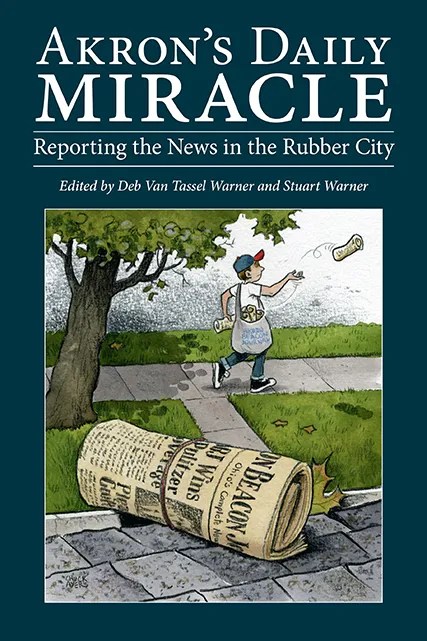
(This chapter is excerpted from “Akron’s Daily Miracle,” copyright 2019, University of Akron Press
By Tim Smith
Sometime in late 1979, (memory dims after a couple weeks, let alone after 40 years), two Akron police detectives – Helmut Klemm and Sgt. Ed Duvall – were investigating the reappearance of handguns that were supposed to have been tossed into a blast furnace. The story started developing after the Beacon Journal had run a series of stories about corruption in the sheriff’s office. The series was written by Dick McBane, the Beacon’s courthouse reporter, and Morse Diggs, the police reporter, joined by investigative reporter Keith McKnight, a curmudgeonly old bulldog I had hired from the Dayton Journal Herald (full disclosure: also my oldest friend).
McBane and Diggs had been hearing rumors about an investigation into guns missing from evidence lockers or maybe showing up in pawn shops. Klemm and Duvall started leaking stuff to Diggs about the guns and how deep into the courthouse their probe went. They also wanted us to run some blind-source stories about their suspicions, of course without offering any hard evidence and nothing they would stand behind.
Imagine our reluctance to participate.
But Klemm and Duvall were serious cops, even if a little naïve about the news business and standards of proof prior to publication. And, of course, they were cops. They had the same trust level that lambs have with lions. (I doubt they would appreciate the imagery.) Still, they were able to convince me that the probe could reach deeper into the courthouse than we had been led to believe, including to judges and major local political figures.
After clearing their request with Editor Paul Poorman, I allowed the two cops to come to the newsroom on a Sunday afternoon when the place was vacant to examine our clip files on, among other topics, Probate Judge James V. Barbuto and Akron lawyer Robert Blakemore, the former county party chairman and a significant figure in state and national Democratic politics. They were there for several hours and I made copies of numerous newspaper stories – called “clips” – that would later come back to haunt me (more on that below).
Though we were digging into the story, we weren’t moving fast enough for the cops, who decided to up the ante. In early 1980, they invited the ABC-TV investigative show 20/20 – and its star Geraldo Rivera (a.k.a. Jerry Rivers before he became a TV icon) – to Akron to dig into the story.
We heard rumors that Geraldo had been spotted when I got a request to meet with his producer Charlie Thompson. (I remember talking to him in my BJ office, but I cannot remember how he got invited.) I was a newly minted night school lawyer (having passed the bar in `77) and one of my law-school favorite clichés came to mind: “You knew it was a snake when you picked it up.”
Charlie talked a good game about sharing and helping each other, but mostly he just kept trying to milk me for as much information as he could get about the main players we had been looking at for weeks. What I didn’t know at the time was that the cops had already provided Thompson and his crew with copies of the clips I had given them. I guess with the hindsight of 40 years, I can’t blame the cops. They didn’t trust anybody: the prosecutor, the judges, certainly not the Beacon Journal and probably not some of their fellow cops (some of whom got caught up in the gun probe). And, hanging out with Geraldo was a lot cooler than some local newspaper reporters.
It turned out that the gun probe was small potatoes compared to what the cops turned up on the local judge, Barbuto. They had women who were willing to testify about being pressured for sex, but they wanted a special prosecutor to handle the case because they didn’t trust Prosecutor Stephan Gabalac, who had been Barbuto’s chief assistant before taking over when Barbuto was elected to the bench. It didn’t help that Gabalac didn’t trust the cops, apparently fearing their agenda included bringing down as many Democratic officeholders as they could.
In the midst of all this, 20/20 producer Thompson was going around town, bad-mouthing the Beacon Journal at every opportunity, including doing the occasional radio interview. Taking shots at the local newspaper was always a popular game for other local media and some local politicians (except when they wanted an endorsement). You could hardly blame them. By this time in the paper’s storied history, it was probably at the peak of its influence and near the top of its local reach, circulating in four counties, with bureaus in Stark, Medina and Portage counties besides the headquarters in Akron.
The paper had long worked behind the scenes to influence issues in the city under the guidance of Executive Editor and Publisher Ben Maidenburg. Following his retirement, there was something of a revolving door in the editor’s office until Poorman was hired in 1976. Shortly after the gun probe got underway, Poorman hired a tall, curly-haired, kick-ass type from the Philadelphia Inquirer named Dale Allen to be the new executive editor. Allen was soon caught up in the local intrigue surrounding the gun probe and the Barbuto investigation.
Not long after Dale’s arrival, 20/20 aired its story about crime and corruption in Summit County. The gun probe barely figured in the story because the cops had shared their findings about Barbuto’s sexual escapades while a sitting judge. And former Democratic Party chairman Robert Blakemore provided the angle to justify doing a story about hanky-panky in the courthouse: the Beacon clips showed a connection between Blakemore and the Kennedy family from the 1960s. Never mind that the connection was tenuous, and old, and unrelated to Barbuto, guns or anything else in the 20/20 story. The Kennedys were the hook. This was a story with national implications.
Well, not actually.
It was classic Geraldo. Barbuto was up to his neck in trouble, as subsequent events would prove. But the rest, as time would show, was made-for-TV-razzle dazzle. The program’s most dramatic scene was Rivera chasing an alleged “hitman,” Bobie Brooks, supposedly hired by Barbuto to intimidate witnesses, through a downtown hotel and through city streets. The show presented the event as a bold confrontation between the intrepid Rivera and the shadowy “hitman.” The hitman turned out to be a small-time crook with a conviction for manslaughter in his past. Even better, a picture later surfaced of Rivera sitting with his arm around Brooks at the Tangier restaurant, taken some time before the “chase” took place.
Another feature of the program was an interview with one of the witnesses against a young woman who had met with the judge. Rivera and his cameraman, lugging a hidden camera and mike in a suitcase, talked their way into the woman’s house with a promise that she would not be identified nor quoted by name. The whole segment was done with Rivera’s voiceover while showing the young woman sitting in her house facing Rivera. The woman sued Rivera and 20/20 sometime later and the need for the voiceover became apparent. The cameraman had taped Rivera repeatedly reassuring the woman he wouldn’t take her picture, use her name or reveal anything she said. Of course, he did all three. Hence, the need to pass on the tape recording and just stick with the video. (The woman won at trial, but lost on an appeal.)
Still, with all its faults, the show left the Beacon looking as if it had ducked a major story. Fact was, we had missed a major story about Barbuto’s conduct. We immediately started playing catch-up, including an extraordinary meeting at Allen’s house called by Poorman and attended by me, editorial page editor Dave Cooper and a local lawyer, Orville Hoover, who would soon be appointed special prosecutor. Hoover was a compromise appointment agreed upon after Gabalac and the common pleas judges ended a stand-off on how to handle the Barbuto allegations.
Dale recently admitted to some reservations about getting involved with community issues from the outside, instead of being the usual neutral observer. I can’t say I was wild about it, either, but I had a much longer history with such conduct at the Beacon under Maidenburg, who had often acted as an arbiter when local rubber worker unions struck the local rubber companies, which they did like clockwork every three years. There was also a local chamber of commerce committee of bankers and other heavyweights who met in secret any time a city, county or school tax levy was being considered. Maidenburg attended and the rule was no endorsement of a levy that the committee dinged. All done in secret.
I know because when I was a county government reporter in the early 70s, Ben invited me to attend a committee meeting, off the record of course, to discuss county government finances, which were a shambles. On the walk back to the paper, Ben commented archly on county operations. Feeling a bit stung at the implication that my coverage was lacking, I allowed as how the presentation made by a chamber economist missed the problems of county government by a country mile.
Put up or shut up, Ben replied, leading to the publication of my series on county government that prompted the first formation of a county charter commission and a county charter (that got clobbered on the 1972 ballot – another decade would pass before one was adopted). Ben’s famous line about all that: ”There’s probably a special place in hell for those who manage the news.”
So the meeting with Hoover, no matter how uncomfortable, was nothing new for me.
Meanwhile, Barbuto went on trial, got convicted, and was sentenced to prison. He got out a few months later on “shock probation.” I often wondered whether he knew too much to be left in prison too long.
The gun probe that started it all ended more with a whimper than a bang. A few law enforcement types got rounded up and procedures were changed to eliminate light-fingered treatment of guns confiscated in crimes.
Now, looking back 40 years at the story, I’m trying to focus on the lessons of my encounter with journalism from the receiving end. The Geraldo story itself was a whole separate trip, but, at bottom, it was just another story. Complicated, to be sure, and more than a little frustrating when you’re caught between feuding public officials like the cops and the county prosecutor, with neither side trusting you and both sides trying to get you to spin the story their way.
But the enduring part — still crystal clear despite the passage of four decades — was my interview with Wall Street Journal media reporter Dan Machalba. He had heard about Geraldo stirring things up in Akron, resulting in some Beacon coverage about the tensions between the TV star and the local paper. He had already interviewed Poorman and Allen, but he wanted the perspective of the line editor, the one in charge of the staff having to deal with Geraldo.
“Why not,” I remember thinking. “Just another reporter. How tough can it be.”
So much for my predictive ability. What I remember most of the lengthy interview was what he didn’t write down. When I made what I thought were substantive points about our coverage and the 20/20 team’s less-than-professional approach to news gathering, Machalba listened politely, but he didn’t take any notes. However, when I lapsed into one of my occasional smartass remarks (really out of character for me), he wrote it down.
I should have known. When his story appeared a short time later, in the middle column of A-1 in the Wall Street Journal, my worst suspicions were confirmed. The story accurately recounted my quotes, just not in the order that I made them, nor in reference to the topics they involved. But they were good quotes.
For example, Machalba asked me about the reporting work the 20/20 crew was doing. I called it “sleazy,” being charitable. Machalba placed it next to reference to the show 20/20 aired, which didn’t appear until long after my interview. It was, it turned out, a sleazy show, but that’s not what I was talking about. Other quotes were also out of context. Made for a good story, but my sense was that it played more like how the little hick paper got rattled by the big time, if disreputable, reporter.
It was a lesson about how journalists can spin stories to fit a preconceived notion that stayed with me and influenced how I taught journalism for 30 years.
(Excerpted from “A Placed Called WriterL: Where the Conversation Was Always About Literary Journalism” copyright 2022 Jon Franklin, Lynn Franklin and Stuart Warner)
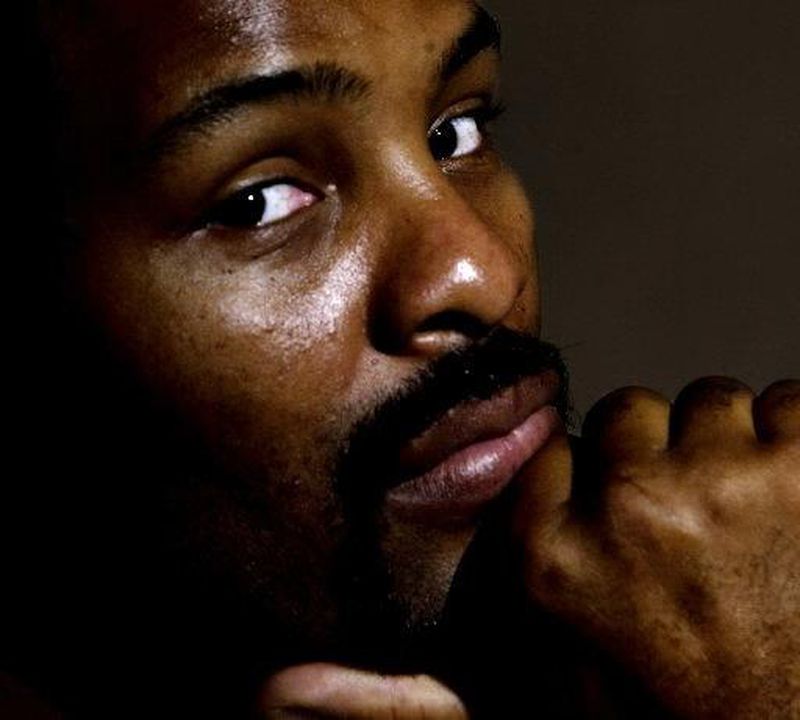
Photo of Michael Green by Eustacio Humphrey/The Plain Dealer 2002
Before Christmas of 2002, WriterL member Deborah Robson wrote an excellent critique of the writing techniques Connie Schultz used to develop the characters in her five-day, 25,000-word series “Burden of Innocence,” published in The Plain Dealer in Cleveland earlier that year. A Black man, Michael Green, spent 13 years in prison after he was falsely convicted of rape. Schultz followed him for a year after he was released. When the WriterL posting began again after the holiday break, Lynn Franklin wanted to pick up that discussion. Publisher and author Sol Stein along with Schultz, her editor Stuart Warner, and freelance writers M. Bozena Syska and Liz Duffrin and Jon Franklin provided a lively conversation about character development
Lynn Franklin: One of the things Deb mentioned was that Connie had managed to make all of the characters, even minor ones, three-dimensional.
People often ask me how one creates well-rounded characters, which would make it a good topic for discussion. Connie, could you tell us a little bit about how you did this? Were you consciously aware of the need to show all aspects of your characters, to make them real people? What details were you looking for in order to do this?
M. Bozena Syska: Could we start at the basics and define what makes a “three-dimensional character” or a “well-rounded character”?
Lynn Franklin: Bozena’s question sent me scurrying through our writing books, looking for a good definition. The most helpful came from Edith Wharton’s “The Writing of Fiction.” Originally published in 1924, it’s not a classic how-to book, but more of a series of essays on fiction at that time.
Wharton began the book talking about changes in fiction. Here is what she said about characters: “The next advance was made when the protagonists of this new inner drama were transformed from conventionalized puppets – the hero, the heroine, the villain, the heavy father and so on – into breathing and recognizable human beings.”
She goes on to describe recognizable characters as “… never types … but always sharply differentiated and particular human beings.”
So in the case of “Burden of Innocence,” Michael [Green] is not just “the hero.” He is a real human being, with real human angers, frustrations, successes and failures. Connie shows him changing from an angry young man into a mature adult, able to confront both the good and the bad in society.
Connie’s characterization of Michael is much deeper than, say, the classic fictional hard-boiled detectives, who tend to exist only on one level. Another example of shallow characterization is Harry Potter’s cousin in the first book of the series (I haven’t read the others so don’t know if the cousin is ever developed). All we see of Harry’s cousin is a spoiled, domineering tattletale. He is more of a caricature than a character.
Many – if not most – popular fiction, television and movie characters exist in a single dimension. This makes it difficult to recognize when we’re falling into the same trap in narrative journalism.
Sol Stein: Here are a number of craft ideas for creating characters readers cotton onto:
1. Try to find an eccentricity that characterizes. Most of the protagonists of fiction that have survived the century have more than a touch of eccentricity. It’s the one characteristic they have in common, though each eccentricity is different.
2. Pick a particularity and compare it to a known quantity. For example, “Archibald was Wilt Chamberlain tall.” Another way of doing it: “Frank is so tall he entered the room as if he expected the lintel to hit him, looking like a man with a perpetually stiff neck.”
3. Exaggeration of truthful attributes: “This distributor had a lawyer so short you wouldn’t be able to see him if he sat behind a desk. And he was Yul Brynner bald. But when he shook your hand you knew this fellow could squeeze an apple into apple juice.”
Another: “She stood sideways so people could see how thin she was.”
4. Pick on a part of a face or body. “It was difficult to make eye contact with her. She seemed to be looking for spots on the wall.”
5. Characterize through an action. Example: “The mayor moved through the crowd as if he were a basketball player determined to bounce his way to the basket.” Another: “He moved slowly across the room, age and arthritis made him seem brittle, but when he spoke – anywhere about anything – people stopped to listen as if Moses had come down with new commandments.”
You can characterize a place. I did a short piece for Ogonyok, the Time magazine of Russia, on 9/11. I assumed most of the readers hadn’t been to New York and the photos they’d seen did not give a picture of its overall vulnerability, not just the tall buildings. I characterized New York City as it might be seen from above, a skinny island with tentacles, the bridges and tunnels reaching out in all directions.
Connie Schultz: I was thrilled to see Sol Stein weigh in on character development before I could answer Lynn’s question because, unbeknownst to Mr. Stein, I am a devotee of his. I frequently turn to his book, “Stein on Writing” to jump start my own writing, and did so a lot while I was working on the “Burden of Innocence” series. I have shared his Chapter 12, “How to Show Instead of Tell,” with many of my colleagues, and it was my guide in developing my characters in a way that allowed them to move the story along.
It helped that I had an astute editor in Stuart Warner. Over the course of the writing, I frequently asked Stuart to fine-tune his radar for any signs of my romanticizing the main characters, particularly Michael. I knew that, were he and the others not fully human, their story would not be believable and I would have lapsed into melodrama. This was particularly challenging because the story was inherently dramatic.
Fortunately, Stuart was ever vigilant.
One of Stuart’s other strengths as an editor is his ability to see the overall arc of a story. One of my strengths is noticing what makes a person an individual. I apparently have an ear for cadence, which Stuart pointed out to me toward the end of the project. I often read aloud to “hear” the story, and Stuart said my voice, inflections and mannerisms were different for each of the characters, which I hadn’t even noticed. He was right. I had spent so much time with these people that I really did know their mannerisms and speech patterns. I also learned over time what was predictable behavior for them and what was unusual, perhaps even staged, which helped me know what to trust and what to leave out.
On rereading the above I realize that what I am really emphasizing here is spending time with people. As I’ve said in an earlier dispatch, I often sat on the floor, out of everyone’s line of vision. That allowed me to come as close to invisible as is humanly possible for a reporter, and then I would shut up and watch. I tend to write down everything I notice and not worry that I don’t yet know what matters and what is discardable. That comes later, when I’ve taken enough notes to see what surfaces as habitual behavior.
One of Stuart’s hard-and-fast rules for me stated at the very outset of reporting was that I could never say a character was feeling something. I had to show it, and that meant I had to really get to know the characters so that I could adequately interpret their actions and then describe them in a way that allowed readers to feel they knew what was in those characters’ heads.
Jon Franklin: This is well put, and since it’s a topic that perhaps more than other gives people fits, I hope she will go into this a little more. If you can’t simply say a person “feels bad” or “is happy,” then what do you say to show it?
Connie Schultz: Showing how a character was feeling, rather than simply saying it, was the single greatest challenge for me on the series. Repeatedly, my editor, Stuart Warner, would read a section and scrawl in the margin: “Show us this.” Excruciating. Infuriating. Exhilarating, when I finally got it.
Here are a couple of examples:
Example No. 1
The main character, Michael Green, faced the parole board four times and each time refused to confess to the rape that sent him to prison. He did this knowing that such an admission was the only way the parole board would release him early, but he refused because he was innocent.
I wanted to show his courage at this juncture, and so I spent hours interviewing him over and over again about that last walk to the parole board. I visited the prison and asked officials to take me on the exact walk Michael took, from his bunk to the parole board hearing room, at the exact time he made that walk. I wanted readers to feel his conflict and lack of freedom, and experience his resolve. Here’s the final version of that walk:
“On a sunny spring afternoon in 1999, Michael walked out of the prison pod door and squinted as he faced the winding path that cut across the yard of the Grafton Correctional Institution.
“His steps were slow and deliberate as he trudged the hundred paces or so to D Building. He looked around as he walked, taking in the expanse of grass where he was not allowed to step, the tidy beds of flowers he could not touch. He tilted his head just right so he could catch a glimpse of clear blue sky unmarred by the unforgiving loops of razor wire that had kept him caged for the last 11 years.
“He could walk this route at Grafton with his eyes closed. He walked this way to the lunchroom and adult education classes, to the gym and the Braille lab.
“Guards constantly monitored the path, barking at inmates: ‘Keep moving. Keep moving. Keep moving.’
“Today, it could also be the path to freedom. In D Building, the two parole board members were waiting.
“Michael had not served even half the 25-year sentence. Three times the parole board told him confessing to the 1988 rape and enrolling in the prison’s sex offenders program was the only way he’d get out before 2013. Three times, he said no.
“If he gave them a different answer this time, he could get out early.
“If he served the entire sentence, Michael would be 48 years old and have spent more than half his life in prison by the time he got out. ‘I don’t know how much more of this I can take,’ he told his sobbing mother, Annie Mandell, on the phone.
“The double doors to D Building were now in clear view. All Michael had to do was walk through them, look the two parole board members in the eyes and say, ‘All right, yes. Yes, I raped that woman.’
“A confession might get him out of prison, but he would never be free. He would be labeled a sexual predator and have to report to authorities every three months for the rest of his life. Neighbors and colleagues would be warned about him everywhere he went, anywhere in the country.
“It would be just another kind of prison. A prison with no parole, no escape, until the day he died.
“‘Progress, not regress,’ [fellow inmate] Arthur Freeman used to tell him. ‘The only way to go is to continue. Things will work out. That’s the spirit of innocence.’
“A guard buzzed Michael into D Building. Another ordered him to sit in the visitors room until he was called.
“Michael sat in the chair nearest the door and waited for a half-hour before he was ushered into tiny, windowless Room 294.
“Michael sat in the chair opposite the two women behind the table.
“‘Do what you’re going to do, he said. ‘You know you’re not going to parole me. You already know what you’re going to do.’
“One of them asked if he was willing to admit to the crime.
“Michael shook his head.
“‘I’m not confessing to something I did not do.’
“For the fourth time, the parole board rejected him.”
Example No. 2
When Michael first got out of prison, he was terrified that he could be picked up by police at whim and thrown back into prison. I wanted to show this fear, because it was real and he was constantly voicing it to me, which were quotes I couldn’t use. Then I found out about his first night out, when he couldn’t quite bring himself to leave the fenced-in area of his parents’ house. First Michael told me about it, then I asked his stepfather to describe that moment and his description was virtually identical to Michael’s. I interviewed them both about it several more times over a period of months, just to be sure the stories remained consistent.
This is the final version of the passage:
“The crowd didn’t disperse until after midnight. Michael joined his stepfather on the porch. They looked at each other and smiled. ‘Go ahead, son,’ Mandell said, pointing to the street.
“Michael walked down the front steps and stopped at the chain-link fence.
“He reached toward the gate, hesitated, pulled back.
“He reached again, pulled back.
“His stepfather winced as he watched. ‘It’s all right, son. You won’t be electrocuted. It’s just a fence, a plain old fence.’
“Michael smiled sheepishly. ‘This is far enough for now,’ he said, turning back toward the house. ‘Maybe later.’
“Man, to take a late-night walk through the old neighborhood. He used to do that all the time. He would stomp through the tangle of weeds and wildflowers on vacant lots, breathe in deep as he wove in and out of the cool, musty woods along Martin Luther King Jr. Drive.
“But he didn’t have a single piece of identification on him, nothing to distinguish him from any other Black man the cops might feel like picking up. No one could talk him out of that fear.
“Michael walked back up the steps.
“‘Tomorrow, Pops,’ he said. ‘Maybe I’ll take a walk tomorrow.'”
Lisa (last name withheld): Perhaps the answer (to character development) lies in an old reporting exercise. I’ve benefited greatly over the years from the exercise of asking myself “How do you know?” in nearly every story (aka “prove it”). And I think it applies as much to writing as to reporting. How do you know he’s happy?
He broke into a deep, satisfying smile that didn’t entirely leave his face for hours.
He whistled.
Jokes were made.
Friends like to hang around him because they always seem to have a good time when he’s there.
That’s how you show it and not tell it.
Stuart Warner: I don’t mean to argue with what Lisa said as much as to augment it. I believe we have to be even more vigilant in the unattributed narrative because we are asking for a lot of trust from our readers. If you say that smile didn’t entirely leave his face for hours, then you should have been there to see it didn’t go away. Or at least confirm with two sources that it didn’t. If we say friends “seem” to have a good time, again, we better confirm that they enjoy his company. Better yet, show their actions of having a good time. Or repeat the jokes that were made. Such is the burden of the nonfiction narrative writer. If you say the sky was blue and you weren’t there, you darn sure better have the weather report from that exact moment in time because somebody, somewhere is going to remember.
Liz Duffrin: I have questions for Connie Schultz. How do you get the subjects of your narrative to recall events in such vivid detail? For instance, how did you find out that Michael’s stepfather winced as he watched his stepson reach his hand toward the gate? How do you know that Michael’s smile was sheepish or that he tilted his head just right to catch an unobstructed glimpse of sky? Did you have them act it out? Do you have a particular technique for questioning them? And how on earth do you get people to put up with you while you squeeze that kind of detail out of them?
Connie Schultz: Whenever possible, I actually do ask the subjects to act out a scenario when all involved agree happened. For example, Michael and his stepfather agreed to walk outside with me and show me how that evening’s moment at the fence unfolded. Understand, however, that this is not something I asked of them early on. I spent months just hanging out, quietly taking notes and asking questions sparingly at times so as not to alienate them or make them acutely aware of this reporter’s presence at all times. By the time they reenacted the fence scene, I had known them for months, and they had grown accustomed to my questions and appreciated my desire to get it exactly right.
I had earned their trust and engaged them in the effort to portray as accurately as possible their story, not mine. Also, I knew them well enough at that point to expect certain facial expressions and body gestures. I was familiar with their physical quirks, if you will, having studied them for nearly a year.
I had to smile at the question regarding how I get people to put up with me. It really is a matter of earning their trust and then encouraging them to invest in the outcome almost as much as I.
With the prison walk scene, I asked Michael to describe the moment – when and where – on his walk to the parole board hearing when he could catch a glimpse of that sky. Then I visited the prison and took the exact route, watching the sky just as he did. Finally, I checked with the National Weather Service to see what the weather was like when he made that walk.
I regularly told Michael and his family, “I want this to be your story, not a white woman’s account of your story.” Over time, they understood what I meant, and almost always they were actually grateful for my attention to detail. I endured my share of ribbing from them, of course, and Michael does a pretty impressive imitation of me rattling off the questions: “OK, so you were standing, where? Uh-huh, and what were you wearing? When you said that, how did he react? …”
I asked my project editor, Stuart Warner, to describe his role in this process. He adds the following:
Stuart Warner: It’s also important to remember that this story was edited with the same scrutiny an investigative story is edited.
Just as an investigative editor does document checks on every fact, I asked Connie to verify every incident or anything that could be subjective. But except for trial transcripts and a few other legal papers, the only documents were her exhaustive collection of notes. How did Connie know he saw “Connecticut” on the flip side of the new quarter? Did the guards really say, “Keep moving. Keep moving.”? [Connie went there and heard them herself].
We debated every adjective. How would we describe Michael’s fiancé. White women might think she was a plus size. Black women might not. (We finally decided to let that one go.)
Any time there was a discrepancy, we went back and asked again. And again. Michael’s stepfather said he found the evidence kit in a box. The clerk insisted that all evidence kits are put in plastic bags. By checking with even more sources we found that it was indeed in a box, and the reason that it was may lead us to another story, which we can’t discuss here.
In short, narrative writing can require even more reporting and re-reporting than even the most complicated investigative stories.
Postscript from Stuart Warner: A few days after this conversation occurred on WriterL in January of 2003, Roderick Rhodes turned himself in to Cleveland police for the rape of the cancer patient for which Michael Green was convicted. Rhodes said he was a heavy drug user at the time the rape was committed in 1988 and didn’t even remember it until he read Connie Schultz’s series, Burden of Innocence, which was published over five days in October 2002. Cleveland police scoffed at his confession, but the DNA that had not been used as evidence in 1988 proved that Rhodes was guilty. He was convicted and served five years in prison. Michael received more than $1 million from the state for false conviction and another $1 million from the city of Cleveland after it was proven, as the series revealed, that the medical examiner falsified evidence to obtain the conviction.
In March of 2003, the series won the Robert F. Kennedy Award for social justice reporting and Best in Show at the National Headliners competition. It was a finalist for the 2003 Pulitzer Prize for feature writing. Two years later, Schultz’s columns on Green’s battle with the state for reparations were part of her entry that won the Pulitzer for commentary. She is now a national columnist for USA Today and her first novel, “The Daughters of Erietown,” made The New York Times bestseller list. She credits what she learned about developing nonfiction characters with creating her fictional characters.